
In many businesses, content production is still a highly manual chain of tasks.
Marketing creates the plan. Content staff write the content. Designers create the visuals. Video Editors produce the videos. Social Media staff then continue editing, copying content to each platform, scheduling posts, and monitoring publishing status.
As the number of products, campaigns, and communication channels increases, the challenge is no longer simply about “creating content faster.”
Businesses need a system capable of organizing the entire process:
Data → Content → Image → Video → Approval → Publishing → Tracking
That is the challenge ICSC AI Content Automation is designed to address.
Instead of using AI as a standalone tool for writing captions or generating images, businesses can integrate AI into a complete automation workflow in which data, AI, people, and media platforms are
connected.
- THE PROBLEM IS NOT A LACK OF AI TOOLS
Today, businesses can easily find one AI tool for writing content, another for generating images, and another platform for creating videos. But having many tools does not necessarily mean having an efficient workflow.
A Marketing employee may still have to:
Get product information from Google Sheets. Copy data into an AI tool. Write prompts. Edit the content. Switch to an image generation tool. Create another prompt for the image. Write a video script. Generate or edit the video. Copy the caption to Facebook. Adjust it for Instagram. Prepare a version for TikTok. Wait for manager approval. Publish the post. Return to the Sheet to update the status.
AI is already present in the workflow, but most of the process still depends on human actions.
This is the gap between “using AI” and “AI-powered automation.”
AI Content Automation is designed to close that gap.
- WHAT IS AI CONTENT AUTOMATION?
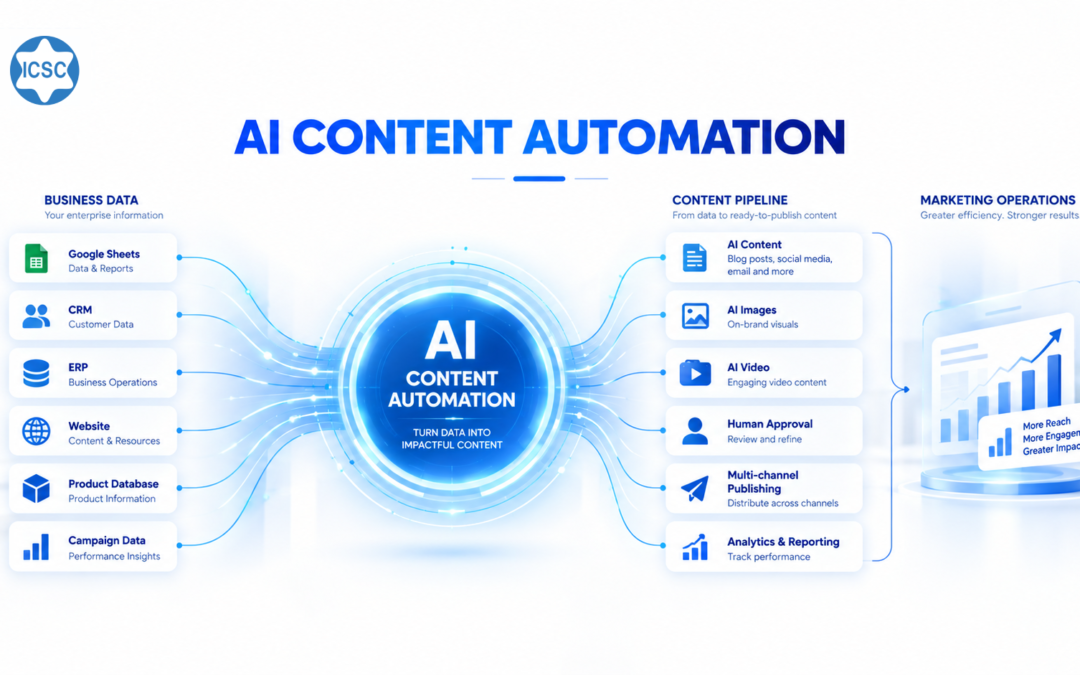
AI Content Automation is a system that connects a business’s input data with AI models, media generation tools, and Social Media platforms to automate part or all of the content production – approval – distribution process.
A typical architecture can be described as:
GOOGLE SHEETS / DATABASE / CRM ↓ AI CONTENT ENGINE ↓ AI IMAGE / VIDEO ENGINE ↓ APPROVAL WORKFLOW ↓ FACEBOOK • INSTAGRAM • TIKTOK ↓ PUBLISHING LOG & REPORTING
Google Sheets can serve as a simple Content Control Center.
Businesses do not necessarily need to build a complex management platform from the beginning.
Marketing only needs to enter or update:
Product name Topic Key content Promotion Target audience CTA Planned publishing date Publishing channels
The Automation system receives the data and triggers the corresponding AI Agents or workflows.
- HOW DOES THE SYSTEM WORK?
Stage 1 – Receiving Data
Content does not necessarily have to start with a prompt.
Data sources can include:
Google Sheets Website Product Database CRM ERP Form or APIs from internal systems.
For example, a business enters:
Product: Summer Collection Promotion: 20% Off Target audience: Women aged 18–30 Date: 25/09 Channels: Facebook, Instagram, TikTok
This becomes the input data for the entire Content Pipeline.
Stage 2 – AI Content Engine
AI analyzes the data and creates content tailored to each channel.
Instead of using the same content everywhere, the system can create multiple versions.
More detailed content with a headline, product information, benefits, and CTA.
A shorter optimized caption combined with hashtags and visuals.
TikTok
AI can focus on:
Hook → Main Content → CTA
or directly turn product information into a short-form video script.
Importantly, AI does not simply receive one fixed prompt.
The system can be configured based on:
Brand Voice Product Information Customer Persona Content Guideline Do/Don’t Rules CTA Library Campaign Context
This enables AI to understand how the brand wants to communicate instead of generating generic content.
- FROM CONTENT TO AI IMAGE
After the content is generated, the workflow continues to the visual production layer.
There are two main implementation approaches.
Template Automation
The business prepares templates in advance based on its Brand Guideline.
AI selects the appropriate content, images, headlines, and components and automatically places them into the template.
This approach is particularly suitable for businesses that need to maintain consistent brand identity.
Generative AI
AI automatically builds prompts from the content and sends them to an Image Generation Engine.
The system can create:
Product Visual Lifestyle Visual Social Media Illustration Campaign Concept Background Supporting Visual
In many cases, the best model is Hybrid:
AI Generation + Brand Template
AI handles the creative component, while templates help maintain brand consistency.
- AI VIDEO AUTOMATION
Video is one of the most time-consuming stages in a traditional Content Pipeline.
AI Automation can divide this process into multiple modules:
Content Idea ↓ AI Script ↓ Scene Planning ↓ Visual / AI Video ↓ AI Voice ↓ Subtitle ↓ Music / Audio ↓ Render ↓ Video Output
For example, from a single line of product data, the system can create a 30–60 second video script using the following structure:
HOOK
Capture viewers’ attention in the first few seconds.
↓
PROBLEM
Present the customer’s problem.
↓
SOLUTION
Introduce the product or solution.
↓
BENEFIT
Clarify the benefits.
↓
CTA
Call to action.
The output can be standardized in a vertical 9:16 video format suitable for short-form content platforms.
- HUMAN APPROVAL – AI AUTOMATES, BUT PEOPLE REMAIN IN CONTROL
Automation does not mean businesses have to allow AI to publish every piece of content freely.
A good AI Content Automation system needs a Human-in-the-loop approach.
After AI completes the content, the person in charge can receive:
CONTENT READY FOR REVIEW Facebook Content: Ready Instagram Content:
Ready TikTok Content: Ready Image: Ready Video: Ready
They can then choose:
APPROVE REGENERATE REJECT
Only approved content proceeds to the Publishing Engine.
This is an important point for businesses.
AI handles tasks that can be automated, while people retain control over the brand, messaging, and final content.
- AUTOMATED MULTI-PLATFORM PUBLISHING
After approval, the system continues with the Publishing Workflow.
Depending on the APIs and access permissions supported by each platform, the system can connect to channels such as:
Facebook Instagram TikTok
and expand to other channels as needed.
The workflow handles:
Media Upload Caption Publishing Schedule Authentication Access Token Publishing Status Error Handling Retry
After successful publishing, the results are written back to the management system.
For example:
Status: Published Channel: Facebook Published Time: 09:00 Post URL: …
Error: None
Marketing no longer needs to manually check each platform to determine which posts have been published.
- WHAT PROBLEMS DOES AI CONTENT AUTOMATION SOLVE?
Reducing Repetitive Tasks
Copying data, switching between multiple tools, entering prompts, copying captions, uploading media, and updating statuses are all tasks with high automation potential.
Staff can spend more time on strategy, concepts, and campaigns.
Increasing Content Production Capacity
One original piece of content can be restructured into multiple media assets.
For example:
1 Product Data
can become:
1 Facebook Post 1 Instagram Post 1 TikTok Script 3 Caption Variations
1–3 Visuals 1 Short Video
Instead of producing each asset independently, the business builds a Content Pipeline.
Reducing Dependence on Individual Manual Actions
The process is standardized into a workflow.
This is particularly useful for businesses with many products, multiple branches, or frequent content publishing needs.
Maintaining a Consistent Brand Voice
Prompts, knowledge, and brand rules are built directly into the system.
AI can be guided on:
How the brand addresses its audience. Words that should and should not be used. CTA structure. Product characteristics. Target customer groups. Content style. Visual standards.
Reducing Operational Errors
The workflow can automatically record:
Pending → Generated → Waiting Approval → Approved → Published → Failed
When an error occurs, the system can send alerts or retry according to configured rules.
- ONE SYSTEM CAN SERVE MANY DIFFERENT INDUSTRIES
AI Content Automation is not only for Marketing Agencies.
Retail & E-commerce New Product → Content → Visual → Social.
F&B Menu / Promotion → Campaign Content → Social Post.
Real Estate Project Information → Content → Visual → Video → Social Media.
Education Course → Educational Content → Short Video → Lead Generation.
Fitness & Gym Training Program → Tips → Visual → Video.
Beauty & Spa Service → Educational Content → Promotion → Social.
B2B Case Study → Linked Content → Social Content → Sales Material.
The core platform architecture can remain similar, but workflows, prompts, data, and approval processes need to be designed specifically for each business.
- AI CONTENT AUTOMATION IMPLEMENTATION ROADMAP
An AI Automation project should not begin with the question:
“Which AI should we use?”
The first question should be:
“How does the business’s current process operate?”
At ICSC, a project can be implemented through the following stages.
Stage 1 – Process Assessment
Analyze:
Current Content Process Data Sources Participating Staff Communication Channels Approval Process Brand Guideline Content Volume Tasks Currently Performed Manually
The goal is to identify which areas are truly worth automating.
Stage 2 – Automation Architecture Design
ICSC builds the architecture:
Data Source ↓ Workflow Engine ↓ AI Models ↓ Media Generation ↓ Approval ↓ Publishing ↓ Monitoring
At the same time, we determine which steps are handled by AI and which require human control.
Stage 3 – AI & Workflow Development
The team implements:
Workflow Automation Prompt Architecture Content Generation AI Image Integration AI Video Integration Data Mapping Approval Logic Social Integration Error Handling Logging
Stage 4 – Brand-Specific Training
AI is configured based on the business’s actual data.
This includes:
Brand Guideline, previous content, products, services, customer persona, tone of voice, and internal Marketing rules.
The goal is not simply for AI to “be able to write content.”
The goal is for the system to create content that fits that specific business.
Stage 5 – Testing & Pilot
Before full automation, the workflow should be piloted on a small scope.
For example:
1 Brand 1 Product Group 1–2 Social Channels 1 Content Workflow
The team monitors output quality, API errors, processing time, and the level of staff intervention required.
Once the workflow is stable, it can be expanded.
Stage 6 – Go Live
The system is put into real-world operation.
Marketing moves from:
“Manually performing each task”
to:
“Managing and controlling the Content Pipeline.”
Stage 7 – Monitoring & Optimization
AI Automation is not a system that is implemented once and then remains unchanged forever.
Prompts need optimization. Workflows may change. Platform APIs may be updated. Businesses may add new channels. Content Strategy also changes over time.
Therefore, monitoring and continuous optimization are important parts of long-term operations.
- FROM CONTENT AUTOMATION TO AI MARKETING OPERATIONS
AI Content Automation may only be the first step.
Once the Content Pipeline has been digitized, businesses can continue expanding.
CRM ↓ Customer Insight ↓ AI Content Planning ↓ Content Generation ↓ Publishing ↓ Performance Data ↓ AI Analysis ↓ Next Content Recommendation
At this stage, AI is no longer involved only in content production.
AI becomes an intelligent layer between data – operations – Marketing.
This is the evolution from a single workflow into an AI Marketing Operations Platform.
- DO BUSINESSES NEED TO REPLACE THEIR ENTIRE EXISTING SYSTEM?
Not necessarily.
One of the advantages of Automation Architecture is its ability to connect with the tools businesses already use.
Google Sheets can continue to be used for data entry.
The website can remain unchanged.
The CRM can continue operating.
Marketing can continue using its existing Social Channels.
AI Automation acts as an orchestration layer that connects these systems into a unified operational flow.
Businesses can start small, measure effectiveness, and gradually expand.
- START WITH THE MOST VALUABLE WORKFLOW
Not every business immediately needs a system capable of creating hundreds of pieces of content every month.
A more practical approach is to identify:
Which process is repeated most often? Which step consumes the most working hours? Which data is already structured? Which content can be standardized? Which steps require human approval?
From there, the business can implement its first workflow.
For example:
Google Sheets → AI Content → Approval → Facebook
Once this workflow proves its value, the system can continue expanding:
Facebook + Instagram ↓ AI Image ↓ TikTok ↓ AI Video ↓ Website ↓ CRM ↓ Analytics
This approach helps AI Automation evolve from a technology experiment into a system capable of directly participating in the business’s real-world operations.
AI AUTOMATION IS NOT JUST ABOUT CREATING CONTENT FASTER
The greater value of AI Content Automation lies in its ability to redesign how businesses operate their Content processes.
Instead of:
People operating tools
businesses gradually move toward:
People design the process → AI executes → People remain in control.
When implemented properly, a single data input can move throughout content creation, media production, approval, publishing, and tracking without staff continuously moving data between multiple tools.
This is the shift from AI Tool to AI Workflow, and further toward AI-powered Operations.
IMPLEMENT AI CONTENT AUTOMATION WITH ICSC
Every business has a different Marketing process.
Therefore, ICSC does not simply implement one fixed workflow. We can assess the current process and design an AI Automation architecture suited to the business’s data, team, Brand Guideline, and existing
systems.
Businesses can start with a small process such as:
Google Sheets → AI Content → Approval → Social Media
and then gradually expand to:
AI Image • AI Video • Multi-channel Publishing • CRM • Website •
Reporting • Marketing Automation
If your business has many repetitive Content tasks and wants to assess which steps can be automated with AI, contact ICSC for consultation on a suitable implementation model.
ICSC – AI & Automation Solutions
Email: info@icsc.vn
Transform a manual process into an AI-powered operational system.