When hiring the right people becomes increasingly difficult
In many businesses, recruitment is no longer just about posting a vacancy and waiting for candidates to apply. As organizations grow, they face a familiar paradox: applications may come in large numbers, but finding the right person, at the right time, for the right role becomes harder than ever. HR teams are expected to process large volumes of CVs from multiple channels, respond to repetitive candidate questions, coordinate interview schedules among different stakeholders, and track every hiring stage across fragmented tools. When the workflow is not well connected, companies can easily lose qualified candidates long before the final interview.
This is why applying AI in recruitment has become a strategic topic for modern businesses. AI is not just a technology trend that looks impressive in presentations. When implemented properly, it can reduce repetitive manual work, standardize recruitment operations, improve response speed, and significantly enhance the candidate experience. More importantly, AI helps employers make more informed decisions based on data rather than pressure, assumptions, or inconsistent judgment.
From an operational perspective, the biggest value of AI is not replacing recruiters. Its real strength lies in enabling HR teams to spend more time on high-value tasks: assessing people, strengthening employer branding, and choosing talent that truly aligns with the company’s growth direction. For businesses looking to modernize hiring, an AI chatbot solution can become a practical assistant throughout the recruitment journey, from application intake and screening support to candidate interaction and centralized recruitment reporting.
Common bottlenecks in traditional recruitment workflows
Candidate data comes from too many sources
Many companies receive applications from job boards, email, social media, LinkedIn, Google Forms, corporate websites, and employee referrals. When candidate data is scattered, HR teams often consolidate information manually or track progress through spreadsheets. This creates duplicate records, missed applications, and poor visibility into hiring status. What seems like a small operational issue can become a serious obstacle when multiple roles need to be filled at the same time or when recruitment campaigns run at scale.
CV screening is time-consuming and not always accurate
Reading dozens or even hundreds of CVs for one role is standard work for HR teams. However, the larger the volume, the greater the risk of rushed or inconsistent evaluation. A strong candidate may be overlooked simply because the CV format is weak or because the recruiter is under time pressure. At the same time, manual data entry, status tagging, and candidate comparison consume a large amount of time and slow down the entire hiring process.
Candidates wait too long for a response
Today’s candidates care not only about salary and job titles but also about the recruitment experience itself. If a company responds slowly, fails to update application status, or takes too long to answer basic questions, strong candidates may quickly move to another opportunity. In a highly competitive talent market, response speed has become a clear hiring advantage.
Interview scheduling is still manual
Behind every interview lies a series of administrative tasks: contacting candidates, checking interviewer availability, adjusting time slots, sending confirmations, issuing reminders, and updating changes. These are small but highly repetitive actions that take a considerable share of HR time. As hiring volume grows, manual coordination can easily lead to confusion, delays, or a less professional employer image.
Recruitment data is underused
Many companies already have recruitment data, yet very few truly turn that data into management insight. They struggle to answer essential questions such as which source delivers better candidates, which positions take the longest to fill, at which stage candidates drop off, or why offer acceptance rates remain below expectations. Without data visibility, recruitment remains reactive rather than measurable and optimizable.
How AI is transforming recruitment workflows
AI is shifting recruitment from a reactive process to one that is more proactive, intelligent, and consistent. Instead of asking HR teams to handle every task separately, companies can use AI across the recruitment lifecycle: from defining hiring needs and drafting job descriptions to receiving applications, screening profiles, answering candidate questions, coordinating interviews, summarizing conversations, and reporting insights to management.
An important point is that recruitment AI should not stop at a simple auto-reply chatbot. To create real value, the system must connect with internal data, hiring criteria, recruitment policies, interviewer calendars, and the HRM, ATS, or ERP platforms already used by the company. That is when AI evolves from a generic assistant into a real operational recruitment partner.
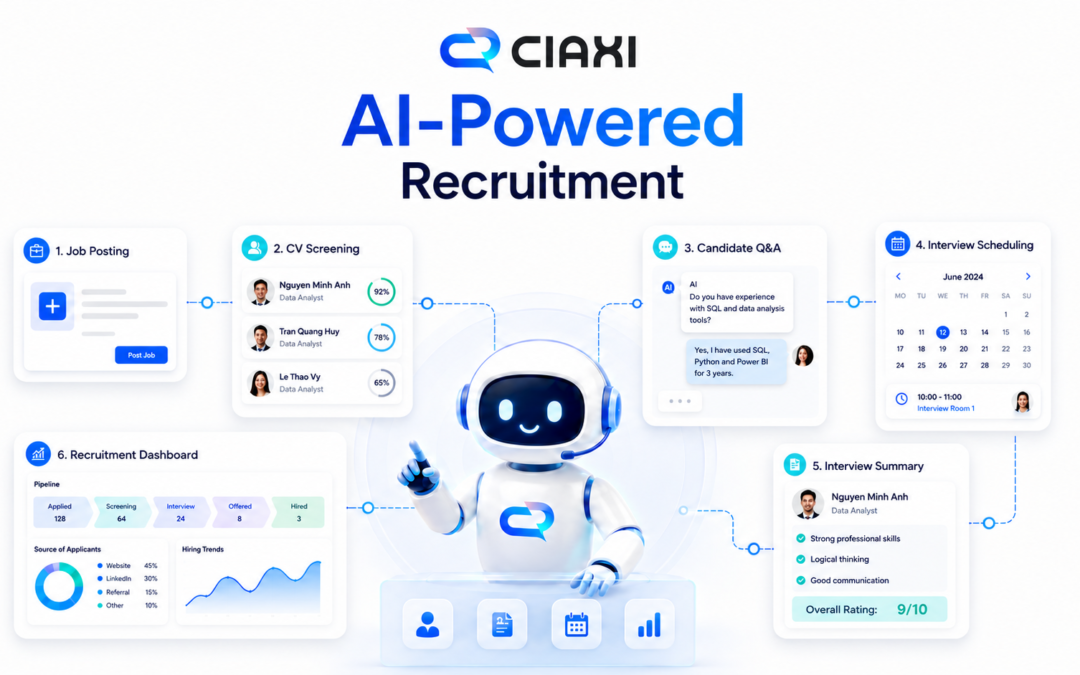
With a well-designed AI chatbot solution for HR, the recruitment flow becomes much clearer: hiring request, job posting, application intake, data normalization, fit evaluation, candidate communication, interview scheduling, assessment summary, and final hiring recommendation. The difference is that these steps are no longer isolated. They are supported by data and automation exactly where operational value is highest.
Key AI applications in recruitment
From a practical deployment perspective, an AI chatbot solution can support employers with a wide range of meaningful capabilities. The following functions are among the most important features companies should look for when selecting a recruitment AI solution.
• Job description support: AI can help draft and refine job descriptions based on the role, seniority, required skills, and department needs, making hiring content clearer, more attractive, and more consistent.
• Candidate data intake and normalization: The system can read CVs from multiple formats, extract information such as experience, skills, education, certifications, and previous roles, then convert them into structured candidate profiles.
• CV screening support: AI can compare applications with job requirements and group candidates into categories such as highly relevant, worth reviewing, or less suitable, helping HR prioritize faster.
• Rediscovering candidates in the existing database: AI can search historical candidate pools to find applicants who were previously promising or who may fit a different open position.
• AI chatbot for candidate Q&A: Candidates can ask about job responsibilities, workplace location, benefits, recruitment stages, or application status and receive fast, consistent answers around the clock.
• Interview scheduling and reminders: AI can suggest time slots, send confirmations, issue reminders, and support rescheduling, significantly reducing coordination work.
• Interview question suggestions: The system can recommend relevant interview questions based on the job role, target competencies, candidate level, and CV content.
• Interview summarization and storage: With permission, AI can help capture interview content, convert conversations into text, summarize key points, and store records for easy review.
• Multi-interviewer evaluation summary: AI can consolidate feedback from HR, hiring managers, and interviewers, highlighting strengths, concerns, and differences in evaluation.
• Recruitment dashboard and analytics: Managers can track application volume, sourcing channels, conversion rates by stage, hiring cycle time, and major bottlenecks in one place.
• Workflow and system integration: The solution can connect with career websites, email, calendar tools, CRM, HRM, ERP, and internal forms so information flows consistently.
• Human handoff when needed: For complex situations or in-depth conversations, the AI chatbot can hand off directly to the responsible recruiter to maintain a seamless candidate experience.
What does an AI-assisted recruitment process look like?
Imagine a company needs to hire sales executives for a new branch. In a traditional process, HR would collect requirements from the department head, manually draft job ads, publish them across different channels, gather CVs by hand, and spend more time interacting one by one with applicants. With AI in place, the workflow becomes much more streamlined.
From the beginning, the AI system can help standardize the job description, required skills, mandatory criteria, and recruitment messaging. Once the job post goes live on the company website or external channels, incoming applications are automatically routed into one unified system. AI reads the CVs, extracts structured data, tags skills, and suggests an initial relevance level. Instead of reviewing all applications in chronological order, HR can focus first on the most promising candidates.
During the process, candidates can interact with the AI chatbot to ask about the role, the application process, or the expected response timeline. When suitable candidates are moved to the interview stage, the system supports schedule coordination between the applicant and interviewers, while also sending confirmations and reminders automatically. After the interview, AI can summarize key discussion points, support evaluation consolidation, and update candidate status on the shared dashboard.
The key point is that AI does not replace the recruiter’s final judgment. HR still reviews important applications carefully, speaks directly with candidates, and evaluates cultural fit, mindset, communication, and long-term potential. However, by handling repetitive administrative work and organizing the data layer, AI allows recruitment teams to operate faster, more accurately, and more professionally.
Benefits of AI for businesses and HR teams
The first and most visible impact is shorter time-to-hire. When application intake, early-stage screening, frequently asked questions, and interview scheduling are partially automated, the handling time per candidate drops significantly. This matters especially for companies that need to hire quickly, fill multiple roles, or recruit at scale on a recurring basis.
AI also reduces repetitive workload for HR teams. Instead of spending hours updating statuses, retyping the same explanations, or compiling recruitment data manually, recruiters can focus more on candidate interaction, collaboration with hiring managers, and building a stronger hiring strategy aligned with business growth.
Another major benefit is greater consistency in evaluation. When job descriptions, screening criteria, and assessment templates are standardized within the system, companies reduce the risk that each interviewer interprets a role differently. This not only improves hiring quality but also creates a more professional and structured recruitment experience.
From the candidate perspective, AI creates a smoother journey. Applicants receive faster responses, easier access to information, and more flexibility in scheduling. They feel seen, guided, and respected by the organization throughout the process. In a competitive talent market, this experience can meaningfully strengthen the employer brand.
Finally, AI enables a more data-driven approach to recruitment management. With centralized dashboards, leadership teams can understand the performance of each channel, stage-by-stage conversion, average hiring cycle, and the most critical bottlenecks. Recruitment then becomes a measurable business operation rather than a purely manual support function.
Can AI replace recruiters?
This is one of the most common questions businesses ask when they begin exploring AI. The practical answer is no. AI can process data faster than humans, automate repetitive actions, and generate recommendations based on structured criteria. But it cannot fully replace observation, empathy, judgment, and the nuanced understanding required to assess people in a recruitment setting.
A polished CV does not always mean the candidate is the right fit, and a candidate with a less refined profile may still be highly capable. Important dimensions such as attitude, motivation, cultural fit, communication style, and reaction in real situations still require human evaluation. The right direction, therefore, is not to eliminate HR but to augment recruiters with better tools.
With a strong AI chatbot solution, HR professionals can gradually move from administrative execution to strategic coordination. They can spend more time on hiring quality, candidate experience, and workforce planning, while technology takes care of the data foundation, reminders, and process automation.
Risks companies need to control when applying AI
Although AI brings considerable value, it must be implemented with clear governance. The first risk is bias in data and criteria. If a company builds its hiring support model on historical data that is unbalanced or overly subjective, the AI system may repeat the same bias in its recommendations. This is why periodic review and human oversight are essential.
The second risk is relying too heavily on keyword-based filtering. Some capable candidates may not present themselves using conventional terms or formats. If businesses allow AI to reject applicants automatically without human review, they may miss strong talent and reduce fairness in hiring outcomes.
Candidate data privacy is another critical concern. CVs contain sensitive personal information such as phone numbers, email addresses, work history, and other identifying data. Any AI recruitment system should support permission control, access logs, secure storage, and internal policies for responsible data handling.
Transparency also matters. Recruiters need to understand why the system suggests a candidate as suitable or unsuitable instead of receiving an unexplained score. Finally, organizations should remember that AI cannot fix a recruitment process that is fundamentally unclear, poorly assigned, or disconnected between HR and hiring departments. Technology only performs well when the underlying workflow is already structured.
Where should businesses start?
The first step is always to standardize the current recruitment process. Companies need clarity on the stages they already have, who is responsible at each point, what the transition criteria are, and which data should be retained. Without that operational clarity, introducing AI may only digitize existing confusion instead of creating meaningful improvement.
The next step is to begin with a specific and measurable use case. Many organizations succeed by starting with recruitment Q&A chatbots, CV intake and normalization, candidate rediscovery in old databases, or automated interview scheduling. This approach makes it easier to evaluate outcomes, reduce risk, and scale step by step according to business priorities.
Integration capability is the next critical factor. A truly effective AI chatbot solution should connect with the company’s career site, email, calendars, internal documents, and existing HRM, ATS, or ERP systems. When the data is connected, the business avoids creating another isolated tool that adds complexity without solving the full problem.
Finally, a human review mechanism and continuous measurement should be established. Important recommendations related to screening, evaluation, or candidate communication should still be reviewed by recruiters. At the same time, businesses should monitor hiring cycle time, response rates, offer acceptance rates, and candidate satisfaction to keep improving the system over time.
An effective AI recruitment solution must fit each company’s unique process
Every business has a different operating model, industry context, hiring volume, and recruitment structure. Some organizations hire frontline teams in large numbers, while others recruit specialists or senior leaders. Some prioritize response speed, while others require strict multi-level approval flows. For that reason, an effective AI recruitment solution should not be a one-size-fits-all tool. It should be configured around each company’s documents, evaluation criteria, and real recruitment workflow.
From this perspective, ICSC’s AI recruitment chatbot solution can serve as a highly practical support platform for employers. The system can be designed as an intelligent AI assistant connected to the company’s recruitment data. It can support job information Q&A, application intake and classification, screening suggestions, interview coordination, conversation summarization, and centralized recruitment dashboards. When deeper intervention is needed, the AI can seamlessly hand off the case to a recruiter, ensuring a consistent candidate experience.
The strength of this model does not lie in having a chatbot that simply “talks.” Its true value comes from connecting data, recruitment knowledge, and operational workflows. Companies can feed the system with job descriptions, FAQs, assessment criteria, internal guidelines, and collaboration flows between HR and hiring managers. In that way, the technology becomes part of a modern recruitment ecosystem that is controlled, scalable, and aligned with business operations.
For business owners looking for a solution that accelerates hiring while improving candidate experience, this is a direction worth considering. A properly designed AI system can reduce HR workload without taking away human control, create a more professional recruitment process, and scale alongside the organization’s growth.
Conclusion: Recruitment becomes more effective when AI and humans work together
Applying AI in recruitment is no longer a distant concept. It is now a practical direction that helps businesses solve familiar hiring pressures: large application volumes, slow responses, fragmented data, manual workflows, and limited visibility into performance. When implemented properly, AI helps companies recruit faster, operate more systematically, and use data more effectively without diminishing the essential role of people.
What matters most is that businesses do not need to start with an overly large or complex system. By identifying the right bottleneck, standardizing the workflow, and choosing a suitable AI chatbot solution, recruitment teams can already create meaningful improvements in handling speed, candidate interaction, and hiring governance. In a competitive labor market, this is not only an operational optimization issue but also a real advantage in attracting the right people and building stronger teams over time.
If your organization is looking to build a modern, intelligent, and scalable recruitment process, investing in an AI recruitment solution is a step worth considering now. The right technology will not replace recruiters, but it will absolutely help them work better, faster, and more effectively.
Please contact ICSC’s solution consulting team.
Email: info@icsc.vn
Tel: +84 28 37 15 07 81