1. Great spa service begins before the customer walks through the door
In the spa industry, customer experience does not begin when a guest enters the treatment room. It starts the moment someone sees an ad, visits a website, sends a message through Facebook or Zalo, or looks for the right treatment on a landing page. At that early stage, response speed, consultation quality and the ability to understand the customer’s real needs are what determine whether the conversation moves forward or the prospect turns to another brand.
In practice, many spas invest heavily in ambiance, equipment and skilled therapists, yet still lose opportunities at the first point of contact. Prospects ask about skin concerns, body treatments, package pricing, promotions, available time slots or treatment duration, but the response comes too late, the answers are inconsistent, or the information is scattered across channels. This is a common bottleneck in service businesses, especially for spas trying to acquire customers through digital marketing.
That is why AI is no longer a distant concept. For spa businesses, AI is becoming a new operational layer that can support 24/7 consultation, capture customer intent, assist with booking, classify leads, send reminders, automate aftercare and connect data so managers can monitor performance. When implemented properly, AI does more than reduce pressure on front-desk and consultation teams. It helps elevate the service experience from the very first customer touchpoint.
This is also why more service businesses are paying attention to AI Agent platforms such as CIAXI, a solution designed to help companies standardize consultation, optimize operations and retain customers more effectively.”
2. Common consultation and customer-care challenges in spa operations
Spa operations may look simple on the surface, but in reality they involve many tightly connected moving parts. On the front end, marketing activities drive prospects to different channels. In the middle are consultants, receptionists, booking coordinators and therapists. At the back end are reminder workflows, post-service care, package renewals, upsell opportunities and customer data management. If one part breaks down, customer experience declines and revenue opportunities are affected immediately.
The first major challenge is repetitive consultation work. Every day, staff members answer the same questions: what services are available, how much a treatment costs, how long it takes, whether promotions are available, which specialist is suitable, what treatment matches a particular skin concern, and whether weekend or evening slots are still open. Once message volume increases—especially after a marketing campaign—the workload on front-line staff rises sharply.
The second challenge is fragmented customer data. Some customers submit forms on the website, some message the fanpage, some comment on posts, some contact the business on Zalo, and some call directly. Without a centralized workflow, information is easily lost, staff cannot clearly track interaction history, and handoff between marketing, sales, reception and customer-care teams becomes inconsistent.
The third challenge is heavy dependence on individual staff capability. A strong consultant may know how to ask the right questions, uncover needs and convert interest into a booking. But if service quality depends entirely on individual talent, the business becomes difficult to scale. As staff change or new hires come in, messaging often becomes inconsistent and consultation quality may fall below brand standards.
The fourth challenge lies in aftercare and customer retention. Many spas invest significant effort in acquiring new customers, yet do not build a structured post-service care process. Follow-up reminders, rebooking suggestions, treatment-cycle guidance, feedback collection and loyalty activation are often handled manually and can be overlooked. At a time when customer acquisition costs are rising, true business value depends increasingly on bringing customers back and extending customer lifetime value.
These realities explain why many spa owners are now looking for a solution that can reduce operational pressure while maintaining consultation quality and creating a stronger foundation for bookings and long-term revenue.”
3. How AI is reshaping the spa customer journey
The real value of AI is not limited to automated replies. In a more modern operating model, AI can participate in the entire customer journey—from the moment a prospect raises a question to the post-treatment care phase. Instead of seeing AI as just a chatbot, businesses should view it as an operational assistant working together with data, workflows and human teams.
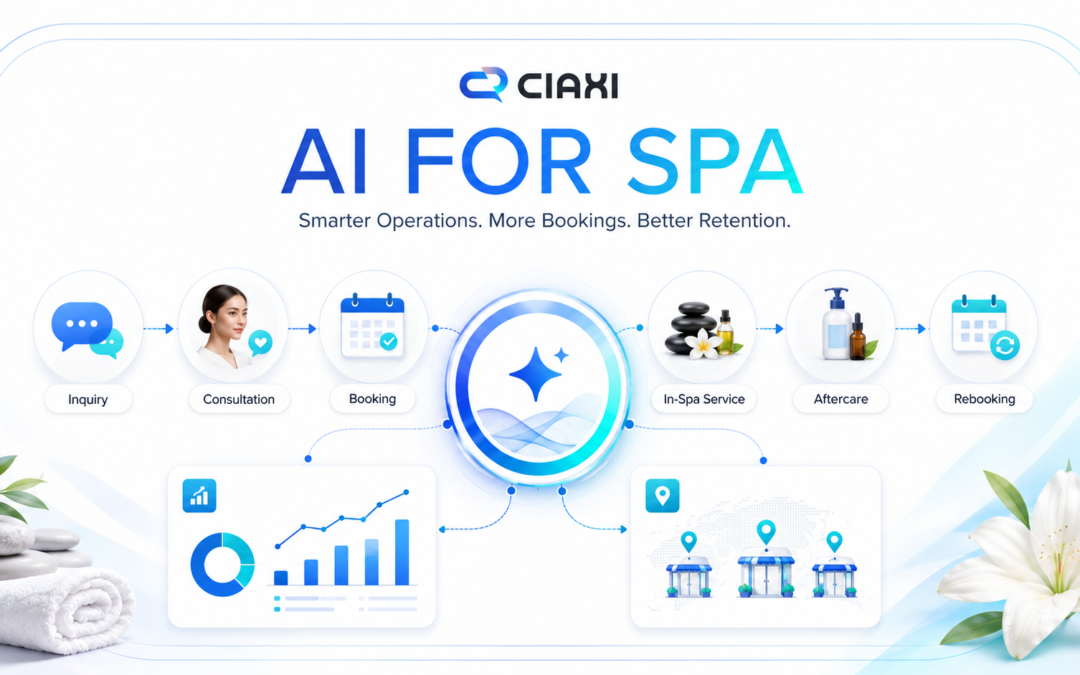
In a spa business, that journey usually follows a clear path: capturing the customer’s need, consulting on services, collecting information, assisting with booking, handing over to staff, following up after the service and suggesting the next treatment step. When these stages are connected smoothly, customers feel consistently cared for and the business gains better control over every commercial opportunity.
AI can handle many conversations at once and provide immediate responses based on the spa’s own knowledge base and consultation scripts. It can also ask follow-up questions to better understand the customer’s real concern—whether they are interested in skincare, body therapy, slimming treatments or relaxation services; whether they are a first-time visitor; and what they expect in terms of schedule, budget or location. From there, AI can recommend a suitable direction and capture the right details for the next step.
Even more importantly, AI makes the customer journey more seamless. Instead of forcing customers to repeat information when the conversation is transferred, the system can summarize the exchange, categorize the need, route it to the right consultant or receptionist, and continue supporting the journey. This is a strategic upgrade because it allows the spa to respond faster while also serving customers in a more structured, consistent and professional way.”
4. Key AI applications in the spa service model
Below are some of the most valuable capabilities an AI Agent system can bring to a spa business, especially when the goal is to optimize operations while enhancing customer experience:
– 24/7 service and treatment consultation: AI can answer frequently asked questions about services, pricing, duration, procedures, promotions, branches, operating hours and basic pre-treatment guidance.
– Conversational need discovery: The system can ask structured questions to identify the customer’s main concern, treatment goal, budget range, preferred schedule and readiness to book.
– Relevant service recommendations: Based on the spa’s knowledge base and consultation rules, AI can suggest suitable treatment groups or next steps while escalating more specialized cases to human staff.
– Booking assistance and information capture: AI can receive booking requests, record the preferred branch, desired date and time, service interest and contact information, then pass the request into the spa’s booking workflow.
– Automatic lead classification: The system can distinguish between highly interested prospects, exploratory inquiries, leads needing more education and those that should be transferred immediately to a human consultant.
– Conversation summary and staff handoff: One of the most useful AI Agent capabilities is the ability to record and summarize the conversation so staff can grasp the context quickly without reviewing the entire thread.
– Appointment reminders and no-show reduction: AI can send confirmations, pre-appointment reminders and preparation notes, while also supporting rescheduling requests.
– Post-treatment customer care: The system can send thank-you messages, aftercare guidance, satisfaction follow-ups and escalation alerts for cases that need human attention.
– Rebooking and next-treatment prompts: Based on the service used, treatment cycle or recommended follow-up timing, AI can remind customers to return at the right moment and create repeat-sales opportunities.
– Omnichannel deployment and data synchronization: AI can be deployed across the website, landing pages, Facebook, Zalo and other customer channels while syncing data into CRM or internal operating workflows.
– Management dashboard and reporting: Conversation volume, lead counts, booking conversion rates, rejection reasons, top-interest service categories and channel effectiveness can all be aggregated to support better decision-making.
Taken together, these capabilities show that AI in spa operations solves more than the question of “who answers customers.” It addresses a broader operational challenge: how to make the entire consultation, booking and care journey smarter and more consistent.”
5. Personalizing customer experience without increasing staffing pressure
One of the biggest challenges in service businesses is delivering personalized care without letting operating costs spiral upward. Spa customers do not want to feel as if they are reading from a static FAQ sheet. They want to feel heard, understood and guided toward the right solution. Yet doing that manually for hundreds of conversations every week places heavy pressure on the team.
AI helps solve this problem by using data to personalize the consultation flow. When configured correctly, the system does more than answer questions. It can guide the conversation differently for different need groups. A customer concerned about acne-prone skin will require a different dialogue path from someone interested in body relaxation, massage or skin rejuvenation. A first-time prospect also needs a different message from a returning customer who has already used the spa’s services and may be ready to rebook.
This level of personalization does not replace specialists. On the contrary, it gives human staff more time to focus on high-value conversations, complex cases and meaningful sales opportunities. Repetitive, time-consuming and easily overlooked tasks are automated, while deeper human consultation remains in human hands. That combination is ideal for spas that want to improve service quality without scaling headcount too quickly.
From a brand perspective, personalization also helps the business appear more professional and attentive. Customers feel cared for before, during and after the appointment. That continuity is exactly what supports the transition from a one-time buyer to a loyal long-term customer.”
6. How AI improves operational efficiency and business performance
When businesses talk about AI, the conversation often begins with technology. But for spa owners, the more relevant question is what commercial results AI can create. The answer usually rests on three pillars: reduced workload, more bookings and stronger customer retention.
First, AI reduces pressure on front-line operating teams. Receptionists, consultants and customer-care staff no longer need to spend most of their time replying to basic repetitive questions. The system receives and answers them immediately, allowing staff to focus on booking conversion, in-depth consultation and cases that genuinely require human interaction. This becomes especially valuable during evenings, weekends or peak campaign periods when inquiry volume rises quickly.
Second, AI can improve the conversion rate from inquiry to booking. When a prospect receives a quick response, is guided according to their needs and can move directly into a booking flow, the chance of losing that opportunity drops significantly. AI also helps the spa identify who is ready now and who needs further follow-up, making sales resource allocation more effective.
Third, AI supports better customer retention. In the spa industry, long-term value does not come from a single appointment but from the full customer lifecycle: repeat visits, treatment packages, membership programs and referrals. Features such as reminders, post-treatment care, feedback collection and next-step suggestions create the conditions for stronger recurring revenue.
In addition, the data captured by AI gives managers a clearer view of the business. They can see which services attract the most attention, what time slots are most in demand, why customers hesitate to book, and where the strongest leads are coming from. This insight is critical for optimizing marketing, sales and service strategy over time.”
7. What spas should prepare before implementing AI
Successful AI implementation does not start with buying a tool. It starts with standardizing data and workflows. If service information is unclear, pricing is inconsistent, consultation scripts are undefined or internal handoff processes are weak, AI will not be able to deliver its full value.
The first preparation step is to organize the core knowledge base. The spa should have a clear list of services, concise but accurate descriptions, pricing or pricing principles, branch information, working hours, promotions, pre- and post-treatment guidance, frequently asked questions and escalation scenarios. This is the business knowledge layer the AI depends on to answer consistently and in line with the brand.
The second step is defining the customer journey that AI should support. Some spas may only need AI for FAQs and lead capture. Others may want AI to go further into guided consultation, intent capture, booking support and reminders. Some businesses may also want to connect CRM, appointment management or aftercare workflows. The clearer the objective, the more effective the implementation roadmap becomes.
The third step is establishing routing and handoff rules. How far should AI be allowed to consult? Which situations must be transferred to a human? Who receives qualified leads? What response time is expected? Who is responsible for updating data? All of these rules need to be defined. In the spa sector, particularly for issues related to skin conditions, treatment recommendations or contraindications, the line between automated guidance and specialist consultation should be carefully controlled.
Once data and workflows are prepared, AI becomes more than a new feature. It becomes a scalable operational support system that can grow with the business.”
8. CIAXI – an AI Agent solution for spa consultation and customer care
For businesses that want a practical solution rather than a generic discussion about technology, CIAXI offers a compelling direction. It is an AI Agent platform designed to help companies deploy AI assistants built around their own data, workflows and operational goals.
In the spa model, CIAXI can be configured from the business’s own knowledge assets, such as the service catalog, consultation content, training documents, booking procedures, customer-care policies, promotional programs, branch-level operating rules and escalation scenarios. As a result, the AI’s responses stay much closer to real business practice instead of sounding generic.
Beyond answering customer questions, CIAXI can capture structured customer information, classify needs, record readiness to use a service, summarize conversations and transfer leads to the right team. The system can also support appointment reminders, post-service care and internal workflows so the spa can maintain a smooth end-to-end customer experience.
An important strength of CIAXI is that businesses can implement it in phases. The journey can start with common needs such as automated replies, lead capture, consultation assistance and booking support, then expand into website, fanpage, Zalo, CRM, dashboards and deeper operational workflows. This staged approach helps spa businesses invest at the right level, measure impact and scale when the business is ready.
For spa owners, the most attractive value is not AI for its own sake. It is having a tool that standardizes consultation quality, reduces dependency on individuals and turns daily customer conversations into a useful management asset. That is where CIAXI creates meaningful value for modern service businesses.”
9. A practical AI implementation roadmap for spas
One common misconception about AI is that a business must launch a large, complex initiative from day one. In reality, the more effective approach is to start with a clear use case that can be measured and that directly affects operations.
In the first phase, a spa can deploy AI for frequently asked questions and initial need capture. The objective here is to reduce staff workload, guarantee fast 24/7 responses and avoid missing prospects across digital channels. This stage is also ideal for building the base knowledge layer and setting the tone of the AI according to brand standards.
In the next phase, the business can expand toward structured lead capture, guided consultation, lead classification, booking support and staff handoff. At this stage, AI goes beyond answering questions and starts acting as a genuine support arm for sales and service coordination.
In a more advanced phase, the spa can connect AI to CRM, appointment systems, dashboards or post-service workflows. Once data is synchronized, the business gains stronger visibility into channel performance, service-category demand and customer return behavior. That is when AI becomes part of the operating system rather than just a communication tool.
A phased roadmap makes it easier to control risk, train teams, measure return on investment and build a stronger foundation for sustainable growth.”
10. AI does not replace care; it helps care stay consistent at every touchpoint
The spa business is built on trust, experience and emotion. No matter how far technology advances, people remain at the center of service quality. Yet in a competitive market, care only becomes a true differentiator when a business can deliver it consistently at every touchpoint.
AI does not remove the human element. Instead, it frees human teams from repetitive work so they can focus on interactions that create greater value. AI helps customers receive faster responses, more structured guidance, timely reminders and more organized aftercare. For management teams, AI provides a layer of data that supports more informed decisions, better operational performance and stronger service quality.
In the journey toward smarter spa operations, AI is no longer a tool reserved for technology companies. It is becoming a practical competitive advantage for service businesses. From reducing staff workload to increasing bookings and retaining customers, the value of AI lies in helping the business grow more sustainably on the foundation of better data and better customer experience.
If your company is exploring an AI solution for a spa model, now is the right time to assess your current workflow, standardize consultation data and begin implementing a system that can support long-term growth. With an AI Agent platform like CIAXI, spas can move forward step by step to modernize operations, improve service quality and unlock new business opportunities.”
Hashtags
#SpaAI #AIforSpa #SpaDigitalTransformation #AIAgent #CustomerExperience #BookingAutomation #CIAXI #ICSC #ServiceOperations #BusinessGrowth
Contact Information
Please contact ICSC’s solution consulting team.
Email: info@icsc.vn
Tel: +84 28 37 15 07 81