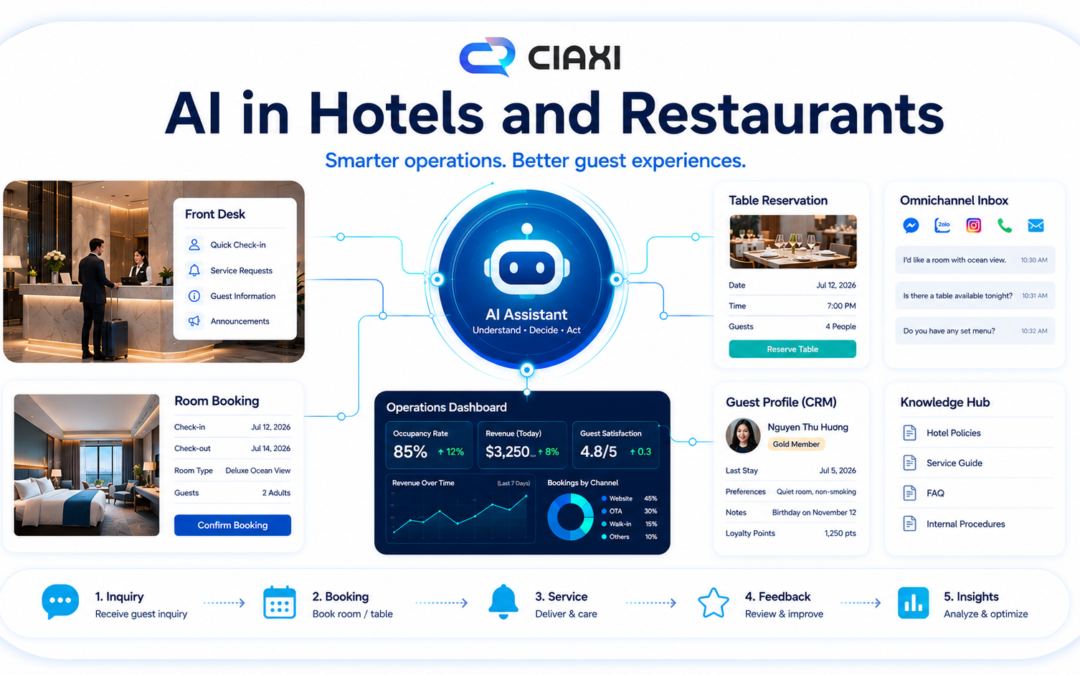
From an after-hours message to booking, on-site service and post-visit engagement, AI is creating a new operating model for Hospitality—faster, more consistent and driven by connected data.
Guest experience begins before arrival
A traveler sends a message at 11 p.m. asking whether a balcony room is still available. A family wants connecting rooms, an extra bed and an airport transfer arranged in one request. At the same time, another customer is searching for a restaurant venue for a birthday celebration and needs information about menus, capacity, private rooms, decoration and deposit policies. While demand keeps arriving, the front-desk or reservations team may be checking in guests, answering calls, reviewing bookings and coordinating with several back-office departments.
In hotels and restaurants, service is not judged only when a guest enters a room or sits at a table. It starts at the first touchpoint: a website question, a Facebook message, a hotline call or a request submitted through Zalo. Response time, information accuracy and the feeling of being understood all shape the brand experience before a transaction takes place.
This is why AI is moving from an experimental tool to a front-line operational layer. When trained on real business data and connected to management systems, AI can do more than answer quickly. It can preserve context, standardize consultation, route requests to the right team and turn every conversation into structured data for growth.
The operational bottlenecks hotels and restaurants know too well
Most questions received by service teams are not complex, but they occur at high volume. Hotels repeatedly answer questions about room types, rates, check-in and check-out, children, extra beds, pets, breakfast, pools, spas, transportation and cancellation terms. Restaurants repeatedly handle questions about opening hours, location, menus, signature dishes, private rooms, group capacity, deposits, vegetarian options and food allergies. When every question depends on human availability, teams are easily overwhelmed during peaks and outside business hours.
The next bottleneck is fragmented data. A guest may start on Facebook, call to confirm and continue on Zalo. If those touchpoints are disconnected, employees must ask the same questions again, context is lost and managers cannot see where the guest is in the journey. The result is not only a weaker experience, but also lost leads, limited marketing attribution and excessive reliance on personal notes.
Service quality can also vary across shifts and locations. Experienced employees understand policies, while new team members may need to search files or ask a supervisor. Inconsistent answers about pricing, deposits, promotions or incident procedures can directly affect trust. In a service environment where small details influence final reviews, inconsistency is a material operational risk.
Behind the front desk and dining room is another bottleneck: shift handover. Daily briefings, front office-housekeeping coordination, banquet plans, VIP preferences, food feedback and group changes are often stored in notebooks, chat groups or personal memory. Without structured capture, tasks are missed and accountability becomes difficult to follow.
Hospitality AI is more than an automated chatbot
At the first level, AI answers common questions about rooms, tables, menus, services and policies. That alone can reduce workload, but it is not the full opportunity. When designed around business workflows, AI can ask for additional details, classify demand, create a customer profile, schedule follow-up, trigger reminders and hand complex cases to employees.
At a deeper level, AI can connect to CRM, property management systems, booking engines, POS, ERP, data repositories and existing applications through APIs. Responses can then be based on approved enterprise data rather than generic scripts. The assistant can help check request status, capture booking data, trigger workflows and produce insights from conversation data.
CIAXI is designed as an enterprise AI assistant using large language models with retrieval-augmented generation to access internal documents and databases. It supports configurable scripts, logic and brand voice, as well as integration with CRM, ERP and other management platforms. Adapted for Hospitality, CIAXI can therefore become a connection layer between guests, employees and operating systems—not merely a chat window on a website.
CIAXI AI Concierge: a 24/7 front-line assistant
For hotels, CIAXI can be trained on room categories, amenities, rates, promotions, check-in and check-out rules, child and extra-bed policies, cancellations, spa, pool, on-site dining, transportation and destination information. When guests ask questions naturally, the assistant can answer from the hotel’s own knowledge base, maintain a consistent brand voice and guide the guest toward the next step.
For restaurants, the training set can include menus, ingredients, allergens, vegetarian choices, set menus, combinations, signature dishes, zone capacity, private rooms, outdoor spaces, deposits, decoration and event services. Instead of giving a generic reply, AI can ask about the occasion, group size, budget or special requirements to provide a more relevant response.
For businesses serving international guests, multilingual support provides a first-response layer without relying entirely on the language skills available on each shift. It does not replace qualified multilingual staff; it handles routine questions quickly, reduces waiting time and routes requests that require expert service.
CIAXI capabilities that can be adapted for Hospitality
| No. | Capability | Hospitality application |
| 1 | Context-aware 24/7 support | Answers from approved enterprise data, maintains brand voice and captures after-hours demand. |
| 2 | Omnichannel conversations | Brings Website, App, Facebook, Zalo, Telegram and integrated channels into one operating flow. |
| 3 | LLM + RAG | Combines large language models with internal retrieval to improve relevance and reduce generic responses. |
| 4 | Lead capture and qualification | Records room, table, event and group needs, then evaluates and routes the opportunity. |
| 5 | Omnichannel CRM | Stores conversation history, guest profiles, service status, bookings and marketing source in one system. |
| 6 | AI-human handoff | Transfers complex cases to employees while preserving context and conversation history. |
| 7 | Reminders and post-service care | Supports confirmation, booking reminders, surveys, feedback and return-guest milestones. |
| 8 | Personalization and recommendations | Suggests rooms, services, menus and offers based on behavior, needs and context. |
| 9 | Knowledge Hub | Searches SOPs, policies, training material and internal knowledge through natural language. |
| 10 | System integration | Connects CRM, ERP, PMS, POS, booking engines and existing applications through scoped APIs. |
| 11 | Conversation analytics | Tracks lead source, interaction volume, handling status, topics and conversion performance. |
| 12 | Meeting Assistant | Supports Meet, Teams and Zoom with recording, speech-to-text, speaker recognition, multilingual capture and post-meeting query. |
| 13 | Configurable and flexible deployment | Customizes interface, scripts and logic; supports cloud or on-premise deployment. |
From a conversation to a room or table reservation
A productive conversation should not end with an answer. With a well-designed workflow, CIAXI can collect check-in and check-out dates, adults and children, bed type, budget, transportation needs, view preferences, connecting rooms and special requests. For restaurants, it can capture date, time, party size, seating zone, private room, occasion, menu preference, decoration, dietary requirements and allergies.
The system can then create a lead or customer record, attach the marketing source, classify interest and route the request. Group accommodation, conferences or long-stay contracts can go to Sales; weddings and events can go to Banquet; urgent service matters can be prioritized for the front desk or restaurant manager.
A key capability of the CIAXI AI Omnichannel CRM model is the handoff between AI and employees while preserving conversation history. The employee can see what the guest asked, what information was provided and which service is being considered. Consultation continues without forcing the guest to start again.
Managing an omnichannel guest journey—not isolated chats
A useful customer profile includes more than a name, phone number and email. In Hospitality, it should reflect conversation history, room or service interest, special requirements, booking status, stay or dining history, feedback, complaints, marketing source and responsible employee. With centralized data, teams work from the same context.
A guest who asked about a room on Facebook and moved to Zalo to confirm airport pickup should not have to repeat the entire request. Likewise, a corporate event lead that discussed a package through the website should be recognized when calling the hotline to update attendance. Omnichannel CRM treats those interactions as one journey rather than unrelated conversations.
Centralized data also enables practical management questions: which channel generates the most inquiries, which source produces valuable bookings, what topics repeat, when guests contact the business, which campaigns create group demand, which conversations remain unanswered and where the process loses conversion.
Personalized experience and relevant upselling
A family with children needs a different experience from a business traveler, a leisure couple or a conference group. With context, AI can recommend room upgrades, breakfast, airport transfer, spa, local tours, laundry, celebration setup or late check-out when appropriate. In restaurants, recommendations may include a set menu, signature dish, pairing, private room or decoration package.
The value of a recommendation engine is not the number of offers it produces. Timing and relevance matter. A guest reporting an allergy should receive food-safety information before any upsell. A dissatisfied guest should not be approached with an automated promotion. Technology creates a better experience only when service logic is designed with operational judgment.
When relevant recommendations are combined with CRM profiles and behavior data, businesses gain opportunities to increase guest value while preserving the feeling of attentive service. That is the difference between indiscriminate upselling and true personalization.
AI Knowledge Hub: turning operating documents into an internal assistant
CIAXI’s enterprise knowledge capability can organize hotel procedures for check-in, check-out, upgrades, refunds, lost and found, complaint handling, front office-housekeeping coordination, service standards and departmental contacts. Employees can ask questions in natural language instead of searching through multiple files.
Restaurants can organize information about ingredients, allergens, service standards, seating, table moves, returned dishes, promotions, banquet workflows and guest feedback. With controlled content updates, internal answers become more consistent across shifts and locations.
The Knowledge Hub is particularly valuable for onboarding. New employees can find procedures independently, while managers spend less time answering repetitive questions. The business should still establish permissions, authoritative sources and approval processes so that AI uses only current and validated information.
CIAXI AI Meeting Assistant for daily briefings and handovers
Hotels and restaurants depend on short but important meetings: daily operations briefings, front-desk handover, housekeeping coordination, room-status updates, banquet preparation, complaint review, revenue meetings and discussions with corporate clients. The value of these meetings is preserved only when decisions, actions and owners are captured clearly.
CIAXI AI Meeting Assistant can participate in Google Meet, Microsoft Teams and Zoom meetings, convert speech to text, identify speakers, store recordings, support multiple languages and make content searchable through an AI Chatbot. Adapted for Hospitality, it can summarize previous-shift issues, record VIP requirements, capture event changes and identify post-meeting actions.
Meetings become searchable operational data instead of events that disappear. When teams disagree about an agreed requirement or responsibility, they have a record to review. For multi-site businesses and shift-based workforces, this reduces information loss.
Supporting guests before, during and after service
Before arrival, AI can advise, collect needs, confirm services, send instructions and remind guests of key milestones. During a stay or meal, the assistant can answer service questions, receive routine requests and route issues to the right department. After service, it can send surveys, capture feedback, classify satisfaction and support return-guest workflows.
For hotels, the journey can begin with room consultation, continue through arrival instructions and in-stay support, and conclude with feedback or loyalty engagement. For restaurants, it can begin with menu consultation and booking, continue through special-request capture during the meal, and extend into feedback, relevant offers and occasion-based rebooking.
When these touchpoints are connected in CRM, the business manages a customer lifecycle rather than isolated requests. Each interaction adds data; data improves personalization; better experiences increase the likelihood of return and recommendation.
How should AI and people work together?
AI is well suited to repeatable tasks with clear rules: answering FAQs, searching documents, capturing information, classifying requests, scheduling reminders, standardizing data, summarizing meetings and detecting conversations that need priority. These tasks consume time but do not always require a manager or experienced employee.
People should directly handle serious complaints, compensation, emotionally charged situations, high-value contracts, exceptions to policy and interactions that require judgment and empathy. CIAXI supports the handoff by giving employees the full context rather than forcing the guest to restart.
Hospitality remains a human industry. AI’s proper role is to perform repetitive work well so that teams can spend more time on interactions requiring empathy, judgment and accountability. Clear role design improves service instead of turning it into a mechanical process.
A practical AI implementation roadmap
An effective AI project begins with data and a specific bottleneck. The first stage is to consolidate FAQs, standardize rates, policies, menus, services and procedures, and define what the assistant is authorized to answer. This stage determines the quality of the system.
The business can then deploy the AI Chatbot on its website and high-volume channels, define human-handoff rules and measure first response time. Once stable, the platform can be extended to CRM, booking, POS, PMS or ERP to create records, preserve history, synchronize status and trigger workflows.
Later stages bring AI into internal operations through the Knowledge Hub, onboarding, Meeting Assistant and shift handover. Finally, conversation, source, booking, feedback and upsell data can be used to identify bottlenecks, improve scripts and optimize performance.
CIAXI supports cloud or on-premise deployment for different infrastructure and security requirements. ICSC can advise on an integration architecture built around the business’s existing systems, enabling a measured rollout rather than a single disruptive replacement.
The performance indicators that matter
AI should be assessed by operating results, not by the volume of generated replies. Important indicators include first response time, missed-message rate, percentage of routine questions handled by AI, inquiry-to-booking conversion, correctly routed leads, cancellations and no-shows, revenue from additional services, employee time spent on repetitive questions, repeat-guest rate and post-service satisfaction.
Internally, businesses should track handover-related errors, new-employee training time, Knowledge Hub questions that remain unresolved and the percentage of meeting actions completed on schedule. These metrics show where AI is creating value and where the workflow still requires improvement.
Which business models can start now?
CIAXI can be adapted for boutique hotels, resorts, hotel groups, independent restaurants with high inquiry volume, restaurant chains, convention and wedding venues, and hotel dining operations. It is especially relevant to businesses with many communication channels, multiple locations, international guests or existing CRM, POS, PMS and ERP systems whose data is not well connected.
The approach also extends to complex service organizations such as golf clubs, customer-service centers, logistics companies and port enterprises. These sectors share the same characteristics: multiple touchpoints, cross-functional coordination and a strong need for centralized data. Port operators and other service businesses can therefore apply the same Omnichannel, Knowledge Hub and Meeting Assistant principles to their own operational cases.
Smart Hospitality still begins with understanding the guest
Technology does not replace employee dedication. AI creates value when it helps a business respond at the right time, retain context, standardize information and route requests consistently. An assistant trained on real data can become a bridge between guests, teams and management platforms.
With CIAXI, a hotel or restaurant can begin with a familiar issue such as after-hours inquiries and then expand into Omnichannel CRM, booking management, customer care, Knowledge Hub, Meeting Assistant and system integration. This is a practical route from automating one task to building an intelligent, data-driven operating model.
In an industry where experience is created by hundreds of small details, AI matters only when it helps connect, remember and act on those details at the right moment. That is the direction ICSC and CIAXI bring to enterprise transformation: applying technology to the right bottleneck so businesses can serve better and grow sustainably.
Contact ICSC for solution consultation
Contact ICSC’s solution consulting team.
Email: info@icsc.vn
Tel: +84 28 37 15 07 81