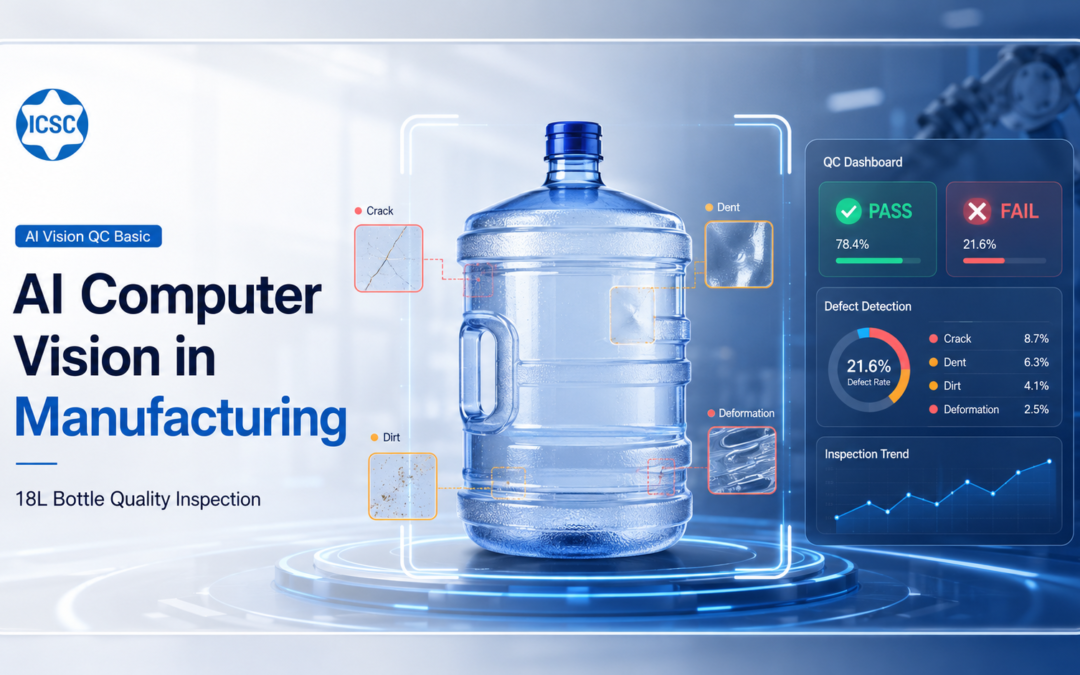
In many bottled water manufacturing facilities, quality inspection for 18L bottle shells remains a familiar yet highly demanding process. Every day, large volumes of bottles move through a repetitive operational cycle: collection, transportation, cleaning, inspection, refilling, and redistribution. A small crack, a dent, surface contamination, or a bottle deformation may seem minor at first glance, but in reality, such defects can affect product quality, operational consistency, and ultimately brand reputation.
As manufacturing environments become increasingly data-driven, the pressure to improve speed, consistency, and traceability in quality control is also rising. Relying solely on manual inspection is no longer the most effective long-term approach, especially for businesses aiming to scale and standardize operations. This is where AI Computer Vision can become a highly practical starting point for automation.
With that direction in mind, ICSC Corporation introduces AI Vision QC Basic — an AI-powered quality inspection software package designed specifically to help businesses automate the quality inspection of 18L bottle shells using camera images. More than just a technical experiment, this solution is positioned as an accessible first step toward digital transformation in manufacturing quality control.
The Quality Inspection Challenge in 18L Bottle Manufacturing
For bottled water businesses, the 18L bottle is not a disposable packaging unit. It is a reusable asset that goes through repeated operational cycles and, therefore, repeated quality risks. Bottles are returned from customers, transported back to the facility, cleaned, inspected, refilled, and delivered again. Over time, visible and invisible wear accumulates, making inspection an essential part of maintaining product standards.
In practice, common bottle defects such as cracks, dents, dirt, and deformation are not always easy to identify with the naked eye, particularly when inspection is done manually under production pressure. Human inspection may vary by shift, by operator, or by the pace of the working environment. When output volume increases, the risk of inconsistent inspection naturally increases as well.
Another common problem is the lack of structured inspection data. A factory may know whether a bottle passes or fails at the moment of inspection, but often does not retain a searchable image record, timestamp, defect category, or performance trend over time. Without this information, managers struggle to identify recurring issues, evaluate defect rates, or improve operational quality based on evidence.
For business owners in the bottled water industry, the question is no longer only about how to inspect faster. It is also about how to inspect more consistently, how to retain inspection data, and how to make quality control measurable. This is the exact type of operational challenge where AI Computer Vision can offer meaningful support.
Why AI Computer Vision Is Suitable for Quality Control
AI Computer Vision enables software systems to analyze visual information and interpret patterns in images in a way that supports automated decision-making. In quality inspection, this means a system can examine an image of a product and determine whether it meets or fails predefined quality standards.
For manufacturing environments, AI Computer Vision is particularly well suited to repetitive, image-based inspection tasks where classification rules can be learned through data. In the case of 18L bottle shells, the system can be trained to distinguish between acceptable and defective bottles while also identifying common defect groups such as cracks, dents, dirt, and deformation.
One of the most important advantages of AI Computer Vision is that businesses do not need to begin with a massive end-to-end automation project. A more practical approach is to start with a clearly defined use case that has measurable business value. Inspecting the quality of 18L bottle shells is exactly that kind of use case.
When implemented properly, AI Computer Vision can reduce dependence on manual inspection while simultaneously creating structured inspection data. This gives managers the ability to review PASS / FAIL rates, examine past inspection images, identify defect trends, and make more informed decisions about quality improvement and process optimization.
What Is AI Vision QC Basic?
AI Vision QC Basic is an AI Computer Vision software solution developed by ICSC Corporation to help businesses automate the inspection of 18L bottle shell quality using images captured from a camera or another configured image source.
The system is designed to analyze images and classify each inspection result into two primary statuses: PASS for bottles that meet quality requirements and FAIL for bottles that do not. In addition, the solution supports the detection of basic defect groups including cracked bottles, dented bottles, dirty bottles, and deformed bottles. The actual defect list is configured based on the initial training dataset provided by the client.
A key strength of AI Vision QC Basic is its positioning as a clearly defined, fixed-scope package suitable for MVP-level deployment. With a fixed packaged price of 99,000,000 VND, the solution allows businesses to begin adopting AI Vision in a focused, controlled, and cost-transparent way before moving into more advanced requirements such as line integration, multiple cameras, multiple factories, ERP or MES integration, PLC connectivity, or advanced analytics.
Rather than being only a proof-of-concept AI model, AI Vision QC Basic includes the essential components of a usable business solution: the software itself, one trained AI model, a web dashboard, an API connection layer, a user guide, and initial deployment support. This allows the business not only to “have AI,” but to operate a structured quality inspection workflow supported by AI.
How the System Works
The operational workflow of AI Vision QC Basic is designed to be straightforward and practical for manufacturing businesses. The process begins with the client providing an initial image dataset related to 18L bottle shells. This dataset includes examples of both acceptable bottles and bottles with the defect types the business wants the system to identify.
Based on this dataset, ICSC receives and prepares the data, performs the initial labeling process, and trains one AI model according to the client’s real-world inspection needs. The model is then fine-tuned to an MVP level to support initial deployment and practical use.
Once the model is ready, the system is configured to receive images from a camera or another approved image source. As images are submitted, the AI processes them and returns an inspection result. The result includes the PASS / FAIL classification and, where applicable, the defect type detected by the system.
Importantly, the system does more than provide a one-time visual judgment. It also stores inspection records, allowing the business to retain the inspection timestamp, the inspection image, the PASS / FAIL result, and the defect type identified by the AI. This creates a digital inspection history that can be reviewed and analyzed over time.
Through the web dashboard, managers can access a list of inspection records, review images from each inspection event, monitor PASS / FAIL statistics, and view defect occurrence statistics. Compared with traditional manual inspection, this creates a far more structured and traceable approach to quality control.
Key Features of AI Vision QC Basic
AI Vision QC Basic is intentionally focused on the core needs of businesses that want to begin applying AI to 18L bottle shell inspection. The package includes the most essential functional components required for a practical first-stage deployment:
- Receiving the image dataset provided by the client
- Initial dataset labeling
- Training one AI model based on real client data
- Fine-tuning the model to MVP-level performance
- Analyzing images from a camera or configured image source
- Classifying inspection results as PASS or FAIL
- Detecting basic defect groups such as cracks, dents, dirt, and deformation
- Sending images to the AI engine for processing and returning the result
- Storing inspection time, inspection image, PASS / FAIL result, and detected defect type
- Providing a web dashboard for inspection management
- Allowing users to review inspection history images
- Displaying PASS / FAIL statistics
- Displaying detected defect statistics
- User management and login functionality
- Basic AI parameter configuration
- Data backup functionality
- Delivering the AI Vision QC Basic software package, one trained AI model, the web dashboard, API connection, user guide, and initial deployment support
These features give businesses a practical starting point for using AI in visual quality inspection without requiring them to commit immediately to a highly complex enterprise-wide system. It is a focused package for companies that want a real operational foundation first, followed by gradual expansion later.
Which Businesses Is the Basic Package Suitable For?
AI Vision QC Basic is particularly suitable for bottled water manufacturers, businesses that manage reusable 18L bottle operations, and production teams that still rely on manual inspection but want to take a first step toward AI-supported quality control.
For business owners in the bottled water sector, the challenge is not simply whether defects can be detected. The larger issue is whether inspection quality can remain stable, consistent, and measurable over time. As production grows, inspection standards must become more disciplined as well. A Basic AI Vision package can help businesses start building structured inspection data, evaluating defect rates, and identifying quality trends that may have been difficult to measure before.
Beyond bottled water manufacturing, the solution may also be relevant to businesses in other industries that have a similar visual inspection need. However, if the application involves products other than 18L bottle shells, multiple production lines, more complex defect patterns, or additional system integrations, the project scope would need to be reviewed and quoted separately.
What makes the Basic package effective is its clarity. It does not attempt to solve every possible industrial challenge at once. Instead, it focuses on a clearly defined use case: supporting the quality inspection of 18L bottle shells using AI Computer Vision, PASS / FAIL classification, basic defect detection, and dashboard-based inspection data management. That clarity makes the solution easier to evaluate, easier to deploy, and easier for businesses to adopt.
A Transparent Scope for More Effective Implementation
One of the most important principles in AI deployment is setting the right scope from the beginning. AI Vision QC Basic is positioned as a fixed-scope, fixed-price starter package. This helps businesses understand exactly what they are investing in and helps ensure smoother communication throughout consultation and implementation.
The Basic package does not include industrial cameras, GPU computers, lighting systems, on-site data collection, image capture services, new dataset cleaning, or AI retraining based on a new dataset. It also does not include ERP, MISA, SAP, MES, or PLC integration, mobile app development, robotic or conveyor integration, custom dashboards, advanced BI reporting, multi-product recognition, or multi-line quality control.
This clear boundary should not be seen as a limitation of the solution. Instead, it is what makes the implementation practical. In the first stage, the most important goal is to validate the feasibility of AI Vision on real data, establish the image-processing workflow, train the AI model, and provide a usable dashboard for quality inspection management. Once the business has operational data, moving toward advanced deployment becomes more meaningful and more data-driven.
Additional requirements such as expanding the number of AI defect classes, training with a new dataset, integrating ERP / MES / SAP / MISA, integrating PLC and production lines, supporting multiple cameras, periodic AI retraining, custom dashboards, mobile apps, multi-factory management, multi-line management, advanced AI analytics, or third-party API integration can be handled through separate Professional or Enterprise scopes.
From Basic to Professional and Enterprise: A Flexible Growth Path
Not every business needs to begin with a large-scale AI program. In fact, many successful digital transformation initiatives start with a clearly defined operational use case, gain traction through early implementation, and then expand based on real business value.
That is why ICSC structures AI Vision QC into three levels. AI Vision QC Basic is the entry-level package with a fixed scope, designed to help businesses begin applying AI to 18L bottle shell inspection at an MVP level. It gives the client a functioning solution that includes software, a trained AI model, a dashboard, and an API layer.
As business needs evolve, Professional can be introduced as an expanded scope for clients who need more defect classes, more training data, more customization, or additional dashboard capabilities. This stage is suitable for organizations that have already validated the AI use case and want stronger operational alignment.
At the highest level, Enterprise is intended for clients who require multi-line deployment, multi-camera environments, multi-factory management, or deeper integration with ERP, MES, SAP, MISA, or PLC systems. At that point, AI Vision becomes more than an inspection tool — it becomes part of the broader digital manufacturing ecosystem.
This phased approach helps businesses manage budget, reduce implementation risk, and maintain a clear roadmap. Rather than making a large investment upfront, companies can begin with the Basic package, evaluate the results, and scale only when the business case is proven.
Important Considerations for Real-World AI Vision Deployment
AI Computer Vision offers strong potential, but businesses should approach it with the right expectations. AI is not a magic solution that instantly replaces every quality control process. Its effectiveness depends on how well the solution is aligned with real-world data, image quality, operational conditions, and inspection criteria.
The first key factor is the quality of the training dataset. If the system is trained on representative examples of both passing and failing cases, it will have a much stronger basis for making reliable classifications. If the dataset is too small, inconsistent, or not aligned with actual production conditions, performance may be limited.
The second factor is image consistency. Camera angle, image sharpness, lighting condition, and environmental stability all affect how the AI interprets visual patterns. Even small changes in camera positioning or lighting can influence detection outcomes, which is why image standardization is critical.
The third factor is how the business defines PASS / FAIL criteria. One company may treat a certain surface defect as unacceptable, while another may classify it differently based on internal standards. For this reason, AI training should always reflect the real operating rules and quality expectations of the business.
When deployed with the right scope, the right data, and the right expectations, AI Vision can become a highly valuable support tool for quality control teams. It not only improves inspection consistency, but also creates a foundation of data that supports better management and decision-making.
Start Digital Transformation with a Practical Use Case
Digital transformation in manufacturing does not have to begin with large, expensive, and highly complex systems. For many businesses, the smarter path is to start with a practical problem that has visible operational value and measurable outcomes.
The quality inspection of 18L bottle shells is exactly such a problem. It is repetitive, quality-sensitive, and closely tied to brand image and production efficiency in the bottled water industry. By applying AI Computer Vision to this use case, businesses can take a meaningful step toward automation while also building the inspection data needed for stronger long-term quality management.
AI Vision QC Basic is designed to support that journey with a clear scope, a fixed cost, and a flexible expansion path. From PASS / FAIL classification and defect detection to inspection history storage and dashboard-based reporting, the solution provides a practical first step for manufacturers ready to bring AI into production.
In an increasingly competitive market, businesses that begin early with data, automation, and AI will be better positioned to improve quality, optimize operations, and build stronger management capabilities over time. With AI Vision QC Basic, ICSC aims to support that first step: starting from a clearly defined challenge, implementing a focused solution, and scaling when the business is ready.
Businesses interested in AI Vision QC Basic – AI software for 18L bottle shell quality inspection are welcome to contact ICSC’s solution consulting team for further discussion and deployment assessment.
Please contact ICSC’s solution consulting team.
Email: info@icsc.vn
Tel: +84 28 37 15 07 81