
For many years, when discussing digital transformation in the seaport industry, companies have primarily focused on Terminal Operating Systems (TOS), vessel planning, yard management, gate operations, lifting equipment, or real-time operational dashboards.
While these are undoubtedly critical components of a modern Smart Port, viewing digital transformation solely through the lens of internal operations can lead companies to overlook a layer of experience that directly influences a port’s competitive edge: the customer transaction experience.
For shipping lines, forwarders, cargo owners, transport agents, and trucking companies, a port’s first impression is defined by more than just lifting capacity or infrastructure scale. It is defined by the ease of information retrieval, the convenience of placing orders, the seamlessness of payments, the timely issuance of invoices, and the ability to enter the gate without significant delays.
As logistics increasingly demands speed, transparency, and constant responsiveness, the traditional model of “visiting the port for procedures” is no longer aligned with modern operational rhythms. Customers no longer want to make repeated calls to check container status. Forwarders do not want to wait for email confirmations when orders need urgent processing. Trucking companies do not want to reach the gate only to discover their entry conditions have not been met. Furthermore, port operators themselves want to reduce the time spent on repetitive daily inquiries.
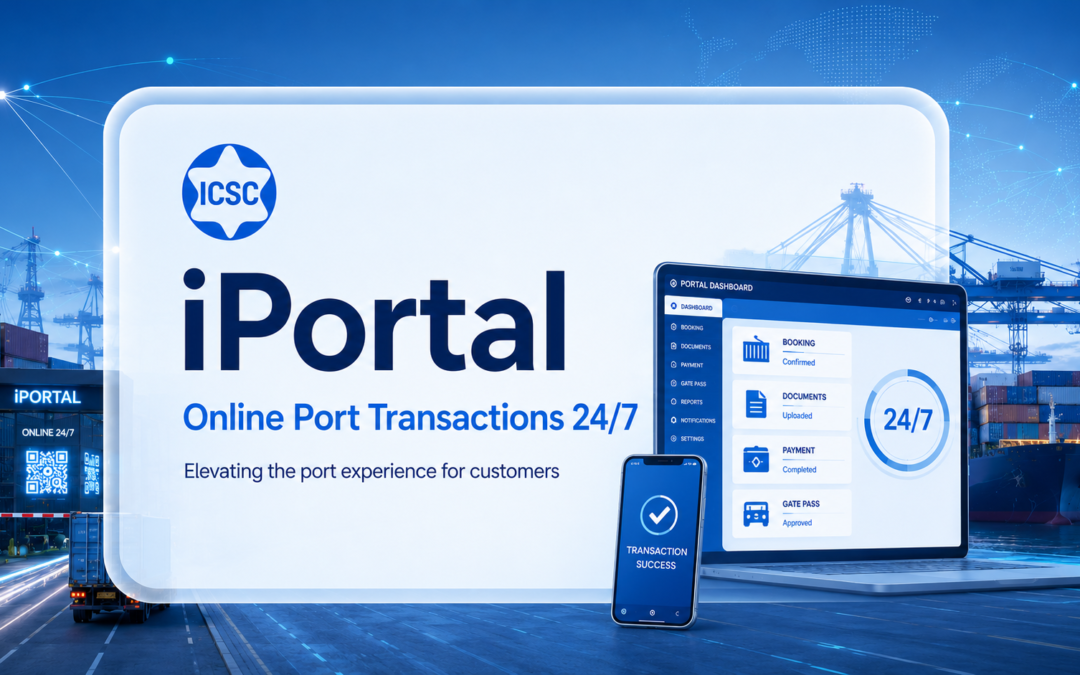
This is why iPortal has become a vital component of the SmartPort ecosystem: an electronic transaction portal that connects the port with its customers, moving inquiries, order placement, payments, invoice retrieval, and gate-in support to a 24/7 online environment.
Beyond Operations: The Criticality of Transactional Experience
In traditional operational models, customers often interact with the port through fragmented channels. Information is exchanged via email, confirmed by phone, buried in internal Excel files, or handled by staff at the service counter.
When transaction volumes are low, this approach is manageable. However, as the number of containers, delivery orders, vehicles, and customers grows, this process creates significant pressure on both sides.
For customers, the inconvenience lies in the wait. A simple container inquiry can drag on due to manual response times. Urgent orders can be delayed due to missing information or pending payment reconciliation. Vehicles reaching the gate face delays because data was not updated on the system in time.
For ports, the pressure lies in the volume of repetitive tasks. Operations, commercial, accounting, and customer service teams are flooded with identical queries: Has the container arrived? Is the order approved? Has the invoice been issued? Is the truck cleared for entry? Has the payment been recorded? Continuing to handle these via disjointed channels hinders a port’s ability to scale without disproportionately increasing headcount.
A modern seaport needs more than just efficient “back-end” operations; it requires a digital “front-end” transaction layer where customers can perform self-service tasks, monitor status, and take control of their workflows. This is the gap that iPortal is designed to bridge.
iPortal: The Electronic Gateway Connecting Port and Customer
iPortal is more than just an informational website. It is an electronic transaction portal designed for the seaport operating environment, where diverse customer groups can execute online operations on a unified platform.
Instead of physically visiting the port or relying entirely on emails and phone calls, customers can access iPortal to perform inquiries, place orders, make payments, receive invoices, and track transaction status. For port owners, this shifts a substantial portion of manual transactions to a controlled, self-service model.
The true value of iPortal lies not just in “digitizing procedures,” but in transforming the transaction portal into a data integration hub that links customers, port operating systems, financial systems, and gate operations. When customers interact via iPortal, data is no longer siloed in emails; it is recorded in a structured format, facilitating subsequent processing steps.
Key Features of iPortal within the SmartPort Ecosystem
iPortal is designed to cover a comprehensive range of critical port-customer interactions:
- Comprehensive Lookup: Real-time access to containers, B/L, Bookings, vessel schedules, invoices, and eDOs. Public lookup is available on the homepage for authorized information without login.
- Online Order Placement: Support for 10 order types, including loading/unloading (laden/empty), stuffing/stripping, yard services, dual cycling, non-containerized services, and Master Bill separation, with configurable auto-approval or manual approval flows.
- Seamless Payments: Multi-channel online payments (Internet Banking, NAPAS, local ATMs, e-wallets, and corporate credit limits).
- Electronic Invoicing: Automated VNPT e-invoice issuance (PDF/XML) immediately following payment.
- Customs Integration: Direct connection to ACCIS to verify customs clearance status and declaration liquidation, eliminating the need for external tools.
- Efficient Gate-in: QR Code support to expedite vehicle entry and reduce manual checks.
- Multi-Tiered Security: Support for multiple users within a single corporate account with granular permission settings.
- Scalability: Multi-entity, multi-business, and multi-port support, suitable for shipping lines, forwarders, and logistics enterprises operating across various terminals.
- Management Reporting: Detailed statistics and invoice reporting, supporting reconciliation with core port operating systems.
Importantly, these features do not act as isolated utilities. As part of the SmartPort ecosystem, iPortal serves as the front-end transaction layer, connecting to back-end systems like ITOS, Billing, iERP, Gate Operation, and management reporting. This ensures a seamless flow of data from the customer into operational, financial, and on-site control processes.
From “Wait and See” to “Self-Service Empowerment”
In the traditional model, customers begin by “reaching out.” They call, email, or visit. This creates inherent latency—not because staff are inefficient, but because the model relies on human-to-human interaction for every step.
iPortal replaces this with a proactive workflow. Customers no longer ask if container data is ready; they search for it. They no longer wait for instructions to place an order; they create it on the system. They no longer wait for manual payment confirmation; transactions are recorded instantly.
For the port, this transition is a fundamental shift in service philosophy. The port moves from “handling requests” to “providing a digital service platform.” This reduces the burden on personnel, mitigates manual entry errors, and ensures consistent transactional data across all departments.
24/7 Operations: A New Competitive Advantage
Logistics does not operate on a strict administrative schedule. Vessels change schedules, containers require off-hours handling, and transport companies need to prepare for early-morning operations. If transactions are restricted to office hours, customers lose their agility.
iPortal extends service capacity to a 24/7 digital environment. While not every task can be fully automated, it allows customers to submit requests, track information, and monitor status at their convenience. This reduces the sense of dependency and empowers stakeholders to coordinate more effectively with their own supply chain partners.
Bridging the Gap: Finance and Operations
One of the most common bottlenecks in port operations is the disconnect between service execution and financial settlement. iPortal bridges this gap by integrating payment and invoicing directly into the transactional flow. By aligning financial data with operational activity, management gains clearer visibility into the relationship between services rendered, revenue, and outstanding accounts.
QR Gate-in: Connecting Online Transactions to the Field
A digital portal creates the most value when online data flows seamlessly into real-world operations. iPortal’s QR Gate-in functionality is a prime example. By standardizing pre-gate data, ports can move away from manual document verification at the gate. A QR code allows the system to instantly validate the order and payment, significantly reducing truck turnaround time and improving terminal efficiency.
Conclusion: Elevating the Customer Experience
In an era where every link in the supply chain is being digitized, iPortal represents a critical layer that connects the seaport to the modern digital economy. It is the evolution from being a “service processing point” to a “digital logistics service platform.”
For port operators, the question is no longer “should we build an electronic transaction portal,” but rather “does our portal truly integrate with our operational data to reduce human intervention and enhance transparency?”
By adopting iPortal, ports do not just improve their internal processes; they deliver a superior experience that becomes a key differentiator in a competitive market. Ultimately, customers do not just need a port that can handle cargo; they need a reliable, technologically advanced partner that moves at the speed of the modern supply chain.
Contact the ICSC Solution Consulting Team:
- Email: info@icsc.vn
- Tel: +84 28 37 15 07 81