In education, a conversation is never just a conversation. It can be the very first touchpoint between a parent and a school, between a learner and a training center, or between someone looking for the right learning pathway and an institution that may accompany them for months, even years.
In the past, admissions consulting often began with a phone call, a visit to the center, or a registration form on a website. Today, that journey often starts much faster and much shorter: a message on a Facebook page, a question after seeing an advertisement, a comment under a post, a form submission after office hours, or a parent sending a message at 10:30 p.m. because that is the only time they have to look for a suitable program for their child.
The challenge is that today’s learners and parents do not simply ask for information. They ask to compare, to evaluate professionalism, to sense whether a program is suitable, and to decide whether an educational institution is trustworthy. When a message is answered late, when information is inconsistent, or when parents have to wait too long to receive tuition details, class schedules, or learning pathways, an admissions opportunity may disappear before the consulting team even notices.
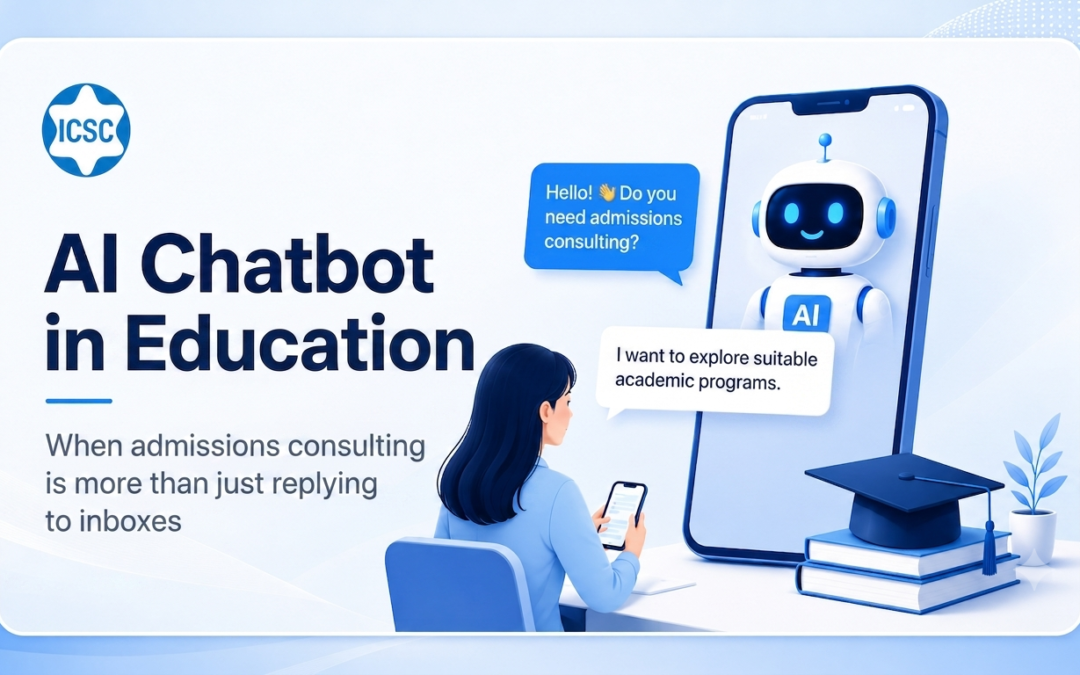
That is why AI Chatbots in education should not be seen merely as tools for replying to inbox messages. When implemented properly, an AI Chatbot can become a digital education consulting assistant: responding quickly, advising consistently, capturing learner needs, classifying admissions leads, and helping consultants focus on conversations that truly require human expertise.
With CIAXI AI Chatbot, ICSC Corporation introduces a more practical approach: applying AI directly to real bottlenecks in admissions operations, starting from daily conversations and gradually upgrading the consulting experience, customer data, and operational efficiency of educational institutions.
Admissions Today Often Begin With a Single Message
For many years, educational institutions have invested heavily in advertising, content marketing, consulting teams, and promotional programs to attract learners. These activities remain important. However, in today’s digital environment, response speed and response quality have become a crucial part of competitive advantage.
A parent may see an advertisement for an English course for their child in the evening. A student may explore a vocational training program after school. A working professional may consider a skills development course on the weekend. A company may need information about corporate training but only leaves a request through the website outside office hours.
These needs do not become valuable only the next morning. In many cases, the interested person is contacting several centers at the same time. The institution that responds faster, more clearly, and more relevantly has a stronger chance of creating a positive first impression.
However, during peak admissions seasons, consulting teams are often overloaded. Hundreds of messages can arrive within the same period. Many questions are repetitive, yet they still need accurate answers: Which age group is the program designed for? How much is the tuition fee? Is there a trial class? When does the next course start? Is the program online or offline? What are the learning outcomes? What curriculum is used? Where should a beginner start?
If everything depends entirely on human consultants, the process can quickly become congested. This does not happen because the consulting team lacks capability. It happens because too much time is spent on repetitive tasks, while deeper consulting conversations are not prioritized at the right moment.
When the Inbox Becomes a Bottleneck for Admissions Teams
The inbox was once considered a convenient communication channel. But when admissions scale up, it can become the place where many operational problems accumulate.
Messages come from multiple sources: Facebook, websites, Zalo, advertisements, registration forms, landing pages, and remarketing campaigns. Without a supporting system to capture and classify these interactions, data can easily become fragmented. A lead may have asked about tuition yesterday, submitted a form today, and sent another message over the weekend, but the consultant may not have enough context to continue the conversation smoothly.
In addition, each consultant may explain information differently. The same program may be described briefly by one person, in more detail by another, while someone else may forget to mention the next opening date or the trial class policy. For educational institutions with multiple branches, various courses, or several consulting teams, this lack of consistency can directly affect brand perception.
The biggest bottleneck is not only the number of messages. It is the absence of an intelligent support layer that can understand questions, retrieve the right information, respond according to the institution’s communication standards, and record the learner’s needs for the consulting team to follow up.
In other words, the real challenge for education is not simply “needing more people to reply to inbox messages.” The real challenge is how to manage every admissions interaction as part of an operational system, rather than leaving it scattered across separate chat threads.
Education Consulting Is Not the Same as Selling a Regular Product
Education is a unique field because enrollment decisions are often connected to trust, expectations, and long-term goals. A parent does not only ask about tuition fees. They want to know whether the program is suitable for their child’s age and ability. A learner does not only ask about the opening schedule. They want to know whether the course can help them improve their career, pass a certification, change professions, or achieve a personal goal.
This makes education consulting different from selling a regular product. A price list is not enough to convince a learner. A rigid automated answer is not enough to create a sense of being understood. Learners need to be guided, informed, and advised according to their own context.
For example, a parent with an eight-year-old child needs a different consultation from a high school student preparing for an entrance exam. A student learning a foreign language for graduation has different needs from a working professional who needs communication skills in a business environment. A beginner needs a different pathway from someone who already has a foundation and wants to prepare for a certification. A company looking for internal staff training requires an entirely different consulting approach from an individual learner.
If a chatbot only responds based on fixed scripts, its value will be limited. But if an AI Chatbot is trained with the real data of an educational institution, including programs, learning pathways, tuition policies, class schedules, frequently asked questions, and admissions procedures, it can support conversations at a higher level: understanding initial needs, providing relevant information, and preparing data for consultants to handle cases that require deeper discussion.
The New Generation of AI Chatbots: From Automated Replies to Digital Education Consulting Assistants
For many years, chatbots were commonly understood as tools that answered questions based on predefined scripts. A user asked A, the system answered B. If the question fell outside the script, the bot would often respond incorrectly, repeat itself, or immediately transfer the conversation to a human agent.
The new generation of AI Chatbots goes far beyond that approach. With a platform like CIAXI, a chatbot can be built on the unique knowledge base of each organization. Educational institutions can provide course documents, consulting content, FAQ files, admissions policies, consultant training materials, website links, or data from internal systems. From there, the chatbot is no longer just a simple response tool; it becomes an AI assistant capable of retrieving information according to context.
The key strength of CIAXI lies in the fact that the platform is designed for businesses to create AI assistants without coding. Users can configure knowledge, behavior, and workflows through a visual interface. For organizations that need deeper expansion, CIAXI also supports API integration, webhooks, and connections with internal systems such as ERP, CRM, Odoo, or Google Sheets.
For the education sector, this approach is highly suitable. An educational institution does not need to begin with a complicated AI project. It can start with the repetitive admissions questions that appear every day, then gradually expand into learning pathway consulting, lead capture, follow-up support, staff onboarding, or the creation of an internal knowledge center for consulting teams.
What Can CIAXI AI Chatbot Support in the Admissions Process?
The goal of CIAXI is not to create a chatbot that simply “talks for the sake of talking.” Its practical value lies in helping educational institutions reduce repetitive work, standardize consulting information, and create a faster response experience for parents and learners.
Key capabilities that can be applied to admissions include:
1. Responding to Parents and Learners 24/7
CIAXI can support responses to common questions about programs, tuition fees, opening schedules, learning formats, suitable age groups, trial class policies, and registration procedures. This helps educational institutions avoid missing interactions outside office hours, especially during the time frames when parents or working professionals are most likely to search for information.
2. Training the Chatbot With the Institution’s Own Data
Educational institutions can provide the chatbot with materials such as PDFs, DOCX files, URLs, course content, admissions FAQs, consulting procedures, or internal guidance documents. As a result, the chatbot responds based on the knowledge of the institution itself, instead of giving generic answers.
3. Consulting on Learning Pathways Based on Learner Needs
When provided with program data, the chatbot can support more relevant guidance for different groups of needs: learning for children, learning for career development, exam preparation, vocational skills, starting from the basics, or corporate training. The chatbot does not replace professional consultants, but it makes the initial conversation more structured and purposeful.
4. Capturing and Classifying Admissions Leads
During conversations, the chatbot can help collect information such as name, learning needs, age, goals, preferred study schedule, location, budget, or level of interest. This allows admissions teams to identify which leads require immediate follow-up, which prospects need more consultation, and which groups should be nurtured later.
5. Standardizing Consulting Content
For centers with multiple consultants or several branches, CIAXI helps ensure that important information is communicated consistently. Tuition fees, class schedules, entry requirements, promotional policies, and course details can be controlled through a shared knowledge source, reducing the risk of inconsistent responses from different team members.
6. Designing Consulting Workflows With a Drag-and-Drop Interface
CIAXI supports visual workflow design, allowing businesses to build processes that match real operational needs. In education, workflows can be used to classify prospects, guide question flows, collect information, transfer conversations to consultants, or connect with data management systems.
7. Integrating With Websites, Zalo, Telegram, and Internal Systems
CIAXI can be deployed on websites, popular chat channels, or connected with internal systems through APIs, webhooks, and MCP. For organizations already using CRM, ERP, Odoo, or Google Sheets, the chatbot can become an intelligent touchpoint between learners and the institution’s operational data.
8. Supporting Natural Vietnamese Communication
One of the most important requirements for education consulting in Vietnam is the ability to understand everyday language. CIAXI is optimized for Vietnamese, helping the chatbot understand diverse question styles, conversational language, and natural interactions with parents, learners, or business customers.
9. Working With Multiple AI Models
CIAXI can work with different large language models, allowing businesses to remain flexible when building AI assistants according to their usage needs, budget, and deployment strategy.
10. Supporting Internal Training and Knowledge Centers
Beyond admissions, CIAXI can be used to build an automated Q&A center for employees, support onboarding for new consultants, explain internal procedures, or help teams quickly look up course information, policies, and operational documents.
Supporting Consulting Teams, Not Replacing People
One common misunderstanding about AI in admissions is the concern that technology will replace consulting teams. In reality, in the education sector, people still play an essential role. Not every question should be handled automatically. Some situations require empathy, experience, persuasion, and the human sensitivity of a consultant.
AI should be placed in the right role: helping people work more effectively.
CIAXI can handle repetitive questions, provide basic information, capture initial needs, classify leads, and standardize data. As a result, consultants have more time for high-value conversations: advising on detailed learning pathways, addressing parents’ concerns, persuading hesitant learners, following up with hot leads, and building trust before enrollment.
When AI handles the foundation well, people can focus on the deeper work. This is the right way to implement technology in education: not removing human connection, but enabling that connection to happen at the right time, with the right person, and for the right need.
From Consulting Data to Smarter Admissions Operations
One of the often-overlooked values of an AI Chatbot is data. Every conversation with a parent or learner contains important information: which course they are interested in, what they are concerned about, whether they ask more about tuition or learning outcomes, when they usually send messages, which channel they come from, and how long they may need before making a decision.
If this data remains only inside inbox threads, it is difficult for an organization to analyze. But when it is captured systematically, it can become a foundation for improving admissions strategy.
A center may discover that a course is frequently asked about but has a low conversion rate. A school may learn that parents are most concerned about tuition, class schedules, or teaching methods. An academy may find that an advertising campaign generates many messages but few high-quality leads. A consulting team may identify which times of day require more support from admissions staff.
From a digital transformation perspective, an AI Chatbot does not only help organizations respond faster. It helps educational institutions turn scattered interactions into operational data. And when data is organized better, admissions can be managed based on real information rather than assumptions.
Why AI Chatbots Are Suitable for Growing Educational Institutions
For a small center, replying to messages manually may still be acceptable in the early stage. But when the number of courses increases, the learner base grows, the consulting team expands, or the institution opens more branches, manual processes begin to show their limitations.
Language centers often have many levels, classes, opening schedules, and learner groups. Private schools need to advise parents according to grade levels, age groups, and admissions policies. Skills academies or vocational training providers have multiple learning pathways connected to career goals. EdTech companies need fast responses across websites, fanpages, and multiple advertising campaigns at the same time. Educational institutions with several branches must ensure that consulting information remains consistent across locations.
In all these cases, an AI Chatbot helps create a stable frontline response layer. This frontline does not only answer questions; it helps maintain rhythm across the admissions process: capturing, classifying, transferring, reminding, and standardizing information.
The more an organization grows, the more it needs a system that reduces dependence on individual memory, speed, and manual processing capacity. CIAXI AI Chatbot is suitable precisely for this stage: when an educational institution wants to scale without increasing operational costs in a linear way.
Beyond Education: An Approach Suitable for Businesses With Complex Operations
Although this article focuses on education, the CIAXI approach is also valuable for many businesses that manage large amounts of information, multiple processes, and numerous customer touchpoints. In sectors such as ports, logistics, business services, software, commerce, and internal operations, the core challenge is often similar: data is stored in many places, users need fast responses, employees answer repetitive questions, and information must be retrieved accurately according to context.
For port or logistics enterprises, an AI Chatbot can be designed to support process lookup, customer guidance, service information responses, internal document search, or connections with operational systems when integrated appropriately. For software companies, a chatbot can replace part of the traditional user manual with a direct Q&A experience. For HR departments, a chatbot can help answer questions about policies, leave requests, onboarding procedures, or internal documentation.
The common point lies in the implementation philosophy: AI should not stand outside business operations. AI needs to be connected to real data, real needs, and real bottlenecks within the organization.
CIAXI and the Approach of Connecting AI With Real Business Data
There are many chatbot tools on the market. But not every chatbot is suitable for a business transformation challenge. A chatbot that only responds based on fixed scripts may handle a few simple questions, but it is unlikely to become a long-term operational support platform.
CIAXI is built with a different approach. The platform allows businesses to create AI assistants for specific domains, train them with documents or question-and-answer pairs, process text automatically, vectorize data, segment Q&A content, and design workflows through a drag-and-drop interface. In addition, its ability to integrate APIs, webhooks, and systems such as ERP, CRM, Odoo, or Google Sheets means the chatbot is not limited to being a simple reply tool. It can participate in real operational flows.
For educational institutions, this means the chatbot can be designed according to the way each organization actually consults. If a school has multiple programs, the chatbot needs to understand the differences between them. If a center has several levels, the chatbot needs to guide learners toward the suitable level. If an academy has various tuition policies, the chatbot needs to respond based on updated data. If the admissions team wants to classify leads, the chatbot needs to be designed to collect the right information from the beginning.
In other words, CIAXI does not simply provide a chatbot. CIAXI provides a platform for businesses to build AI assistants based on their own knowledge, processes, and operational goals.
Better Admissions Begin With a Better Consulting Experience
In education, trust does not appear only at the end of the journey. It begins with the very first interactions. A fast, clear, and relevant answer can create a professional impression. A well-guided conversation can help parents feel more confident. A suitable learning pathway can make learners feel understood.
An AI Chatbot is not a magic solution that replaces the entire admissions function. But when implemented properly, it can help educational institutions solve very real bottlenecks: slow responses, missed leads, inconsistent information, overloaded consulting teams, and fragmented customer data.
With CIAXI AI Chatbot, ICSC Corporation brings a practical approach to today’s digital transformation needs: starting from repetitive tasks, connecting AI with real data, supporting human teams, and gradually turning admissions consulting into a smarter process.
As parents and learners increasingly expect speed, clarity, and personalization, educational institutions can no longer rely only on traditional consulting methods. They need a technology layer that is flexible enough to respond quickly, intelligent enough to understand data, and practical enough to support admissions teams in their daily work.
Admissions consulting is therefore no longer just about replying to inbox messages. It is how an educational institution builds its first impression, manages enrollment opportunities, and creates a more professional experience from the very first touchpoint.
CIAXI AI Chatbot is a practical step in that journey.
Contact the ICSC solution consulting team.
Email: info@icsc.vn
Tel: +84 28 37 15 07 81