For many years, the office was seen as a fixed space: employees had their own desks, meeting rooms were booked via email or text message, and space usage history was often manually recorded by the administrative department. That model was suitable when the majority of the workforce worked full-time in the office. But as businesses shift towards hybrid working, hot-desking, shared offices, and flexible working models, traditional management methods are beginning to reveal their limitations.
A business might invest in a modern office, beautiful furnishings, fully equipped meeting rooms, and an open workspace. However, if employees still have to ask each other, “Is there space available today?”, “Which meeting room is available?”, “Who booked this area?”, or wait for admin confirmation through multiple manual steps, the work experience remains disrupted.
That’s why booking systems are no longer simply a reservation tool. For modern businesses, they are part of a digital office transformation strategy, where employee experience, operational data, and space utilization efficiency are all connected on a single platform.
The ICSC Booking system was developed to address precisely that problem. Not only does it help businesses manage seating, meeting rooms, and workspaces, but it also empowers employees to be more proactive during the workday, reduces manual tasks for management, and helps businesses build a more flexible, transparent, and professional work environment.
Hybrid Working Has Changed Employee Expectations
Previously, employees came to the office according to a fixed schedule. They knew where their desk was, which department their department was located in, and if they needed a meeting, they would contact the admin or send an email to book a room. Things might not have been optimal, but it still worked because the number of employees didn’t fluctuate too much.
Today, the reality is different.
Many businesses no longer require all employees to be present in the office every day. Some employees work remotely, some come to the office on a rotating schedule, and some teams only gather in the office on days when meetings, training, client appointments, or tasks requiring in-person collaboration are needed. For businesses with multiple branches, floors, work areas, or shared office spaces, allocating space becomes even more complex.
In this context, employees need more than just a seat. They need certainty before arriving at the office. They need to know which areas are available, which time slots are convenient, which meeting rooms are usable, whether their reservation has been confirmed, and whether that information aligns with their personal work schedule.
A good work experience doesn’t begin when an employee turns on their computer. It begins before that: when they know where they’ll be working tomorrow, whether they need to book a meeting room, whether their colleagues will be in the office, and everything is ready before they even enter the workspace.
This is the difference between an office that only has “seats” and an office that is driven by data, processes, and user experience.
Small frictions can reduce the quality of a workday.
In business management, there are issues that aren’t large enough to become crises, but are recurring enough to negatively impact daily performance. Seating arrangements, meeting room reservations, or office space management are prime examples.
An employee arrives at the office but isn’t sure if there are any available seats. A team needs an urgent meeting but doesn’t know which rooms are available. A hybrid worker has to register for a seat repeatedly every week. A manager has to ask the admin which areas are available. A reservation has changed but isn’t updated in their personal calendar. A new employee doesn’t know which areas they’re entitled to reserve. These situations may seem minor, but in a business environment with dozens, hundreds, or thousands of employees, they create a very noticeable layer of “operational friction.”
That friction doesn’t just waste time. It also affects employees’ perception of the organization’s professionalism. When everything has to be asked via text message, checked through Excel, confirmed by multiple people, or relies on the admin’s memory, employees easily feel the process lacks clarity. For businesses building a modern image, especially in technology, logistics, ports, finance, consulting, education, or professional services, the internal operational experience is also part of their competitive advantage.
A business undergoing digital transformation cannot simply digitize sales, accounting, or customer management processes while employees’ daily work experiences remain reliant on manual operations. True digital transformation needs to reach the user’s closest touchpoints: how they make reservations, how they use the space, how they receive information, and how they interact with the system.
ICSC Booking System: When Booking Becomes a Proactive Work Experience
The ICSC Booking system is designed as an intelligent workspace management and booking platform for businesses. The solution supports hot-desk booking, meeting room reservations, workspace management, and empowers users to proactively manage their office space.
The key to the system isn’t just about “getting a spot.” The greater value lies in transforming the entire process into a clear, fast, and controllable experience.
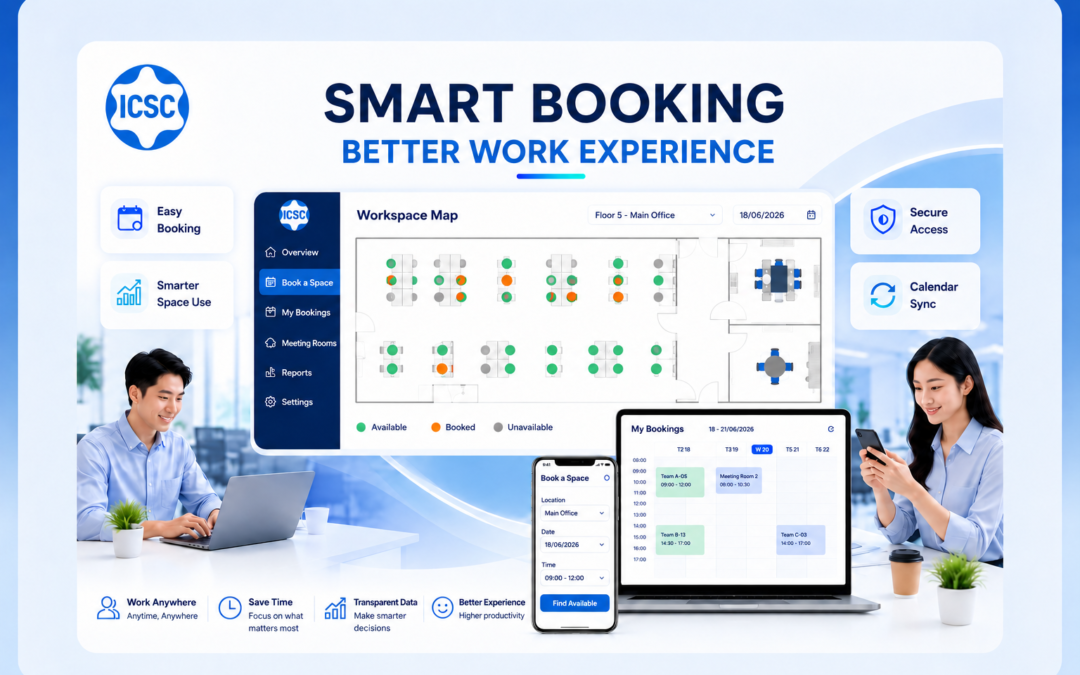
Instead of asking the admin, employees can access the Book a Space interface to begin the booking process. Here, users select their desired workspace, choose a suitable time slot, and view the space availability through a visual map. Available, booked, or unavailable spaces are clearly displayed in different colors, allowing users to quickly understand the current status without having to check through multiple channels.
Once a suitable location is selected, staff can open an information popup, choose a time slot, and confirm the booking. If the booking is successful, the information will be recorded in the system, and users can review it in the My Bookings section. For cases requiring recurring bookings, the system supports recurring bookings by day or week, helping users reduce repetitive tasks and maintain a stable work routine.
This is how a seemingly simple tool can change employees’ mindset. From passively asking for information, they become proactive in checking it themselves. From depending on administrators, they can manage their own work schedules. From feeling uncertain when arriving at the office, they can prepare in advance for a more productive workday.
Key Features That Create a Distinctive User Experience
Every feature of the ICSC Booking system is built around one goal: reducing unnecessary steps, increasing transparency, and making it easier for users to interact with the workspace.
1. Book a Space – Centralized booking interface
Users can access the “Book a Space” section to begin making reservations. This serves as the primary entry point for the entire system usage process, eliminating the need for employees to search for information through multiple channels. Having a centralized interface standardizes the reservation process and reduces the likelihood of each department using its own management approach.
2. Choose flexible time and location.
The system allows users to select their desired work area and time slot. For businesses with multiple floors, offices, or functional areas, the ability to select the right location and time slot makes it easier for employees to schedule their work according to their actual needs.
3. Visual office layout diagram by color.
One of the features that contributes to the user-friendly experience of the system is the clearly color-coded office layout. Available spaces, occupied spaces, and restricted areas are all visually distinguished. Users don’t need to read a lot of information; they can make quick decisions simply by looking at the layout.
4. Book by time slot
After selecting a suitable location, users can choose their desired time slot and save the booking. This approach is suitable for flexible work environments where a single location or meeting room may be used by multiple people at different times.
5. Recurring Reservations
For employees with fixed office schedules, the system supports setting up recurring appointments daily or weekly. Users can select a Daily or Weekly cycle, the frequency of repetition, the days of the week, and the cycle end time. This feature is particularly useful for hybrid working employees, project teams, or departments with rotating work schedules.
6. Notify when all available time slots are full.
When all available time slots are filled, the system displays a clear message so users know and can choose an alternative. This helps reduce waiting times or misunderstandings about space availability.
7. Flexible approval process
Businesses can set up approval mechanisms according to their operating policies. Some seating areas or zones may require prior management/admin approval before confirmation. Others may be automatically confirmed upon completion. This flexibility makes the system suitable for both open environments and environments requiring controlled access to space.
8. My Bookings – Manage your personal booking schedule
Users can access My Bookings to view their entire upcoming booking history. When changes occur, users can cancel their booking and rebook according to their new needs. This makes the booking history clear, easy to track, and reduces reliance on manual reminders.
9. Configure working hours and work days.
The system supports setting working hours and working days, for example, the default time frame is from 09:00 to 17:00, Monday to Friday. When opening a booking schedule, the system automatically selects a suitable time range, saving users from having to manually determine the business’s operating hours.
10. Priority Area
Users can select preferred areas, such as the most frequently used office or floor. Upon logging in, this area map is displayed by default, providing a more personalized experience and saving time.
11. Secure your account with Passkeys and TOTP.
In a business environment, booking systems need to be not only user-friendly but also secure. ICSC Booking supports the setup of Passkeys for users to log in using Face ID, Touch ID, or device PINs, and also supports TOTP through authentication applications such as Google Authenticator. This is a crucial factor when the system is deployed for multiple users and involves access to internal space.
12. Synchronize CalDAV and Nextcloud Calendar
The system supports synchronizing booking schedules with personal work schedules via CalDAV. For businesses using Nextcloud or their own calendar system, this feature ensures that booking schedules are not disconnected from daily work schedules.
13. Connect to Google Calendar
Users can connect Google Calendar to automatically sync events and bookings from the system to their personal accounts. When bookings become part of the work calendar, employees can track them more easily, reducing the risk of forgetting appointments or scheduling conflicts.
From Personal Experience to a Transparent Work Culture
One of the key values of a booking system is its ability to create transparency in how businesses use shared spaces.
In traditional office environments, many space-use decisions are made without sufficient data. Who gets priority for meeting rooms? Which areas are consistently full? Which teams frequently use collaborative spaces? Which spaces are reserved but unused? Without a data-driven system, all answers are likely to be subjective.
When booking data is brought into a centralized platform, space usage becomes clearer. Staff know which spaces are available, which areas are unavailable, which are pending approval, and which schedules have been confirmed. Admins and managers have a basis for fairer coordination, instead of handling each request individually via message or email.
Transparency not only leads to better operations, but it also creates a sense of fairness in the workplace. When everyone uses the same processes, sees the same status, and adheres to the same reservation policies, businesses reduce unnecessary misunderstandings in resource allocation.
For businesses with complex workflows, such as ports, logistics companies, multi-department executive offices, service centers, schools, or multi-branch organizations, this transparency is even more significant. A workspace is not just a place to sit, but also an operational resource. When that resource is managed by a system, businesses can operate more proactively.
The roles of administrators and managers are not being replaced, but rather being upgraded.
A common misconception when implementing software is that the system will “replace” human roles. With a booking system, this is incorrect. The system does not replace administrators or office managers; instead, it helps shift their roles from manual processing to intelligent coordination.
Previously, administrators typically had to receive booking requests, check availability, confirm with users, handle duplicates, and update changes. These tasks were time-consuming but did not generate significant strategic value. As the number of staff increased, so did the number of repetitive requests, making it easy for office management to become bogged down in minor operational tasks.
With the ICSC Booking system, many operations are standardized. Users can check space availability themselves, choose their own time slots, and track their bookings. Admins can focus on setting policies, managing access rights, monitoring approval status, assisting with special cases, and optimizing space allocation.
The role of management also becomes clearer. Instead of relying on the feeling that the office is “overloaded” or “redundant,” businesses can gradually build data-driven decision-making habits. As space usage data accumulates, management has a basis to assess actual needs, adjust hybrid working policies, rearrange workspaces, or consider office expansion strategies.
That’s the greater value of a booking system: it not only reduces the workload for administrators, but also upgrades how businesses manage the customer experience.
Why is Employee Experience an Important Part of Digital Transformation?
Digital transformation is often mentioned in areas such as ERP, CRM, accounting, sales, manufacturing, logistics, or customer service. However, a business cannot achieve complete digital transformation if its employees’ internal experience remains fragmented.
Employees are the ones who use the system every day. They are the ones who best perceive whether a process is convenient, whether a platform is easy to use, and whether a policy is transparent. If a technology tool only serves management reporting purposes but doesn’t help end users work more easily, the digital transformation process will struggle to create real change.
Booking systems are a very practical example. They aren’t a completely unfamiliar or difficult-to-access platform. They address a specific need: how to make it easier for employees to book reservations, track schedules, and utilize space. But from that specific need, businesses can create a broader change in their work culture.
When employees can book appointments themselves, they are more proactive. When schedules are synchronized, they miss less information. When diagrams are visual, they make decisions faster. When approval processes are clear, they understand policies better. When security is well-established, businesses have better control over the system.
Digital transformation doesn’t always start with large systems. Sometimes, it begins with small, repetitive daily experiences. A faster booking process, a clearer work schedule, a more transparent use of space—these are changes employees can feel immediately.
ICSC and the Operational Experience-Centric Approach
ICSC Corporation develops its Booking system not just as a standalone booking tool, but as a platform to support businesses in operating flexible workspaces. The solution connects users, spaces, time, approval processes, account security, and personal work schedules all within a single system.
This approach is suitable for businesses looking to modernize their work environment without increasing operational burdens. Instead of continuing to rely on Excel, internal messaging, or disparate tools, businesses can integrate the entire booking process into a centralized, easy-to-use, and scalable platform.
For hybrid working environments, the system empowers employees to proactively schedule their visits to the office. For co-working spaces or shared offices, it facilitates clearer management of seating and meeting room usage. For businesses with multiple branches, the solution provides a platform for unifying space operations. For port businesses, logistics companies, or organizations with diverse operational departments, a booking system can support more transparent management of work areas, meeting rooms, executive offices, or shared spaces.
Notably, the system is designed for both end users and management. Employees experience fast, intuitive, and easy-to-follow booking. Admins have tools to control approvals, configure areas and times, and provide operational support. Businesses have a data platform to clearly see how space is being used.
That’s the difference between software that only handles tasks and a technological solution capable of upgrading the work experience.
From Workspace to Internal Competitive Advantage
In an increasingly competitive environment for attracting and retaining talent, the work experience has become a crucial element in corporate development strategies. Employees are not only interested in where they work, but also in how the company supports them in working effectively.
A good booking system doesn’t directly replace company culture, but it contributes to making that culture work better. If a company claims to be flexible, employees need a tool that truly enables them to be flexible. If a company wants to foster collaboration, employees need to know when and where they can meet. If a company wants to optimize its office space, management needs data instead of guesswork.
From this perspective, Booking ICSC is not just a utility software. It’s a digital infrastructure layer for the modern workplace. That infrastructure helps businesses reorganize how people interact with the space, with schedules, and with internal processes.
Businesses that are at the forefront of digitizing the work experience will have a clear advantage. They not only save operational time but also create a more professional work environment. In that environment, employees don’t have to waste energy on repetitive, small tasks. They can focus on their core work, on collaboration, on creativity, and on the values the business is pursuing.
When Booking Becomes a Part of Your Daily Work Routine
One of the key criteria for modern enterprise software is its ability to integrate into users’ work habits. If a system is too complex, users will avoid it. If a system is detached from everyday tools, it’s easily forgotten. If a system only serves management purposes without providing direct benefits to employees, usage rates will be low.
Booking ICSC solves this problem by integrating the booking experience into familiar touchpoints: an intuitive booking interface, personal calendar, Google Calendar, CalDAV, preferred areas, My Bookings history, and security authentication. When booking is no longer a standalone operation but becomes part of the workflow, it becomes more receptive to users.
This is especially important for businesses that want to implement technology but are concerned about employee adaptation. A good system needs to be both capable of managing the business and simple enough for end users to find convenient. Booking ICSC follows this approach: focusing on the operational experience, then expanding it to include managerial value.
Conclusion: Better offices start with simpler experiences.
A modern office isn’t judged solely by its size, location, or interior design. It’s also judged by how people use that space every day. If employees arrive at the office feeling uncertain, if meeting reservations still depend on text messages, if work schedules aren’t synchronized, and if administrators have to handle every single request, then the office isn’t truly digitized.
The ICSC Booking system offers a different approach. Instead of viewing bookings as merely an administrative task, businesses can see it as part of the work experience. When employees proactively make bookings, when schedules are clearly managed, when spaces are visually displayed, when approvals are transparent, and when data is synchronized, the office becomes a smarter operating environment.
In the digital transformation journey, not every change begins with large-scale projects. Some changes start with a very simple question: how can we help employees enter the workday with less friction?
With its intelligent workspace management and booking system, ICSC helps businesses answer that question with a specific, practical, and scalable solution. It’s not just about booking; it’s about upgrading the work experience, optimizing office operations, and building a foundation for a flexible working model in the future.
#ICSC #ICSC Corporation #SeatBooking #WorkspaceBooking #HotDesking #HybridWorking #DigitalWorkplace #ChuyenDoiSo #QuanLyVanPhong #EmployeeExperience #SmartOffice #WorkplaceExperience #BookingSystem #EnterpriseSoftware #DigitalTransformation
Contact the ICSC solutions consulting team.
Email: info@icsc.vn
Tel: +84 28 37 15 07 81