

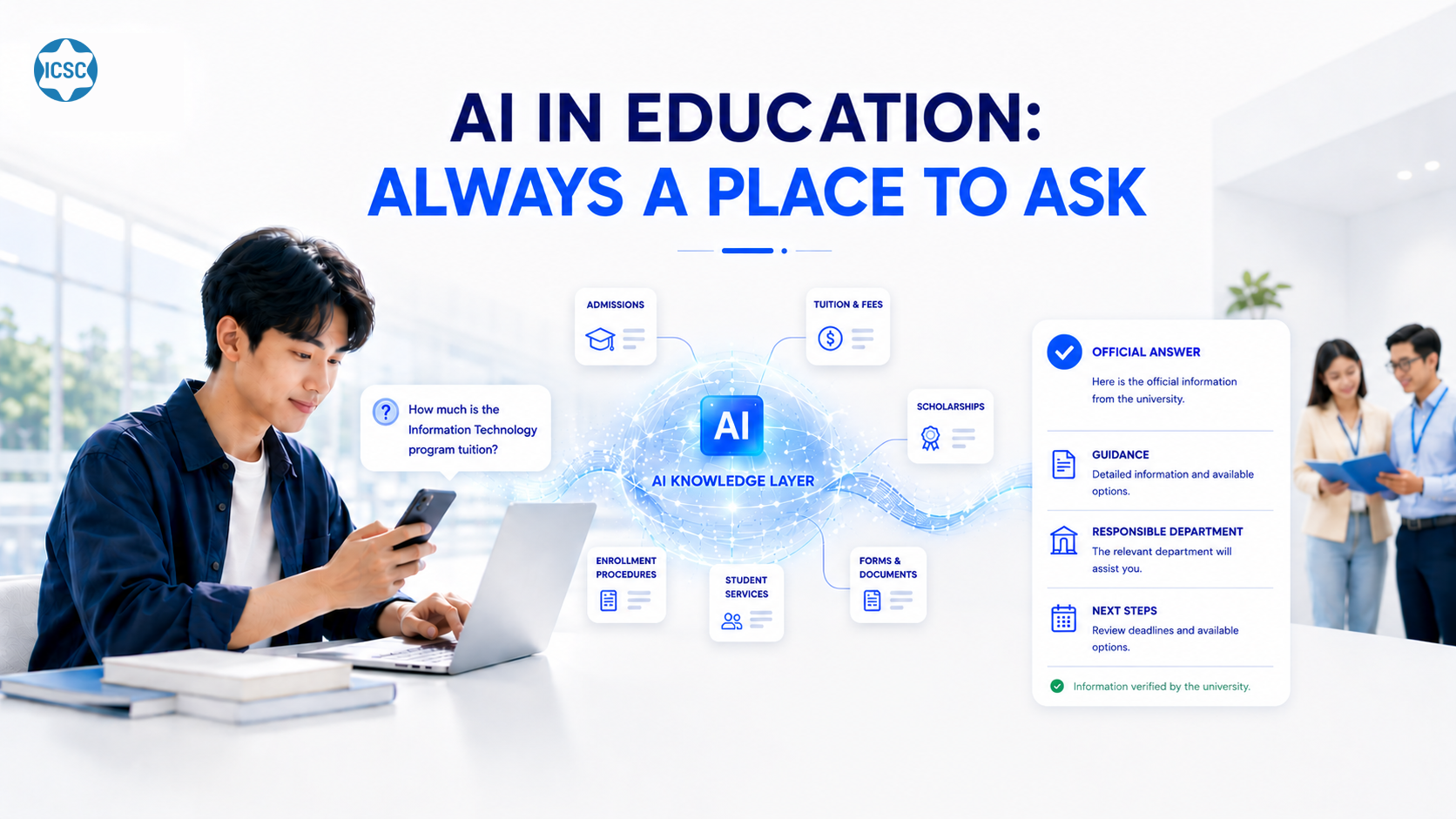
AI is not intended to replace lecturers or admissions officers. Its greatest value is helping students access accurate, official information whenever they need it while reducing repetitive questions for the institution.
| Primary keywords: AI in education, AI admissions assistant, student support AI, education chatbot, AI for colleges. | Search intent: Explanation, applications and implementation. |
A prospective student may make a decision about a college at 10 p.m. A current student may discover a missing enrollment document over the weekend. A learner may urgently need to know which department can resolve an issue, while the answer is scattered across regulations, forms and internal notices.
In these moments, the problem is not a lack of committed staff. The problem is that learners need help at the moment a question arises, while an institution cannot have every team available at every hour and on every channel.
AI in education should therefore not begin with the question, “Who can AI replace?” A better question is: how can every student have a trustworthy place to ask and receive a consistent, accurate answer?
Is AI in education intended to replace lecturers and admissions staff?
No. In a well-designed model, AI does not teach, advise on complex academic decisions or assume institutional responsibility. It acts as an always-available information layer that helps learners find the right content, understand the correct process and identify the next step.
Lecturers remain responsible for teaching, assessment and academic development. Admissions officers remain essential when students need detailed guidance about programmes, individual eligibility or career direction. Student services teams must continue to handle personal records, exceptions and policy decisions. AI takes on the parts that can be standardised: frequently asked questions, regulation lookup, form guidance and request routing.
When this boundary is designed clearly, AI does not make education less human. It gives staff more time for the conversations that genuinely require listening, context and care.
Why do learners still wait when the institution already has the information?
Most institutions are not short of documents. Admissions rules, tuition information, scholarship policies, enrollment procedures, financial support guidance, forms, assignment requirements and graduation processes already exist. The difficulty is that they are distributed across websites, PDFs, announcements, departments and systems.
Learners may not know where to look. A simple question can lead them to search the website, call a hotline, message a social channel, contact an adviser or ask in an informal community. When sources are inconsistent, students can receive outdated or unverified information.
For the institution, the same questions recur every day. Admissions teams repeatedly explain tuition, entry requirements and application documents. Student services repeatedly clarify financial support, forms and administrative processes. Staff capacity is consumed by repeating information rather than resolving cases that need deeper guidance.
How did ICSC deploy an AI admissions and student support assistant?
In a recent project, ICSC deployed CIAXI for a college. The initial objective was to support admissions enquiries and provide learners with fast access to institutional information. During the pilot, our team spent significant time observing how prospective and current students actually used the assistant.
The early questions focused on programmes, tuition, entry requirements and scholarships. The conversations then expanded across the entire learner journey: enrollment procedures, tuition payment, fee reductions, student loan documents, assignment submission, graduation projects, required forms and the simple but important question, “Who should I contact for this?”
This revealed an important point: learners do not experience an institution through its organisational chart. Their needs move continuously across admissions, finance, academic administration and student services. They need one accessible entry point that can understand the question, locate the right source and guide them to the next step.
The assistant does not rely on rigid scripts
CIAXI was not designed as a keyword chatbot that returns a small set of pre-written messages. The assistant is configured around the institution’s own regulations, procedures, documents, forms and approved data.
Students can phrase the same question in many ways, while the AI identifies intent, retrieves the relevant source and explains it in accessible language. The answer must remain grounded in official institutional information rather than inventing policies that have not been issued.
Where a rule depends on individual conditions or requires staff confirmation, the AI must recognise its limits. It can provide initial guidance, identify what needs to be checked and transfer the learner to the correct contact instead of sounding certain when the evidence is incomplete.
What can AI support across the learner journey?
| Stage | Common questions | How AI can help |
| Programme discovery | Programmes, tuition, duration, entry requirements and scholarships | Answer from approved admissions information and guide the learner to relevant programme details. |
| Enrollment preparation | Required documents, deadlines, locations and confirmation procedures | Provide step-by-step guidance and direct the learner to the correct support contact. |
| Student finance | Tuition payment, fee reductions, scholarships and student loans | Explain current policies, eligibility conditions and required documentation. |
| Academic administration | Assignment submission, forms, registration and graduation projects | Locate the correct procedure or form and escalate exceptions to staff. |
| Student services | Leave requests, confirmations, regulations, benefits and department contacts | Resolve common questions and route requests to the responsible unit. |
| Post-graduation | Diploma collection, document confirmation and alumni information | Provide approved procedures, schedules and contact channels. |
The greatest value is not the number of questions AI can answer
During the pilot, what impressed the ICSC team most was not the volume of questions handled. The real value was that learners could receive an official answer at the moment they needed it.
A prospective student did not have to wait until office hours to check an application requirement. A student did not need to call multiple departments for a form. Learners did not have to search through dozens of documents or depend on unverified answers from informal groups.
A timely answer can help a student complete a process, avoid a missed deadline, understand an entitlement and feel less lost within an organisation that has many procedures. That is a measurable service improvement even when the AI does not immediately generate an additional enrollment.
How does AI reduce pressure on admissions and student services teams?
When common questions are handled at the first point of contact, staff no longer need to repeat the same explanations across calls, messages and email. First-line enquiry volume decreases while learners continue to receive rapid responses.
Admissions officers can spend more time on programme choice, career direction and complex applications. Student services teams can focus on policy decisions, verification, exceptions and individual support. Lecturers and academic advisers receive fewer administrative questions that sit outside their core responsibilities.
AI is therefore not only a time-saving tool. It helps institutions allocate capability more effectively: systems handle repeatable information; people handle judgment, accountability and empathy.
How can an education AI provide accurate and consistent answers?
A trustworthy education assistant cannot rely solely on general Internet knowledge. Answers about tuition, enrollment, fee reductions or internal procedures must be grounded in sources approved by the institution.
- Build a governed knowledge base from official regulations, procedures, notices, forms and admissions content.
- Classify information by responsible department, applicable audience, effective period and publication permission.
- Configure the AI not to infer an answer where evidence is incomplete or conflicting.
- Create a clear escalation path for personal records, exceptions and decisions requiring accountability.
- Log conversations so the institution can review quality, identify missing content and update knowledge continuously.
Accuracy depends on more than the language model. It depends on data quality, content governance and operational controls. This is why education AI should be implemented jointly by technology and institutional teams rather than installed as a standalone chatbot and left unmanaged.
What is the right operating model for AI and staff?
The most effective model is tiered support. AI receives the first question, answers content governed by clear rules and collects the necessary context. When the request is complex, sensitive or unsupported by available data, the assistant transfers it to the correct staff member together with the conversation context.
The learner does not have to repeat the entire story. Staff can see what was asked, what information was already provided and where the unresolved issue remains. The experience becomes continuous rather than fragmented between a chatbot and a human team.
| IMPLEMENTATION PRINCIPLE AI handles what has been standardised. People handle what requires verification, judgment, accountability or empathy. Every conversation must have a clear path to human support. |
Which metrics should an institution use to evaluate AI?
Question volume shows adoption but not quality. An education AI project should measure both the learner experience and the operational impact on staff.
| Metric | What it indicates |
| Immediate resolution rate | The share of common requests answered without waiting for staff. |
| Correct routing rate | How reliably complex cases reach the responsible department. |
| Average response time | How much faster learners receive initial support. |
| Answer correction rate | Where knowledge or response controls need improvement. |
| Most repeated questions | Which policies or processes remain unclear to learners. |
| Staff workload reduction | The number of first-line enquiries automated and time released. |
| Learner satisfaction | Whether the service feels useful, clear and trustworthy. |
A practical roadmap for admissions and student support AI
Phase 1: Select a high-demand, well-documented scope
A college can begin with admissions, tuition, enrollment documents and contact guidance. These topics have high demand, relatively clear rules and measurable answer quality.
Phase 2: Govern the knowledge base
Documents should be reviewed for version, ownership and publication permission. Outdated content must be removed. AI quality begins with the quality of the institutional knowledge behind it.
Phase 3: Design conversations and escalation
The assistant must understand different ways of asking, provide concise step-by-step answers and know when to involve staff. Personal data should only be collected when required and under appropriate access controls.
Phase 4: Pilot and observe real behaviour
A pilot is not only a technical test. It is an opportunity to observe real learner language, discover unexpected needs and identify missing or unclear documentation.
Phase 5: Expand across the learner journey
Once stable, the service can extend to academic administration, student services, alumni support or integrations with CRM, portals and learning management systems where appropriate.
Frequently asked questions about AI in education
Can AI replace admissions officers?
No. AI can answer common questions, provide information and collect initial needs. Admissions officers remain essential for complex eligibility, programme guidance and cases requiring verification.
Can students receive support outside office hours?
Yes. When connected to an approved institutional knowledge base, the assistant can provide 24/7 support for content within its configured scope.
Where does the AI obtain admissions and student policy information?
It should use regulations, procedures, notices, forms and data supplied or approved by the institution. Internal policy answers should not be generated from unverified Internet sources.
What happens when the AI does not know the answer?
The assistant should state its limitation, provide any safe initial guidance and route the request to the correct person or department. It should not guess when the available evidence is insufficient.
Can a small or mid-sized college implement this type of AI?
Yes. Institutions can begin with a narrow, high-volume scope such as admissions and enrollment questions, then expand as data and operational readiness improve.
Can the AI work across multiple channels?
Depending on the implementation, the same governed assistant can be delivered through a website, portal, messaging channel or other digital touchpoints, with consistent content and access controls.
ICSC builds AI that understands each education institution
From our experience deploying CIAXI for a college, ICSC has learned that the value of education AI is not how human the conversation sounds. The value is whether the assistant understands the institution’s approved knowledge, respects its operational processes and guides the learner to the right information at the right time.
ICSC does not only build an assistant that can answer. We work with institutions to define scope, govern the knowledge base, design permissions, control responses and create escalation to staff. The objective is to make AI a trustworthy part of improving service quality and the learner experience.
AI in education is not about reducing the role of lecturers or support teams. It is about making sure every learner has a place to ask, while people have more time to do the work only people can do.
Contact information
Please contact ICSC’s solution consulting team.
Email: info@icsc.vn
Tel: +84 28 37 15 07 81