In the modern golf industry, course quality, landscape design, clubhouse facilities, and F&B services are no longer the only factors that define competitiveness. A golf course may have a prime location, well-designed holes, professional caddies, and premium services, yet still risk losing members if it does not truly understand each golfer’s behavior, needs, and level of engagement.
This raises an important question for golf course owners and operators: how can a golf course not only serve customers well during a single round, but also keep them coming back, renewing their membership on time, and continuing to use high-value services?
The answer no longer lies in manual notes, instinct-based follow-up calls, or fragmented Excel files. In an era where customer experience is increasingly personalized, data has become a strategic asset. With ICSC’s Golf CRM, that data is transformed into specific actions: identifying members at risk of leaving, detecting high-potential leads, automating customer care, personalizing offers, and helping management teams make faster, more informed decisions.
Golf CRM is not simply a tee time booking system or a scheduling tool. It is a centralized golf course management and operations platform designed to connect the entire golfer journey, from the first interaction, tee time booking, check-in, service usage, payment, loyalty engagement, and personalized promotions to membership renewal. When all data is brought into one unified system, golf courses can operate more efficiently, understand customers more deeply, and build more sustainable growth.
When a Golf Course Has Customers, but Still Risks Losing Members
Many golf courses today face a common paradox: visitor traffic may remain stable, weekend tee times may still be busy, and daily revenue may still be recorded, but loyal membership growth does not increase at the same pace. Some golfers used to play regularly but gradually appear less often. Some members are approaching renewal dates, yet the customer care team does not receive timely reminders. Some guests have played multiple times and may be ready to become members, but they have never been approached with the right offer.
The issue is not that golf courses lack effort in customer care. The issue is that data is often scattered across different teams. The reception team holds booking information. The cashier team manages payment history. Caddies understand playing habits. Marketing manages promotion lists. Management needs an overall view to make decisions. When these pieces of data are not connected, it becomes difficult to know which customers should be prioritized today.
In a traditional operating model, membership retention often depends heavily on individual experience. A long-time receptionist may remember which VIP guest prefers morning tee times. A caddie may know which golfer usually requests a golf cart. A manager may remember which member is approaching renewal. But as the customer base grows, staff changes, and booking volume increases, personal memory can no longer replace a centralized data system.
ICSC’s Golf CRM is built to solve this exact challenge. Instead of only recording transactions after customers arrive at the course, the system helps golf courses monitor the full golfer lifecycle. From prospects and walk-in guests to active members and at-risk customers, every customer profile is continuously updated with real operational data. This allows operations teams to move away from a reactive model and toward proactive customer care.
For golf course owners, this is a critical shift. Retaining a valuable member is not only about keeping a membership fee. It also means retaining playing frequency, Pro shop revenue, rental services, F&B spending, academy participation, event opportunities, and potential referrals.
360-Degree Golfer Profiles: The Foundation of Personalized Customer Care
One of the core strengths of Golf CRM is its ability to build complete and meaningful customer profiles. Instead of storing only basic information such as name, phone number, and email, the system allows golf courses to manage multiple layers of data related to each golfer’s behavior, value, and experience.
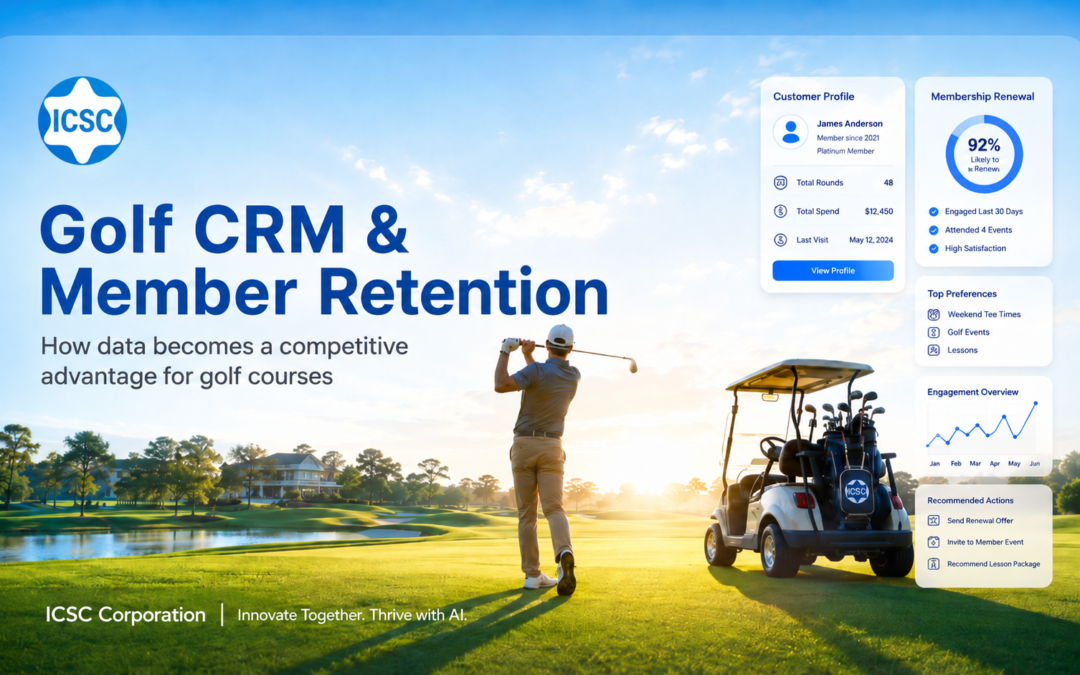
In Golf CRM, customers can be classified as members, walk-in guests, or prospects. Each customer profile can include handicap index, membership number, membership status, start date, expiry date, renewal date, account balance, birthday, preferred language, customer segment, sentiment, and care tags such as VIP, High Value, Tourist, or Churn Risk. This is valuable data for CRM, sales, and customer service teams to understand each golfer instead of approaching everyone with the same message.
A golfer who usually plays on weekend mornings requires a different care approach from a tourist who visits the course only once. A member with a high account balance and consistent booking history should be served differently from a new prospect who first interacted through a chatbot. A player showing a decline in playing frequency may need a timely retention offer, while a walk-in guest who has played several times may be a strong candidate for membership conversion.
Golf CRM ensures that this information is not trapped in personal notes or individual staff memory. Everything is stored in the customer profile, allowing authorized departments to quickly understand the context before serving the golfer. Receptionists know preferred playing times. Caddies gain insight into playing habits. CRM teams know who is due for renewal. Marketing teams know which segment should receive which campaign. Management can evaluate the true value of different customer groups.
This is the foundation of meaningful personalization. It is not merely about calling customers by their names in a message. It is about understanding the right need, at the right time, for the right golfer. In the golf industry, where experience and attention to detail matter greatly, this capability can create a clear difference in how customers perceive service quality.
AI Analytics: Detecting Risks Before Customers Leave
The real power of Golf CRM does not stop at data storage. It lies in the ability to analyze data and support action. With Analytics and AI Predictions, the system helps management and CRM teams identify signals that are often missed when hundreds of customer profiles must be handled every day.
Instead of simply reporting revenue that has already been generated, Golf CRM helps answer more strategic questions: who is at risk of not renewing their membership, who has the potential to become a member, which customer group has high lifetime value, how is playing frequency changing, what languages do customers use, which campaigns are generating responses, and which time slots can still be optimized.
The Analytics module can provide insights into total contacts, customer interactions, course visits, customer lifetime value, and customer distribution by segment. These are not just numbers for reporting purposes. They help golf courses prioritize resources. When the system identifies an At-Risk group, the CRM team can proactively call, send offers, or design a suitable retention program. When the system detects Lead Potential, the sales team can begin a nurturing sequence to increase the conversion rate.
The value of AI in this context is not abstract. It is about turning daily operational data into business signals. A member who plays less frequently, interacts less often, approaches renewal, and no longer responds to previous campaigns may represent a retention risk. A walk-in guest who has played multiple times, engaged with promotions, and shown strong spending behavior may represent a membership opportunity. Without an analytical system, these signals can easily disappear within fragmented data.
With Golf CRM, data does not remain passive. It becomes a tool for alerts, forecasts, and recommended actions. This is especially important for golf courses aiming to modernize management, where decisions should be based not only on intuition, but also on actual operational evidence.
From Alerts to Action: CRM Should Not Only Report, but Recommend What to Do Next
A good CRM system does not simply help managers see problems. More importantly, it helps teams understand what to do next. ICSC’s Golf CRM is designed with this action-oriented approach by connecting customer data with customer care, marketing, operations, and billing activities.
When a member is approaching renewal, the system helps the CRM team identify the case early and reach out proactively. When a golfer is marked as being at risk of leaving, the customer care team can prioritize a call, offer a green fee incentive, or propose a more suitable experience package. When a lead reaches a high potential score, the sales team can place that person into a personalized nurturing journey instead of letting the opportunity go cold.
The strength of Golf CRM lies in its ability to connect actions across multiple departments. Tee Sheet data shows when customers play. Billing data shows what they have paid for, whether they have outstanding balances, and what services they used at the Pro shop or rental counter. Contact data shows membership status, segment, sentiment, and playing preferences. Analytics data identifies risks and opportunities. When these datasets exist on the same platform, customer care is no longer fragmented between departments.
This is also how Golf CRM helps golf courses increase revenue in a more natural and sustainable way. Instead of relying only on mass promotions, golf courses can design messages for specific customer groups. Members approaching expiry dates can receive early renewal offers. Walk-in guests who have played several times can receive membership invitations. New prospects can receive content introducing the course experience, golf academy, or first-time offers. VIP customers can receive priority services and personalized communication.
From a management perspective, this improves the productivity of sales and marketing teams. Staff no longer need to manually filter lists or guess which customers to contact first. The system provides data, alerts, and recommendations so teams can focus on the right customers, at the right time, with the right message.
Key Features That Support Member Retention and Revenue Growth
ICSC’s Golf CRM is designed as a centralized management and customer engagement platform for golf courses. The following feature groups create a closed data loop, helping golf courses improve both customer experience and operational efficiency.
- Customer and Member Profile Management: Classify customers as members, walk-in guests, or prospects; track handicap, membership number, renewal date, account balance, birthday, language, segment, sentiment, and customer care tags.
- Real-Time Management Dashboard: Monitor today’s tee times, active contacts, at-risk members, membership growth, upcoming tee times, latest activities, and course operational status.
- Tee Times & Tee Sheets: Create tee time schedules using formats such as Standard, Shotgun, Crossover, or Custom; manage intervals, block or unblock tee times, assign price sheets by time slot, and coordinate reservations directly on the tee sheet.
- Reservations and Check-In: Create bookings for groups, enter player details, add Player 2, Player 3, and Player 4, record booking notes, and update statuses such as Arrived or No Show.
- Golf Course and Club Profile Management: Configure course information, number of holes, par, operating status, opening hours, rates, tournaments, offers, golf academy, weather updates, and reservation rules as operational and AI context data.
- Staff and Caddie Management: Track total staff, active staff, number of caddies, unassigned groups, caddie availability, busy status, and detailed service schedules.
- Pro Shop, Product, and Rental Management: Manage retail products, rental equipment, services, SKU, cost, selling price, rental rate, stock quantity, and low-stock alerts.
- Billing & Cashier Management: Record sales, rentals, partial payments, outstanding balances, payment methods, cashier opening and closing sessions, and revenue by shift.
- Reports and Analytics: Summarize orders, sales, paid amounts, open balances, customer interactions, visits, segments, languages, customer lifetime value, and AI-powered predictions.
- 24/7 AI Chatbot: Provide information on rates, membership packages, promotions, booking status, account balance, tee time requests, and multilingual communication across channels such as Zalo, Facebook, website, and WhatsApp.
- Omni-Channel Inbox: Centralize messages from Facebook Messenger, Instagram DM, Zalo, website live chat, and email into one interface, while automatically linking conversations to customer profiles in CRM.
- Member App: Allow golfers to view personal information, transaction history, account balance, rewards, tee time bookings, and renewal reminders with personalized offers.
- DILINZ Automated Marketing: Connect CRM data with multi-channel marketing activities, delivering the right content to the right groups, such as members approaching expiry, frequent walk-in guests, or new prospects.
- ERP & Accounting Integration: Synchronize cashier revenue, Pro shop inventory changes, and daily transaction lists to ERP; update CRM inventory when ERP purchase receipts are approved.
- User Access Control: Define access permissions by roles such as management, CRM, billing, and authenticated users to ensure operational data is controlled appropriately.
- Flexible Deployment and Source Code Handover: Support deployment on cloud or private servers, with the option to hand over source code, database, technical documentation, and administration guides after project completion.
Seamless Customer Experience Through Chatbot, Member App, and Omni-Channel Inbox
Member retention is not only about promotions. It is also about experience. A modern golfer expects fast responses, convenient booking, timely communication, and the ability to avoid repeating the same information to different departments. This is why Golf CRM extends customer experience beyond the front desk.
With AI Chatbot, golf courses can respond to customers 24/7. Customers can ask about rates, membership packages, promotions, booking schedules, account balances, or tee time requests. When the chatbot is connected to CRM data, responses are no longer generic. They can be based on the actual information of the course and the customer profile.
Omni-channel Inbox helps operations teams bring conversations from multiple channels into one place. Instead of opening Facebook, Zalo, Instagram, website live chat, and email separately, staff can handle customer conversations from a centralized interface. More importantly, each conversation can be linked to the correct customer profile, ensuring interaction history is not lost. When a customer asks about membership, the system can support the team in recognizing this as an interest signal for follow-up.
The Member App further enhances the customer experience. Instead of calling the course to ask about schedules, balances, or confirmations, members can access their information directly through the app. When CRM detects that a membership is approaching its expiry date, the app can send a renewal reminder with a personalized offer. This allows golf courses to move from reactive customer care to proactive engagement, while reducing workload for reception and customer service teams.
When Chatbot, Member App, and Omni-channel Inbox are all connected to CRM, every customer touchpoint creates data. Each new piece of data helps the golf course understand customers better. This creates a valuable loop: interaction creates data, data enables personalization, personalization improves experience, and better experience increases the likelihood of return visits and membership renewal.
Customer Data as a Long-Term Growth Asset for Golf Courses
In traditional operations, data is often treated as a supporting element. At the end of the day, staff summarize revenue. At the end of the month, managers review reports. When customer care is needed, CRM teams filter lists and make calls. This approach can still work, but it is difficult to build long-term competitive advantage in a service market that increasingly demands personalization.
With Golf CRM, data becomes the center of growth strategy. Booking data helps optimize tee times. Customer data enables personalized care. Billing data reveals spending value. Pro shop and rental data supports inventory control. Staff and caddie data improves service coordination. Marketing data measures campaign effectiveness. AI Analytics identifies risks and opportunities before they become visible in revenue reports.
This approach is valuable not only for golf courses, but also for other complex operating models such as resorts, sports clubs, premium service centers, logistics operations, and smart ports. These businesses share a common characteristic: they have multiple customer touchpoints, multiple departments involved in operations, and a strong need for centralized data. When data is standardized and connected, businesses can operate with greater transparency, serve customers better, and make decisions faster.
For golf course owners, ICSC’s Golf CRM offers a practical approach to digital transformation. It is not digitalization for the sake of following a trend. It is digitalization that solves specific business problems: how to know which members need attention, how to avoid missing leads, how to optimize tee time usage, how to control revenue from Pro shop and rental services, how to synchronize accounting data, and how to make marketing relevant to each customer group.
More importantly, Golf CRM is built with an expandable platform mindset. Businesses can begin with core modules such as Contacts, Tee Times, Booking, Products, Billing, Dashboard, and Reports, then expand into AI Chatbot, Member App, Omni-channel Inbox, DILINZ Marketing, ERP/Accounting, and AI Analytics as their needs grow. This makes implementation more realistic, allowing golf courses to transform step by step while still following a clear roadmap toward smarter operations.
ICSC Golf CRM: From Management Software to a Growth Platform
A modern golf course cannot rely only on scattered experience, Excel files, and manual phone calls. As golfer expectations continue to rise, the ability to understand customers and respond at the right time will become a key part of competitive advantage.
ICSC’s Golf CRM helps golf courses move from simple operational management to complete golfer lifecycle management. Every booking, check-in, payment transaction, message, marketing response, and renewal signal becomes part of one unified data picture. From that picture, management teams can see not only what has happened, but also what may happen next.
In the long term, the advantage of a golf course is not only measured by how many customers play today. It is measured by how many customers continue to return, renew their membership, use additional services, and recommend the course to other golfers. This is the challenge Golf CRM is built to address: helping golf courses retain customers, increase the lifetime value of each golfer, and build a strong data foundation for sustainable growth.
With expertise in software development, AI, ERP/Odoo, FinTech, blockchain, and digital transformation consulting, ICSC introduces Golf CRM as a technology solution designed for real golf course operations. More than a management tool, it is a platform that helps golf course owners build a modern operating model with centralized data and smarter customer experience.
In an era where data determines the speed and quality of decision-making, Golf CRM does more than help golf courses know who their customers are. More importantly, it helps them know when to act, who to act on, and how to act in a way that creates real business value.
Contact the ICSC solution consulting team
Email: info@icsc.vn
Tel: +84 28 37 15 07 81