
For many years, one of the biggest challenges inside seaport operations was not equipment capacity or berth infrastructure — it was operational fragmentation.
Different departments often operated on completely separate systems.
TOS platforms handled container operations. ERP systems managed accounting and finance. Billing platforms operated independently. Operational dashboards pulled data from disconnected sources. Meanwhile, many consolidated reports still relied heavily on Excel spreadsheets and manual communication between departments.
This operating model worked reasonably well when logistics flows were smaller and less complex. However, as cargo throughput, transportation activity, and operational speed increased dramatically, disconnected operational systems began creating serious bottlenecks across the entire port ecosystem.
Operational data became inconsistent between departments. Staff had to perform repeated manual entries across multiple systems. Dashboards often failed to reflect real field conditions in real time. Management teams lacked centralized operational visibility for fast decision-making.
In many cases, containers had already completed Gate Out operations while ERP systems remained outdated. Billing workflows were completed but operational dashboards had not yet synchronized. Cargo throughput reports differed between departments because operational data was updated at different times.
This is one of the main reasons why many ports in 2025 are shifting toward Integrated Smart Port Ecosystems — environments where operational systems are connected through a centralized operational data architecture.
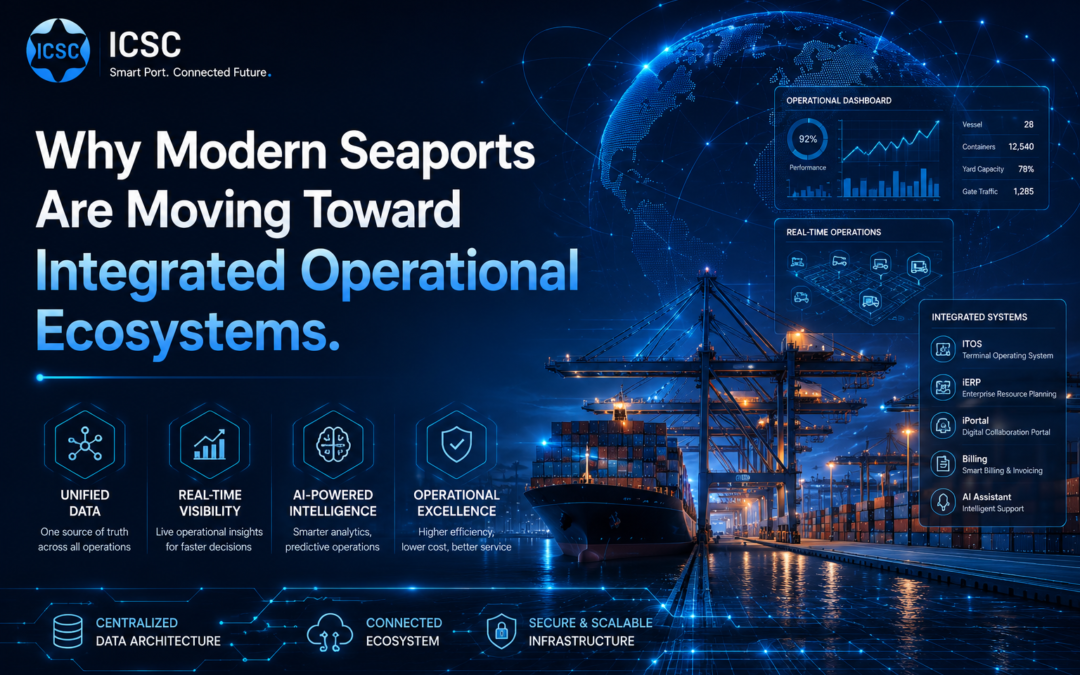
At ICSC, Smart Port ecosystems are designed as unified operational environments rather than isolated software deployments. The architecture integrates ITOS (Terminal Operating System), iERP, iPortal, Billing systems, operational dashboards, and AI Assistants into a centralized operational infrastructure.
The most important value of this model is not simply “system integration.”
The real value lies in creating a continuous operational data flow from field operations to management-level decision-making.
When a container completes a Gate Out operation, the data synchronizes immediately across operational dashboards, billing systems, and ERP platforms. As cargo throughput changes, management teams can monitor operational performance almost in real time instead of waiting for end-of-day reports. AI Assistants can also retrieve operational information directly from the unified ecosystem instead of querying disconnected databases separately.
This represents a major transition in the Smart Port industry.
Previously, port software focused mainly on “container management.”
Today, modern ports are evolving toward fully connected digital operational ecosystems where operational data is continuously synchronized, analyzed, and orchestrated across the logistics environment.
This transformation is becoming increasingly important as modern logistics operations demand faster real-time responsiveness. Ports with stronger operational data synchronization often gain significant advantages in equipment coordination, billing efficiency, operational visibility, and executive-level decision-making.
In the near future, port competitiveness will no longer be measured solely by berth capacity or equipment scale.
It will increasingly depend on how effectively ports build unified operational data ecosystems across the entire logistics chain.
Learn more about Smart Port & Digital Logistics Ecosystem solutions at:
https://smartport.vn
Contact the ICSC solution consulting team
Email: info@icsc.vn
Tel: +84 28 37 15 07 81
#SmartPort #PortOperations #DigitalTransformation #ERP #TOS #OperationalIntelligence #MaritimeTechnology #Logistics #SupplyChain #DigitalPort #RealTimeOperations #AI #IoT #SmartLogistics #DigitalEcosystem