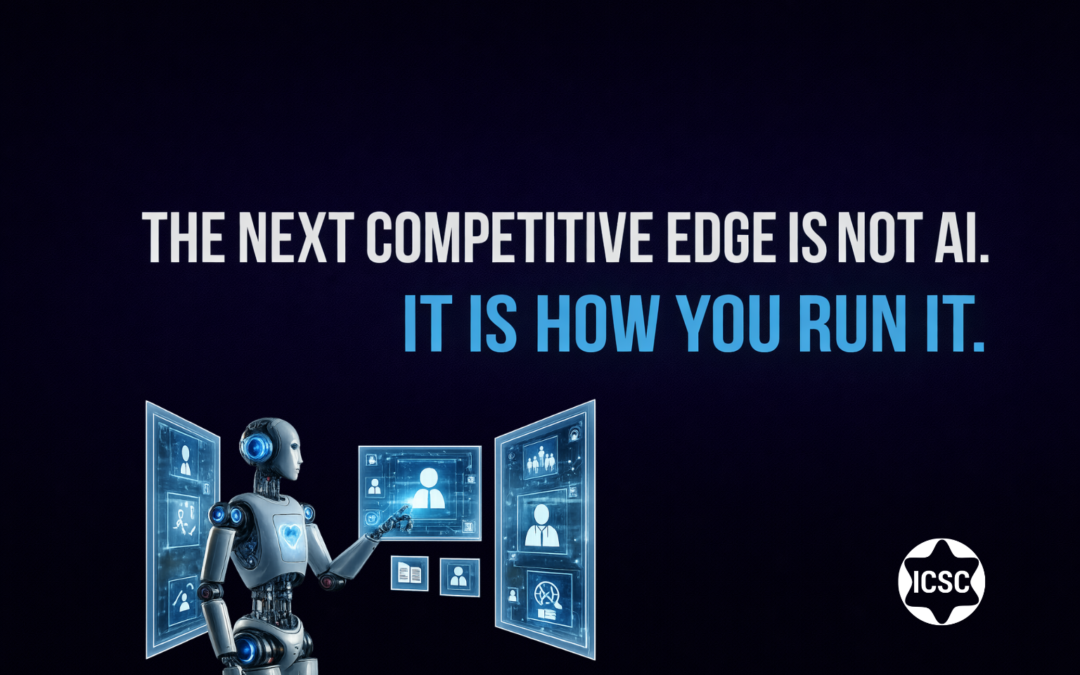
This is not a discussion about the distant future.
This is the current state of AI adoption in Vietnam today.
AI is growing fast, but more importantly, the way it is being used is changing.
Over the past few years, AI has moved from a concept explored in isolation to something that is starting to appear in real business operations. Many organizations have experimented with it, tested different tools, and in some cases, integrated it into parts of their workflow.
But if we look closer, most companies have not yet reached true production-scale deployment.
Vietnam is at a transition point. It is no longer in the exploration phase, but it has not yet reached maturity.
A Growing Market, With a Clear Gap
AI in Vietnam is seeing strong momentum from both local enterprises and global technology companies. Organizations such as FPT, Viettel, and VNG have invested heavily in AI, while international players like NVIDIA, Qualcomm, and SAP are expanding their presence in the country.
This indicates that Vietnam is not only a consumer of AI technology, but is gradually becoming a contributor to its development and deployment in the region.
However, this growth is not evenly distributed. While some companies have made significant progress, a large portion of the market is still in the early stages.
AI exists within businesses, but it has not yet become a core layer of operations.
From Generative AI to Agentic AI
Between 2023 and 2024, most enterprise AI use cases were centered around supporting human tasks. Chatbots for customer service, content generation tools, and AI-assisted coding were among the most common applications.
This is what we refer to as Generative AI. It responds when prompted and stops when the interaction ends.
Since 2025, a new direction has started to emerge more clearly. That direction is Agentic AI.
Unlike traditional AI tools, Agentic AI does not simply respond. It can take a goal, break it down into multiple steps, interact with different systems, and execute tasks continuously.
Instead of asking AI to perform individual actions, businesses can define an objective, and the system will operate toward achieving that objective.
This represents a structural shift in how AI is used in business environments.
The Reality of Deployment in Vietnam
AI adoption is increasing, but most implementations remain at the support or pilot level. Common use cases are still focused on marketing, customer interaction, and internal assistance.
Systems capable of end-to-end automation, integrating multiple systems and running continuously, are still relatively new.
This is not a weakness. It is a natural stage in the lifecycle of a technology moving from experimentation to real-world operation.
The difference between organizations is starting to show in how they implement AI. Some are embedding it into core processes, while others are still treating it as a standalone tool.
What Is Already Running in Practice
Agentic AI is no longer theoretical. Several real-world applications are already visible in Vietnamese businesses.
In customer service, systems can respond 24/7, handle incoming requests, classify users, and convert interactions into leads without manual intervention.
In sales operations, AI can monitor pipelines, remind teams of follow-ups, assess deal progress, and support faster decision-making.
On the financial side, systems can consolidate receivables, automate payment reminders, and assist in cash flow forecasting.
Internally, AI is being used to aggregate data from multiple sources and generate reports, enabling management to access insights more quickly and accurately.
The common pattern across all these use cases is not replacing people, but reducing repetitive work and improving operational efficiency.
Why SMEs Will Move the Fastest
Small and medium-sized enterprises in Vietnam typically operate with limited resources, lean teams, and less optimized processes. This is exactly where Agentic AI creates the most impact.
Without requiring heavy infrastructure or in-house AI teams, businesses can begin by integrating AI into the most friction-heavy parts of their operations.
When implemented correctly, AI enables faster customer response, more efficient workflows, and reduced dependency on manual effort.
In many cases, a small team can achieve a level of output comparable to a much larger organization.
Why Many AI Projects Do Not Reach Production
The primary challenge is not technology, but approach.
Many organizations start by choosing tools rather than understanding the process they need to improve. When workflows are unclear, applying AI rarely produces meaningful results.
Another issue lies in measurement. Tracking the number of AI-generated actions does not reflect business value. What matters are outcomes such as conversion rate, response time, and revenue impact.
In addition, the lack of ownership often leads to systems being abandoned after initial deployment. AI requires continuous monitoring and refinement. It is not a one-time implementation.
The Next 12 Months
AI will no longer be treated as a standalone tool. It will become part of the operational infrastructure of businesses.
Agentic AI will be integrated more deeply into systems such as CRM, ERP, and customer communication platforms.
Organizations that move early will gain advantages not only in technology, but also in data quality, process optimization, and responsiveness.
This gap does not appear overnight, but it compounds over time.
AI in Vietnam has moved beyond the experimental phase, but it is still early in its maturity journey.
This is the stage where decisions about whether to implement AI, and how to implement it, will define competitive positioning in the coming years.
The question is no longer whether AI should be adopted, but when it should be brought into real operational use.
And in most cases, the challenge is not understanding the technology, but applying it correctly within business processes.
ICSC Corporation – bringing AI into real business operations, not stopping at pilot or demonstration stages.
ICSC is a technology company with over 18 years of experience, having delivered more than 700 projects across multiple industries.
Our focus is on bringing AI into real business operations, not stopping at pilot or demonstration stages.
ICSC’s Agentic AI solutions are designed to integrate directly into enterprise workflows, connecting with systems such as CRM, ERP, and Zalo OA, while measuring impact through business-oriented KPIs.
Our approach is not about deploying isolated AI tools, but about building systems that can operate reliably alongside businesses over the long term.