
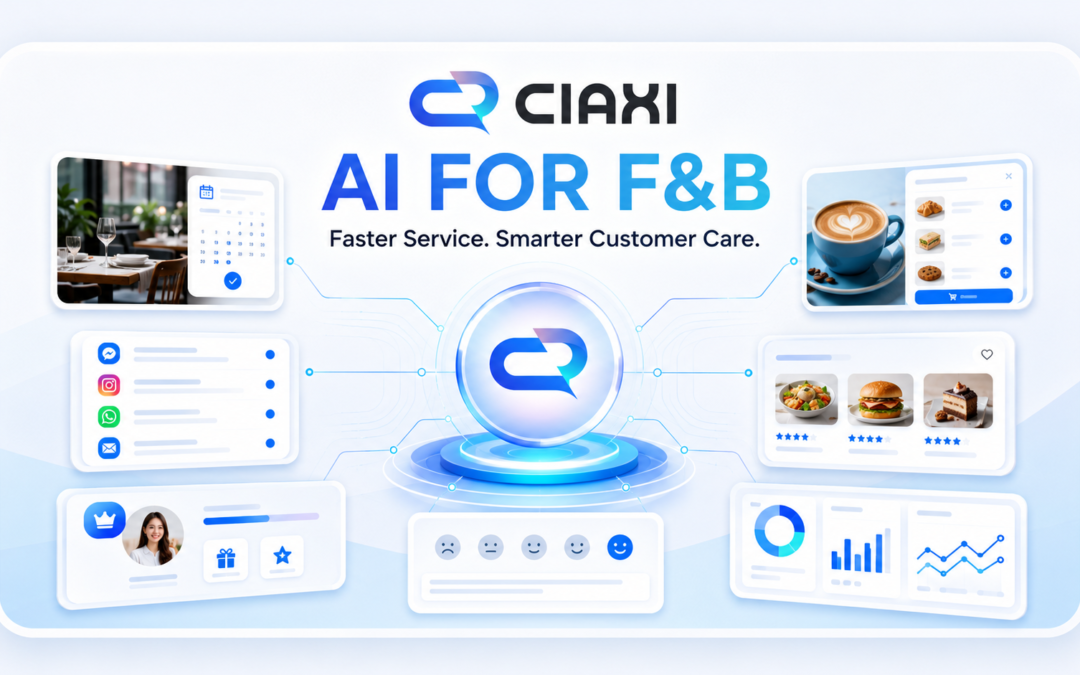
F&B customer service begins before the guest enters the venue
A customer sees a new-dish video on Facebook during lunch and messages to ask which nearby location still has availability. A group wants a table on Saturday night and needs to know whether there is a quiet area, whether they can bring a birthday cake and how much deposit is required. At the same time, a regular coffee-shop customer asks about a drink ordered before, a delivery order needs an address change and the counter team is handling a line of customers waiting to pay.
This is a familiar picture across Food and Beverage businesses. Experience is not determined only by taste or atmosphere. It is shaped by response speed, information accuracy, the ability to remember needs and the way the business handles the journey from discovery and reservation to ordering, payment and post-visit feedback.
The difficulty is that customers do not follow a straight line. They may browse a menu on the website, ask about a promotion on Facebook, confirm through Zalo, call to change the time and leave a review elsewhere. When every touchpoint sits in a separate place, customer service depends too heavily on individual memory, speed and experience.
AI creates a different operating model. Trained on approved business data and connected to workflows, it can become a front-line support layer that responds around the clock, preserves context, captures needs, routes requests, assists employees and turns conversations into structured data.
Why is customer service so difficult for restaurants and coffee shops?
The first characteristic of F&B is concentrated demand. Before lunch, in the early evening, on weekends or during a new campaign, inquiries and orders can rise quickly within a very short period. Employees must serve in-store guests, answer calls, reply to messages, check tables, confirm items and coordinate with the kitchen at the same time. A delay of only a few minutes can be enough for a customer to choose another option.
The second characteristic is constantly changing information. An item may be temporarily unavailable, a location may adjust its hours, an offer may apply only during certain periods, a seating zone may be full or ingredients may need daily updates. A script-based bot can be fast and still be wrong. F&B AI therefore needs controlled data sources and clear handoff rules.
The third characteristic is that requests often contain multiple conditions. One reservation can involve party size, children, smoking preference, allergies, vegetarian choices, a stroller, decoration, corporate invoicing and last-minute changes. A beverage order may include size, sweetness, milk type, toppings, temperature and personal notes. Good service requires understanding the complete context rather than answering isolated questions.
Consultation quality can also vary across shifts and locations. Experienced employees understand products and exceptions, while new staff search several files or ask a manager. Inconsistent answers about ingredients, allergies, item replacement, loyalty points or refunds directly affect trust.
F&B AI is more than a chatbot that reads the menu
At the basic level, AI can answer questions about opening hours, locations, menus, prices, membership programs and reservation policies. But if it stops at question-and-answer, the business is solving only a small part of the problem.
A workflow-oriented AI system can ask follow-up questions, identify the appropriate location, capture date, time and party size, recommend items, create a lead or customer profile, schedule reminders, route a case to an employee and preserve the full history. Connected through APIs to POS, CRM, reservation, loyalty, delivery or ERP platforms, AI can support a process rather than merely produce a response.
CIAXI is designed as an enterprise AI assistant combining large language models with retrieval-augmented generation to access internal documents and data. It supports configurable knowledge, workflows, logic and brand voice, as well as integration with existing systems. In F&B, CIAXI can be configured as a customer-care assistant, reservation assistant, menu advisor, internal knowledge assistant or a conversational layer connected to operations.
CIAXI AI Service Assistant: a 24/7 front line for restaurants and coffee shops
For restaurants, the knowledge base can include menus, ingredients, signature dishes, set menus, vegetarian options, allergy information, capacity, seating zones, private rooms, deposit terms, decoration, event services and cancellation rules. AI can understand natural-language questions, answer from approved information and collect the details required for the next step.
For coffee, tea, bakery and beverage concepts, data may be organized by product group, size, toppings, sweetness, milk type, temperature, bundles, preparation time, location, points and seasonal campaigns. When a customer says, “I want something lightly sweet, dairy-free and easy to drink in the afternoon,” the assistant can recommend based on configured conditions instead of searching a single menu keyword.
For multi-location brands, AI can provide a consistent communication layer while adapting to local opening hours, available menus, delivery rules and reservation status. Cases involving food safety, exceptions or management decisions must be handed to people with the full conversation history.
| No. | Capability | F&B application |
| 1 | Context-aware 24/7 support | Answers from approved business data, maintains brand voice and captures after-hours demand. |
| 2 | Omnichannel conversations | Brings Website, App, Facebook, Zalo, Telegram and integrated channels into one service workflow. |
| 3 | LLM + RAG | Combines large language models with internal retrieval for natural responses grounded in enterprise information. |
| 4 | Intelligent menu consultation | Suggests items, drinks, bundles or alternatives based on needs, preferences and configured conditions. |
| 5 | Allergy and dietary capture | Collects important information, prioritizes warnings and hands off when professional confirmation is required. |
| 6 | Reservation support | Captures date, time, party size, seating, occasion, deposit and special service requirements. |
| 7 | Ordering and order-status support | Captures item configuration, delivery details and status when connected to appropriate systems. |
| 8 | Omnichannel CRM | Stores conversation history, customer profiles, marketing source, orders, reservations and care status. |
| 9 | AI-human handoff | Transfers complaints, special requests and complex transactions without losing context. |
| 10 | Reminders and post-service care | Supports confirmations, reservation reminders, surveys, feedback and return-customer workflows. |
| 11 | Personalization and loyalty | Segments customers and triggers relevant care based on history, membership tier and important occasions. |
| 12 | Knowledge Hub | Helps employees search SOPs, recipes, policies, ingredients, campaigns and operating guidance. |
| 13 | Conversation and sentiment analytics | Tracks frequent topics, response time, unresolved conversations and signs of dissatisfaction. |
| 14 | Flexible integration and deployment | Connects CRM, ERP, POS, booking, loyalty and existing systems through scoped APIs; supports cloud or on-premise deployment. |
From a menu question to a completed reservation or order
A useful conversation should not end with “Here is our menu.” When a customer asks about dinner for six, AI can continue with date, time, preferred location, budget, children, dietary requirements, decoration and contact details. The information can then be standardized into a reservation request for staff confirmation or processed by the booking platform within the integration scope.
For takeaway and delivery, the assistant can clarify items, modifiers, notes, address, pickup method and expected time. Rules for unavailable items, delivery areas, minimum order and fees must come from an up-to-date source. Payment changes or modifications to confirmed orders should be routed through an authorized workflow or employee rather than guessed by the AI.
The difference is the conversion of conversation into structured data. Management sees not only that “a customer sent a message,” but also which location they want, what they need, which campaign generated the inquiry, who owns the case and its current status. This is the basis for reducing missed opportunities and measuring conversion.
Managing an omnichannel customer journey instead of isolated chats
A customer may ask for the menu on Facebook, move to Zalo to share a phone number, scan a membership code in-store and send feedback by email a few days later. If every channel creates a separate record, the employee does not know it is the same person and the customer repeats the story.
An Omnichannel CRM model centralizes conversation history, reservations, orders, membership tier, feedback, preferences, birthdays, occasions, marketing source and responsible employee. When AI and people work from the same context, consultation becomes smoother and the business can analyze journeys rather than count messages.
Centralized data also answers practical questions: which channel produces reservations, which campaign generates repeat guests, what topics occur most often, when messages are missed, which location receives negative feedback and where customers leave the process.
Personalization is not the same as sending more promotions
Effective personalization begins with relevance. A customer who usually orders lightly sweet coffee may receive a suggestion in the same flavor family. A family that books on weekends may be reminded earlier about a suitable seating zone. Corporate customers may be directed to event packages or invoicing support. Someone reporting an allergy must receive safety information before any upsell.
AI can support segmentation, identify signals in interaction history and trigger contextual care. Businesses should still avoid turning personalization into excessive messaging. Frequency, consent, purpose of data use and opt-out mechanisms should be clearly designed.
Combined with loyalty, CRM and transaction data, AI can help identify frequent guests, customers at risk of not returning, fans of seasonal products and positive advocates. The objective is not pressure selling; it is serving more appropriately and building a longer relationship.
Handling feedback, complaints and reviews through a smarter process
A complaint about cold food, late delivery or employee attitude should be treated differently from a routine question. AI can detect negative language, capture essential details, assign urgency, create a ticket and route it to management. The employee should see the relevant order or reservation and the full history.
AI can also summarize feedback by theme, such as speed, food quality, cleanliness, packaging, atmosphere, sound level or staff behavior. When review volume is high, grouping and summarization reveal recurring problems more effectively than reading comments one by one.
Serious complaints, health concerns, payment disputes, compensation and emotionally charged situations still require human responsibility. AI should detect, record and route; it should not shield the brand behind a mechanical response.
AI Knowledge Hub: standardizing knowledge across shifts and locations
F&B employees must remember a large amount of information: ingredients, standard recipes, substitutions, allergy rules, portioning, seating procedures, returned-item handling, delivery checks, promotions and system instructions. When that knowledge is spread across files, chat groups and manager memory, onboarding slows and service quality fluctuates.
A Knowledge Hub organizes SOPs, training material, menus, policies and guidance into a source employees can query in natural language. A new team member can ask, “Which locations accept this promotion?” or “What should I do if a customer reports a nut allergy?” and receive an answer from approved material.
The value is consistency, but it requires governance: authoritative sources, effective versions, update owners and approval processes. AI cannot repair a contradictory process; poor input simply spreads inconsistency faster.
Turning customer-service data into better operations and forecasting
Conversation is an operating data source that many businesses overlook. Questions such as “Is this item still available?”, “How long will delivery take?” or “Do you have space this weekend?” directly reflect demand, inventory, capacity and friction. Connected with POS, stock, orders and reservations, conversational data creates a more complete picture.
At a broader analytics layer, AI can support demand forecasting, labor scheduling, daypart analysis, menu performance, anomaly detection and food-waste reduction. These capabilities are not necessarily standalone chatbot features; they require clean data, analytical models and integration with operating systems.
Toast surveyed 712 restaurant decision-makers in the United States in 2025: 81 percent believed AI would help them become more efficient and 81 percent expected to use more AI. A separate technology outlook covering more than 550 operators found strong interest in AI while also highlighting integration, data-management and use-case clarity as major challenges. The implication is clear: value comes not from adding another tool, but from placing AI correctly inside the operating model.
CIAXI AI Meeting Assistant for pre-shift briefings and handovers
Restaurants and F&B chains depend on short briefings: unavailable items, VIP tables, catering orders, important feedback, staffing changes and campaign plans. When information is shared only verbally, the next shift may miss details and tasks may have no clear owner.
Meeting Assistant can support online meeting recording, speech-to-text, speaker recognition, summarization, decision capture and chatbot-based search. For multi-location businesses, this turns meetings and handovers into retrievable operating data rather than information that disappears when the call ends.
Combined with workflows, post-meeting content can become tasks, owners and deadlines. Menu updates, complaint resolution, event preparation and stock checks become easier to follow.
How should AI and people work together?
AI is well suited to repeatable tasks with clear rules: answering FAQs, searching menus, capturing requests, classifying conversations, scheduling reminders, summarizing feedback, locating documents and flagging priority cases. These tasks consume time but do not always require an experienced employee.
People remain responsible for exceptions, serious complaints, food-safety issues, emotional situations, VIP guests, major event contracts and decisions outside policy. AI should prepare the full context for a fast handoff rather than trapping customers in an automated loop.
F&B is an industry of emotion and experience. A timely greeting, a sincere apology and in-person judgment remain human strengths. AI should remove repetitive work so teams can spend more time on the interactions that distinguish the brand.
A practical AI implementation roadmap for F&B businesses
The first stage should target a measurable bottleneck, such as after-hours messages, repetitive menu questions, missed calls or excessive time spent searching policies. The business consolidates FAQs, menus, pricing, location information, campaigns and handoff rules, and defines what AI is authorized to answer.
The next stage deploys the assistant on one or two high-volume channels, logs conversations, tests realistic scenarios and measures response time. Once the data is stable, the system can expand into Omnichannel CRM, booking, POS, loyalty or ERP to create records, synchronize status and trigger workflows.
Later stages address Knowledge Hub, onboarding, feedback analytics, handovers and forecasting. Each use case needs a business owner, success criteria and monitoring. Cloud, on-premise or hybrid architecture should be selected according to infrastructure, integration depth and security requirements.
The performance indicators that show real value
AI should not be judged by the number of generated replies. More useful indicators include first response time, missed-message rate, accuracy on routine questions, human-handoff volume, conversation-to-reservation or order conversion, cancellation and no-show rate, customer satisfaction, repeat visits and revenue from relevant recommendations.
Internally, operators can track onboarding time, handover errors, Knowledge Hub answer coverage, complaint-resolution time, recurring feedback themes and completion of post-meeting actions. These metrics show whether AI is reducing workload or simply creating another channel to supervise.
Which F&B models can start now?
Independent restaurants with high inquiry volume can start with menu consultation and reservations. Coffee, tea and bakery brands may prioritize product advice, locations, loyalty and takeaway. Multi-location chains benefit from Omnichannel CRM, centralized knowledge and shared data. Fast-casual, quick-service and cloud-kitchen models can focus on order status, delivery, menu availability and peak-period analytics.
Catering and event-based businesses can use AI to capture complex requirements, qualify opportunities and route them to Sales. Businesses that already use POS, CRM, ERP or a proprietary app often have a data advantage, but API capability and integration quality should be assessed before automated workflows are promised.
Customer service becomes manageable when data, process and people are connected
AI does not make dedication less important in F&B. It creates value when it helps the business respond at the right time, provide consistent information, remember context and route work correctly. Guests receive faster service without a cold experience, employees are supported rather than replaced, and managers gain data for improvement instead of reacting only to incidents.
With CIAXI, an F&B business can begin with a narrow problem such as after-hours inbox handling or menu search and later expand into Omnichannel CRM, loyalty, reservations, Knowledge Hub, Meeting Assistant and system integration. This is a practical route from automating one task to building data-driven customer care.
A strong F&B experience is created from dozens of small details. AI does not replace those details. It helps capture, connect and act on them at the right moment, making customer service a far more manageable challenge for teams operating at high speed every day.
Contact ICSC for solution consultation
Contact ICSC’s solution consulting team to assess the use case, data and integration architecture that fit your F&B operating model.
Email: info@icsc.vn
Tel: +84 28 37 15 07 81