

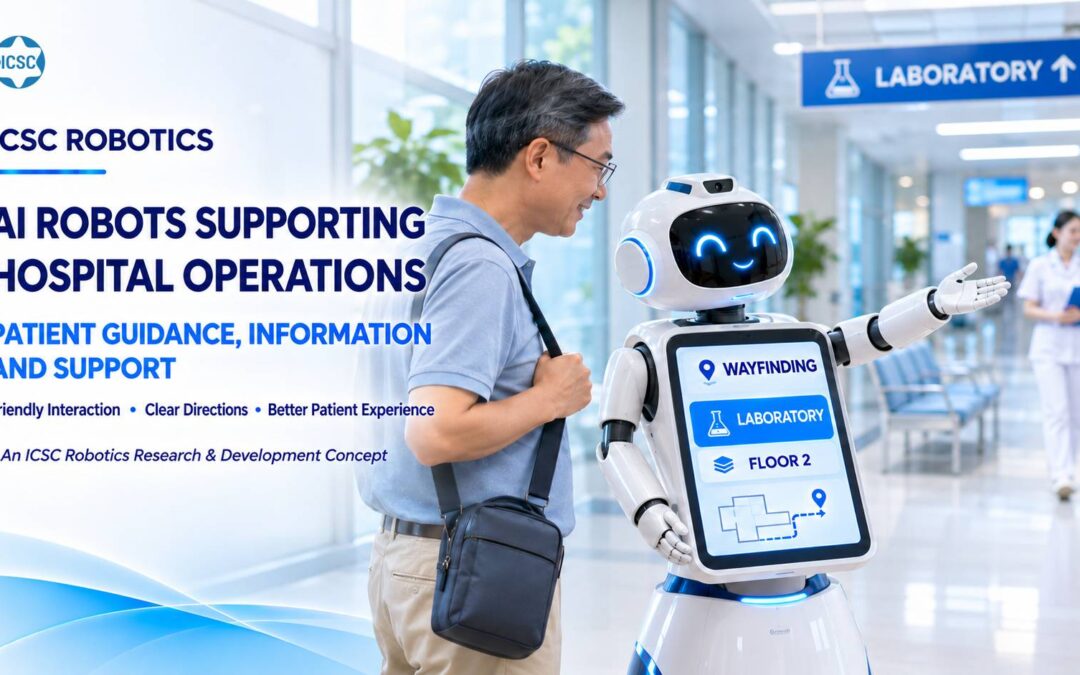
Enhancing Patient Experience, Supporting Operations, and Connecting Healthcare Services
ICSC Robotics Research and Development Direction
1. When Hospitals Need Additional Intelligent Assistants
Hospitals are highly active environments where many processes take place simultaneously: welcoming patients, providing directions, sharing information, coordinating services, and supporting daily activities. While medical teams need to focus on their professional responsibilities, patients and their families continue to need assistance throughout visits, treatment, and care.
As artificial intelligence and robotics advance, hospital assistance robots offer a new approach. Through voice interaction, environmental perception, movement within designated spaces, and integration with software systems, robots may handle certain support tasks that do not involve medical decision-making.
Robots do not replace doctors, nurses, or hospital staff. Their value lies in supporting appropriate tasks, providing consistent information, and helping improve the experience of patients and families as well as operational processes.
This is one of the robotics application areas that ICSC is researching and developing.
2. What Is an AI Hospital Assistance Robot?
An AI hospital assistance robot is a robotic system integrating artificial intelligence, voice interaction, sensors, cameras, and control software to support selected activities in healthcare facilities.
Depending on deployment objectives, a robot may be designed to guide patients, provide service information, assist with wayfinding, interact in reception areas, or transport supplies within authorized areas.
A hospital robotic system may combine the following technologies:
- AI and natural language processing: Receive questions, analyze requests, and generate responses according to controlled scenarios.
- Speech recognition and speech synthesis: Allow patients and family members to communicate with the robot verbally.
- AI Vision and cameras: Help recognize selected objects, signs, or environmental features within a defined scope.
- Sensors and navigation: Support obstacle detection, localization, and movement in suitable environments when the robot has mobility capabilities.
- Hospital software integration: Connect to hospital-authorized information systems or databases to retrieve service information, appointments, or process status.
- Hardware and control systems: Connect displays, microphones, speakers, cameras, sensors, processors, and motion mechanisms.
The specific configuration depends on each hospital’s use case, technology infrastructure, operating policies, and safety conditions.
3. Potential Applications of Robots in Hospitals
ICSC is exploring practical hospital assistance scenarios, prioritizing activities with clear procedures and well-defined system responsibilities.
3.1. Patient Reception and Guidance Robots
In hospital lobbies or reception areas, robots may be developed to greet visitors, provide initial information, and guide patients to the appropriate service area.
Potential interactions include:
- Introducing departments, clinics, testing areas, and other functional areas.
- Explaining examination registration procedures based on information provided by the hospital.
- Answering frequently asked questions about operating hours, waiting areas, or required documents.
- Directing patients to reception counters or responsible staff when further assistance is needed.
The robot must refer users to hospital staff when questions fall outside verified information or patients require direct assistance.
3.2. Hospital Wayfinding Robots
Hospitals often have multiple floors, examination areas, and functional zones. Finding the right location can take time for first-time visitors, older adults, or people with mobility difficulties.
Robots may be developed to provide step-by-step directions, display maps, or, when equipped with a suitable mobile platform, escort visitors to hospital-designated areas.
Actual navigation capabilities must be evaluated against maps, corridors, elevators, pedestrian traffic, restricted areas, and hospital safety procedures.
3.3. Information and Frequently Asked Questions
Patients and families often need information about visiting hours, ward regulations, queue-ticket procedures, service locations, or document preparation.
A robot may use a hospital-provided knowledge base to answer common questions, present information consistently, and reduce repetitive inquiries at reception desks.
Content must be approved, updated, and version-controlled by the hospital. Questions concerning diagnosis, treatment, medication, or an individual’s health must be referred to authorized healthcare professionals.
3.4. Patient Interaction and Emotional Well-Being Support
Waiting for examinations or staying in hospital may leave some patients feeling anxious, bored, or socially isolated. Robots may be explored as a way to provide gentle interaction, entertainment, and suitable content.
Possible scenarios include:
- Simple topic-based conversations within a defined scope.
- Playing appropriate entertainment, music, or stories.
- Helping patients access information about daily activities in the hospital.
- Supporting interactive activities in waiting areas or shared spaces.
Robots do not provide psychological therapy or replace support from healthcare staff, mental health professionals, or family members.
3.5. Internal Transport Assistance Robots
Another robotics application is assisting with the transport of selected supplies or goods within controlled areas, such as documents, everyday items, or non-hazardous materials authorized by the hospital.
Transport robots may be researched with localization, navigation, obstacle avoidance, command reception, and status notification capabilities. Transporting medication, biological samples, medical equipment, or specialized materials requires dedicated professional, safety, temperature-control, and handover procedures; not all goods are automatically suitable for robotic transport.
Before deployment, hospitals must define routes, operating zones, payload limits, pickup and delivery procedures, and incident-response mechanisms.
3.6. Appointment and Daily Activity Reminders
Within hospital-approved limits, robots may remind patients about appointments, scheduled movements to examination areas, or daily instructions set by responsible staff.
Reminders related to medication, treatment regimens, or post-procedure care must be based on instructions and data confirmed by healthcare professionals. Robots do not independently recommend treatments or alter professional guidance.
4. Where Could Hospital Robots Be Deployed?
4.1. Lobby and Reception Areas
Welcome visitors, provide initial information, direct patients to reception counters, and answer common questions.
4.2. Examination and Diagnostic Areas
Provide directions to consultation rooms, laboratories, or medical imaging departments using hospital-provided maps and procedures.
4.3. Waiting Areas and Shared Spaces
Provide information, entertainment, and gentle interaction appropriate to the rules of each area.
4.4. Logistics and Internal Operations Areas
Explore mobile robots to help transport authorized supplies or goods along defined routes.
4.5. Care and Rehabilitation Facilities
Explore interaction, informational guidance, and daily activity support scenarios within a scope approved by professional staff.
5. What Solutions Is ICSC Researching and Developing?
ICSC Robotics is researching AI robots for hospital assistance, focusing on combining artificial intelligence, voice interaction, AI Vision, navigation, and software integration.
Potential areas of research include:
- Hospital information assistant: Develop a question-and-answer system based on hospital-approved data and content.
- Vietnamese-language voice interaction: Research the ability to receive questions, process requests, and respond in clear spoken language.
- Guidance and navigation: Evaluate displaying directions or integrating mobile robotic platforms to assist with wayfinding.
- AI Vision and sensors: Research recognition of selected environmental features and support for movement within appropriate limits.
- System integration: Assess connections to hospital software, data, and operational workflows according to granted access rights.
- Content management and monitoring: Support scenario administration, information updates, operating-status monitoring, and technical incident logging.
These are research and development directions, not a list of commercialized features or functions guaranteed to be available on a particular robot model. Deployment scope will be determined through surveys, technical assessments, trials, and agreement with the hospital.
6. Important Principles for Developing Robots in Healthcare Environments
Hospitals have demanding safety, security, and professional accountability requirements. Robots must therefore be designed with clear limitations and participate only in evaluated and approved activities.
- No replacement for professional decisions: Robots do not diagnose, prescribe, modify treatments, or make medical conclusions on behalf of healthcare professionals.
- Patient data protection: Define what data is collected, its purposes, retention periods, access rights, and protective measures in accordance with hospital rules and applicable law.
- Response content control: Service and procedural information must come from official sources approved and updated by the hospital.
- Safe movement and operation: Evaluate collision avoidance, emergency stops, speed limits, routes, prohibited zones, and incident-handling procedures.
- Suitability for hospital environments: Consider noise, hygiene, disinfection, materials, power supply, and infection-control requirements.
- Human escalation mechanisms: In emergencies, medical questions, or out-of-scope requests, robots must direct users to responsible personnel.
- Supervised testing: Conduct trials within hospital-authorized boundaries before considering expansion.
7. Research, Testing, and Refinement Process
Developing robots suited to hospitals requires collaboration among technology providers, operations teams, and healthcare professionals. ICSC envisions the following phases:
Phase 1 – Needs assessment: Clarify intended areas of use, user groups, existing processes, and tasks that robots might support.
Phase 2 – Define requirements and limitations: Agree on functional scope, permitted data, safety requirements, operational responsibilities, and staff escalation procedures.
Phase 3 – Technology platform research: Evaluate robotic platforms, hardware, sensors, cameras, AI technologies, navigation, and software integration options.
Phase 4 – Scenario design and integration: Develop interaction flows, Q&A content, direction maps, or transport workflows; integrate components into a test configuration.
Phase 5 – Testing in a controlled environment: Evaluate stability, information accuracy, mobility, safety, and user experience within the approved scope.
Phase 6 – Evaluation and optimization: Gather hospital feedback, refine configurations and procedures, and only then consider scaling up.
8. ICSC Seeks Partnerships to Develop AI Robots for Hospitals
To ensure solutions fit real operational needs, ICSC seeks to collaborate with hospitals, healthcare facilities, specialists, and technology partners to identify challenges and evaluate potential applications.
ICSC is interested in collaborating with:
- Public and private hospitals.
- General and specialist clinics and medical centers.
- Care, rehabilitation, and elderly care facilities.
- Hospital management consulting and healthcare digital transformation organizations.
- Healthcare professionals, nurses, operations managers, and infection-control specialists.
- Technology, hardware, robotics, and system integration partners.
Potential collaborations include workflow assessments, identifying priority use cases, consulting on professional requirements, infrastructure evaluations, developing trial scenarios, and jointly assessing solutions under hospital-authorized conditions.
9. Conclusion: Robots Can Help Hospitals Operate More Smoothly
AI robots offer multiple potential support applications in hospitals, from reception, information provision, and wayfinding to patient interaction and selected internal logistics activities.
However, a valuable solution is not defined solely by a robot’s ability to speak or move. What matters is selecting the right tasks, defining responsibilities, meeting safety requirements, and integrating with existing hospital workflows.
Through its AI robotics research and development efforts, ICSC seeks to collaborate with healthcare facilities and professional partners to gradually develop suitable, safe, and practical assistance solutions.
ICSC ROBOTICS – RESEARCH AND DEVELOPMENT OF AI ROBOTS FOR HEALTHCARE ENVIRONMENTS.
Is your hospital interested in AI robots for reception, guidance, or operational assistance?
Connect with ICSC to discuss your needs, assess use cases, and explore opportunities to collaborate on researching and developing suitable robotics solutions.
Website: https://icsc.vn/robotics
ICSC Corporation – AI & Robotic Solutions
SEO – GEO – AIO INFORMATION
| SEO Title | AI Robots for Hospital Assistance – ICSC Robotics Research Direction |
| Meta Description | ICSC is researching AI robots to assist hospitals with reception, patient guidance, information provision, interaction, and internal operations. |
| URL Slug | ai-robots-for-hospital-assistance |
| Primary Keyword | AI robots in hospitals |
| Secondary Keywords | hospital assistance robots, patient guidance robots, hospital reception robots, hospital transport robots, AI in healthcare, ICSC Robotics |
| Search Intent | Explore solutions, technologies, and collaboration opportunities for developing hospital assistance robots |
FAQ – Frequently Asked Questions
What can AI robots do in hospitals?
Depending on their configuration, robots may be researched for reception, patient guidance, information provision, interaction support, or transport of certain supplies in authorized areas.
Can robots advise on illnesses or recommend treatments?
Robots do not replace doctors and do not independently diagnose, prescribe, or modify treatments. Medical questions must be referred to authorized healthcare professionals.
Can robots guide patients to examination rooms?
This is a potential research application using directional maps or mobile robotic platforms, provided technical and safety conditions are met.
Can robots transport medications or biological samples?
Only when the hospital’s professional, control, safety, storage, and handover requirements are met. Not all supplies are suitable for robotic transport.
Has ICSC commercialized hospital robots?
ICSC is currently researching and developing this solution direction. Configurations, features, and deployment scope will be determined through surveys, technical research, and testing.
How is patient data protected? The solution must clearly define collected data, processing purposes, retention periods, access rights, and protective mechanisms in accordance with hospital requirements and applicable regulations.