

An AI solution developed and provided by ICSC under the CIAXI brand
In cosmetics manufacturing, product quality is assessed not only by ingredients or the formulation inside. The external appearance of finished products—from bottles, jars, caps, and labels to packaging—also directly influences customer perceptions and brand image.
On high-output production lines, relying entirely on visual inspection places considerable pressure on quality inspectors. Minor defects such as scratches, dents, contamination, misaligned labels, missing caps, or incorrect printed information may go unnoticed, particularly when products move continuously at high speed.
ICSC develops technology solutions to help businesses address manufacturing quality-control challenges. CIAXI is ICSC’s technology solutions brand. Within this portfolio, CIAXI Vision applies AI Vision (computer vision) to analyze product images and support the detection and classification of visible appearance defects on production lines.
The solution aims to add an AI-powered inspection layer to the quality-control process, helping businesses identify abnormalities more consistently, support quality-control personnel, and gradually automate finished-product inspection.
1. The Challenge of Appearance Inspection in Cosmetics Manufacturing
Cosmetics are produced and packaged in a wide variety of product lines, volumes, packaging shapes, and design versions. A production line may handle serum bottles, cream jars, skincare tubes, shampoo bottles, lipsticks, cartons, or many other packaging types.
In this environment, appearance inspection must ensure that products meet visual quality standards before being packed into shipping cartons or leaving the factory. Common challenges include:
- High output and fast production lines: Inspectors must continuously observe numerous products within a short period, which can cause eye strain and reduced concentration.
- Small defects that are difficult to detect: Fine scratches, stains, black spots, slight deformation, or minor surface deviations may be difficult to identify with the naked eye.
- Multiple defect types and standards: Each product line has its own requirements for packaging, labels, colors, print placement, and acceptable defect levels.
- Inconsistent inspection: Assessment results may vary between employees, shifts, or production periods.
- Difficulty with traceability and root-cause analysis: When defects are found after packaging or reported by the market, businesses need data to identify the production stage at which they arose.
Businesses therefore need an inspection approach capable of continuous observation, comparison against established standards, and recording results to support quality control.
2. CIAXI Vision – Applying AI to Product Appearance Inspection
CIAXI Vision is a solution under ICSC’s CIAXI brand that uses computer vision and AI image-processing models to analyze product surfaces, shapes, and visual characteristics.
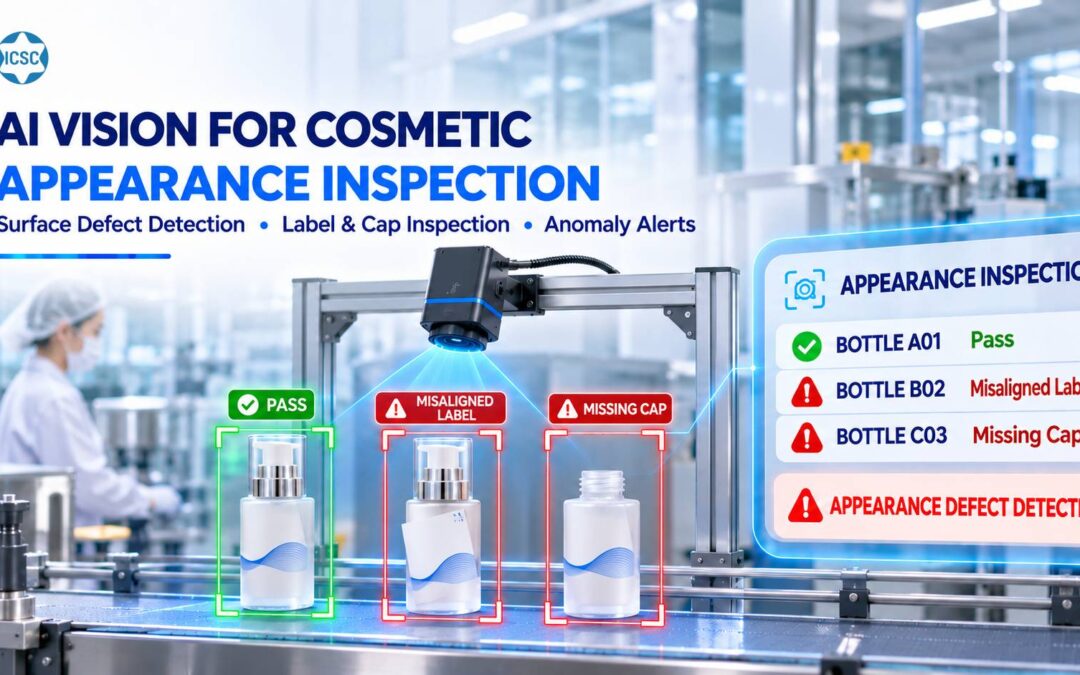
Cameras are positioned at suitable locations along the production line to capture images. The system processes the images, identifies products, and evaluates signs of abnormalities against criteria established for each product category.
Depending on the plant’s characteristics and inspection requirements, the solution can be studied and configured to support inspection of:
- Bottles, containers, jars, and tubes: Scratches, cracks, dents, deformation, stains, or visible foreign matter on surfaces.
- Caps and packaging components: Missing caps, incorrect cap types, misalignment, or unusual assembly conditions visible from the camera angle.
- Labels and printed information: Misaligned, wrinkled, peeling, or missing labels, incorrect positioning, or printing defects detectable from images.
- Packaging and cartons: Dents, tears, dirt, incorrect appearance, or differences from reference samples.
- External consistency: Significant differences in color or appearance compared with reference samples under suitable lighting and camera settings.
The specific detection scope must be determined based on product samples, defect types, the minimum defect size to be identified, and actual imaging conditions. Not every quality defect or internal product defect can be assessed using conventional cameras alone.
3. How the System Works
Step 1: Survey the production line and define inspection criteria. ICSC works with the business to identify inspection points, product types, line speed, defect categories, and pass/fail classification standards. This provides the basis for selecting appropriate cameras, lighting, viewing angles, and processing methods.
Step 2: Capture product images. Industrial or other suitable cameras are installed at inspection points to capture images as products pass through the observation area. Depending on product shape, multiple camera angles may be required to inspect different sides or details.
Step 3: AI analysis and anomaly detection. The system processes images to locate product regions, extract features, and compare them against predefined criteria or reference data. AI supports the identification of scratches, stains, deformation, label misalignment, or packaging anomalies within the scope for which it has been trained and tested.
Step 4: Classify results and issue alerts. Based on the analysis, the system supports classifying products as pass, suspect, or fail according to the deployment rules. Results can be displayed on a monitoring interface for inspectors to review and handle.
Step 5: Record data and enable traceability. Depending on configuration, the system can store images, inspection timestamps, defect types, and classification results. This data supports tracing anomalies, compiling defect statistics, and analyzing quality by shift or production batch.
4. Core Technology Capabilities
4.1. Surface Defect and Appearance Flaw Detection
AI Vision analyzes product surface images to identify deviations from established standards. Depending on the packaging type, the system can be configured to inspect scratches, stains, unusual color spots, cracks, dents, or deformation. Small, low-contrast defects or those on reflective surfaces require testing to determine suitable resolution, lighting angles, and image-capture methods.
4.2. Label Placement and Printed Information Inspection
The system can help determine whether labels are present in the correct position, orientation, and reference appearance, while detecting abnormalities such as wrinkled, misaligned, or missing labels and visible printing defects. If character content, batch codes, or expiration dates must be verified, OCR and data-comparison rules may be considered.
4.3. Cap and Packaging Component Inspection
Using images captured from suitable viewing angles, AI can help detect missing caps, incorrect cap styles, misaligned caps, or certain unusual assembly conditions. Criteria involving tightness, tightening torque, or seal integrity require specialized equipment and inspection methods and cannot be determined from ordinary images alone.
4.4. Product Classification and Anomaly Alerts
Following analysis, the system supports classifying results according to agreed quality criteria. Suspect cases may be referred to staff for verification, while clear defects may trigger alerts on the interface. Integration with an automatic product-rejection mechanism, if required, must be separately designed and connected to suitable control equipment.
4.5. Inspection Image and Data Storage
Each inspection result can be associated with an image, timestamp, product code, or batch information if the input data is available. This provides a basis for reviewing defects, compiling statistics on common defect categories, and helping QA/QC teams assess quality over time.
5. AI Vision Solution Demonstration
In this section, businesses can view a demonstration video or simulation of the AI Vision appearance-inspection process. The video should clearly show products passing the camera, defect areas identified by the system, classification results, and the alert interface.
[INSERT CIAXI VISION DEMO VIDEO LINK HERE]
Suggested video content: scratch inspection – misaligned label detection – missing cap identification – inspection result recording.
6. Benefits for Cosmetics Manufacturing Plants
- Improved appearance defect detection: Adds an image-based inspection layer to the production line to help identify anomalies according to established criteria.
- Standardized quality inspection: Reduces complete reliance on manual observation and helps create more consistent evaluation processes across shifts and inspection points.
- Support for QA/QC personnel: Enables staff to focus on suspect cases, defect verification, and root-cause handling instead of repeatedly observing every product.
- Data for quality analysis: Images and inspection results help businesses monitor common defect categories, occurrence times, and quality trends by batch or shift when linked data is available.
- Gradual production-line automation: Provides a foundation for connecting inspection results to manufacturing management systems, quality dashboards, or suitable product-sorting mechanisms.
7. Factors to Evaluate Before Deployment
The effectiveness of an AI Vision system depends heavily on product characteristics and operating conditions. In cosmetics plants, packaging surfaces may be glossy, transparent, curved, or reflective, while some defects are extremely small and have low contrast. Surveys and testing are therefore necessary before determining the deployment configuration.
- Product and packaging characteristics: Glass, plastic, metal, and paper materials; shape, color, gloss, and transparency.
- Defects to be detected: Defect names, minimum sizes, typical locations, and severity levels under QA/QC standards.
- Cameras and lighting: Resolution, capture speed, viewing angles, distance, ambient lighting, and dedicated illumination solutions.
- Production-line speed and mechanics: Product movement speed, spacing between products, vibration, and feasibility of installing inspection stations.
- Sample data and evaluation standards: Acceptable samples, representative defective samples, and consistent rules agreed upon by production, QA/QC, and the implementation provider.
- Integration and storage: Ability to connect product-code and batch-code data, MES/ERP systems, or dashboards; image-retention and retrieval-time requirements.
During pilot testing, metrics such as correct defect detection rate, missed-defect rate, false-alarm rate, and processing time per product should be evaluated. These metrics should be measured using representative samples and operating conditions before performance commitments are made.
8. Future Expansion: From Appearance Inspection to Intelligent Quality Management
When appropriately deployed, AI Vision can become part of a plant’s overall quality-control system. Beyond packaging appearance inspection, businesses may explore expansion into label and printed-code verification, checking the presence of packaging components, monitoring production-line operations, or analyzing defect trends.
Connecting inspection data with manufacturing management systems allows businesses not only to detect abnormal products but also to gain additional insights into quality by production stage, batch, or work shift. The scope of expansion should be defined based on actual requirements and the plant’s integration capabilities.
9. ICSC – Developing Technology Solutions Under the CIAXI Brand
ICSC develops and provides technology solutions focused on applying AI, automation, and system integration to business management, commercial activities, and operations.
CIAXI is ICSC’s technology solutions brand, focused on applying AI to real-world challenges. Within this ecosystem, CIAXI Vision specializes in computer vision, helping businesses analyze images, detect anomalies, and strengthen process control.
For appearance inspection in cosmetics manufacturing plants, ICSC’s approach begins with surveying the process, defining quality criteria, selecting camera, lighting, and AI-processing configurations, and testing with actual products. The goal is to build a solution tailored to each production line rather than applying one generic recognition model to every product type.
ICSC – Developing technology solutions, enabling intelligent operations.
CIAXI – ICSC’s AI solutions brand.
Contact ICSC to Discuss Your AI Vision Requirements
If your plant needs to improve appearance inspection, detect packaging defects, or standardize production-line quality inspection, ICSC is ready to discuss your requirements, survey the process, and propose a CIAXI Vision solution suited to your products and manufacturing conditions.