

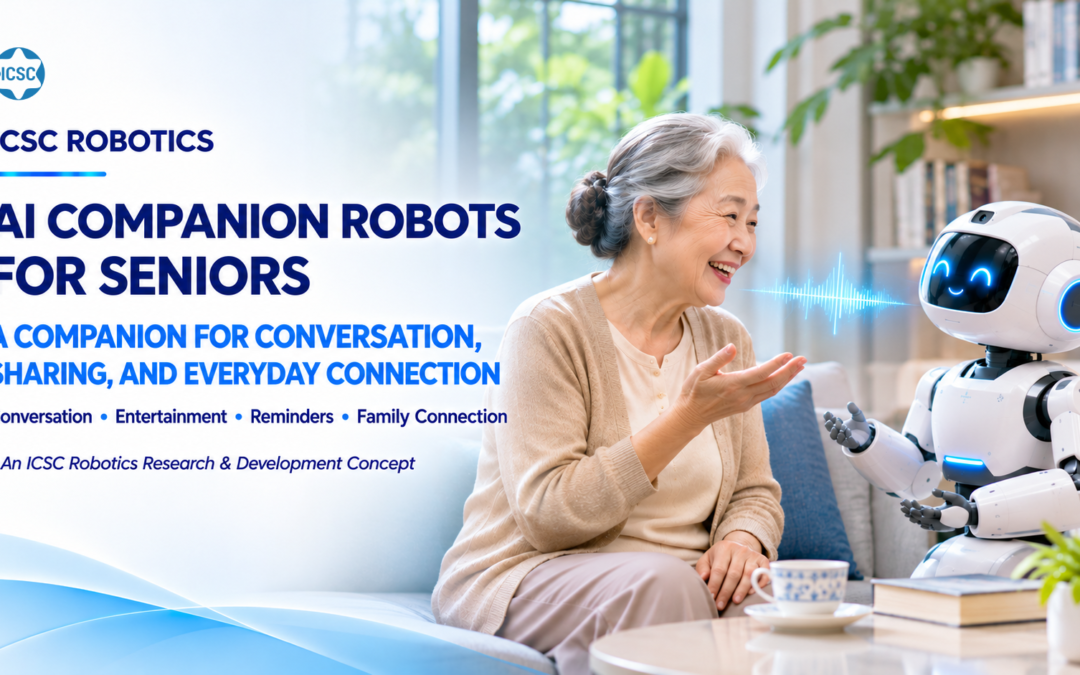
A companion for conversation, sharing, and connection every day
ICSC Robotics’ research and solution development direction
1. When Seniors Need Someone to Talk To
Growing older often brings changes to daily routines. Children are busy with work, family members cannot always be present, and opportunities for everyday conversation and social interaction may gradually decrease. For some older adults, what they need is not necessarily a complex device, but simply someone to listen, check in, and share everyday stories with.
In this context, AI companion robots offer a new approach. Through voice communication, context retention within defined parameters, and responses based on appropriate conversational scenarios, robots may create additional opportunities for conversation, entertainment, and connection for seniors.
Robots cannot replace the affection, care, and presence of loved ones. However, when designed for the right purpose, they can serve as supportive tools that offer older adults more opportunities for interaction throughout the day.
This is one of the Robotics applications ICSC is currently researching and developing.
2. What Is an AI Companion Robot for Seniors?
An AI companion robot for seniors is a robotic system integrating artificial intelligence and voice interaction technologies, intended to support conversation, provide information and entertainment, and offer reminders for daily activities according to its designed configuration.
Unlike a device that merely plays prerecorded content, an interactive robot can receive speech, analyze its meaning, and respond in context. Depending on the hardware platform and development scope, it may use speakers, microphones, screens, cameras, or sensors to create a more approachable communication experience.
Such a system may include the following technology components:
- Speech Recognition: Captures users’ speech and converts it into data for system processing.
- Natural Language Processing: Analyzes content, topics, and communication intent to select suitable responses.
- AI Conversational Model: Helps sustain conversations, answer questions, and suggest topics within controlled boundaries.
- Text-to-Speech: Converts responses into spoken language to enable more natural conversations.
- Context Management and Customization: Supports configuring forms of address, preferences, and topics of interest within the scope of data authorized by the user.
- Hardware and Control System: Connects microphones, speakers, displays, sensors, and the robotic platform to operate interactive functions.
The actual configuration depends on user needs, the deployment environment, and the feasibility research results for each solution.
3. Potential Interactive Capabilities
ICSC is exploring robots that do more than answer questions: they could also create topic-based, familiar conversations suited to the habits of seniors. Potential functional areas include:
3.1. Conversation and Attentive Listening
Older adults could start conversations with simple phrases, talk about their day, recall memories, or share matters on their minds. The robot could respond verbally, ask open-ended questions, and maintain the flow of conversation within appropriate boundaries.
For example, the robot might ask, “Did you go for a walk today?” or “Would you like to hear a story or talk about your hometown?” The goal is to create a friendly, pressure-free interaction that users can end at any time.
3.2. Suggesting Topics and Conversations Based on Interests
Not everyone finds it easy to start a conversation. A robot could be configured to suggest familiar topics such as family, hometowns, food, music, weather, gardening, sports, or memories from the past.
Content and forms of address could be adapted to preferences set by users or their loved ones. Personalization must be transparent, consent-based, and allow users to change or delete stored information.
3.3. Storytelling, News, and Entertainment
The robot could play short stories, poems, folktales, quizzes, audio programs, or other suitable entertainment. Users could ask it to repeat a story, change the topic, or answer questions about what they have just heard.
For seniors with limited vision or little familiarity with screens, voice interaction could make content more accessible. Information sources and playback content should be appropriately selected, reviewed, and updated.
3.4. Reminders for Everyday Activities
Depending on configuration and user consent, the robot could be researched for reminders about daily routines, appointments, light physical activity, or tasks to remember throughout the day.
Examples include reminders to drink water, call family members, attend follow-up medical appointments scheduled by the family, or stand up and move gently. Reminders relating to medication and healthcare must be based on information confirmed by the user or caregiver; the robot must not independently provide medical instructions.
3.5. Supporting Connections with Loved Ones
One potential development direction is to help seniors connect with loved ones through simple voice commands, such as requesting a call to a predefined contact or playing a received message.
This function requires confirmation mechanisms before placing calls or sharing information and must connect only to contacts and accounts authorized by the user.
3.6. Simple, Accessible Communication
Experiences designed for seniors should prioritize simplicity: easy-to-remember commands, clear speech, adjustable volume, and minimal need for complex operations.
Research could explore functions that repeat answers, speak more slowly, request clarification when speech is not heard clearly, and guide users step by step. These features are particularly important in noisy environments or for users unfamiliar with technology.
4. Where Could Companion Robots Be Used?
4.1. At Home
At home, a robot could serve as a supplementary interactive device, giving seniors more opportunities to converse, listen to stories, or receive reminders based on daily routines. Family members could help configure basic content and explain how to use the device.
4.2. In Nursing Homes and Care Facilities
In senior care facilities, robots could be researched to support communication, entertainment, and individual or group activities. Care staff would remain responsible for deciding how robots are used and assessing the suitability of activities.
4.3. At Community Activity Centers
Robots could be used to facilitate interactive activities such as quizzes, storytelling, music listening, or themed conversations. These activities should reflect participants’ cultures, preferences, and ability to access technology.
4.4. In Home Care Service Models
Home care providers may consider robots as supplementary tools for communication and scheduling reminders. Deployment must clearly define the care provider’s responsibilities, users’ control over the system, and procedures for situations beyond the robot’s capabilities.
5. What Solution Direction Is ICSC Researching and Developing?
ICSC Robotics is researching AI companion robot solutions for seniors, focusing on natural communication, ease of use, and suitable daily-life support functions.
Potential areas of research include:
- Vietnamese-Language Conversational Assistant: Researching the ability to understand and respond to speech using familiar, accessible language.
- Topic-Based Conversation Scenarios: Developing conversation topics, open-ended questions, and entertainment content suitable for seniors.
- Personalized Experiences: Exploring the configuration of forms of address, preferences, and topics of interest according to user choices.
- Scheduling and Daily Activity Information: Researching reminders for activities configured by users or their loved ones.
- Connecting with Loved Ones: Exploring support for calls or message forwarding with confirmation and permission controls.
- Accessible Interfaces and Interactions: Optimizing audio, responses, commands, and operations to better accommodate older adults.
These are research and development directions, not a list of commercialized features or functions guaranteed to be available on any specific robot model. Functional scope will be determined through needs assessments, technical research, testing, and evaluation.
6. Important Principles for Developing Robots for Seniors
A companion robot must be designed with respect for its users. For seniors in particular, design should consider accessibility, privacy, reliability, and the limitations of AI.
- Respect for Autonomy: Users should know when the robot is listening, be able to start or end interactions themselves, and have the right to switch the device off.
- Personal Data Protection: Clearly explain what data is collected, why it is processed, how long it is stored, who can access it, and how users can request deletion.
- Transparency About AI: The robot must be clearly presented as an AI system, not impersonate a human or lead users to believe it has emotions or a presence equivalent to a loved one.
- Bounded Responses: When questions exceed its capabilities, the robot should acknowledge its limitations and direct users to appropriate family members or professionals.
- No Replacement for Human Care: The robot is only a supplementary tool and does not replace personal visits, direct care, social support, or healthcare services.
- Safety in Use: Consider device stability, power cables, volume, materials, placement, and users’ ability to operate the robot.
- Support When Needed: Emergency situations, unusual health symptoms, or safety risks require guidance on contacting loved ones, caregivers, or emergency services; the robot must not be relied upon as the sole emergency response system.
7. Research, Testing, and Refinement Process
Developing a solution suitable for seniors requires combining user research, input from care providers, and technical evaluation. ICSC envisions a phased approach:
Phase 1 – Needs Assessment: Understand habits, interests, device-use abilities, living environments, and communication situations where users would like support.
Phase 2 – Scope and Requirements Definition: Clarify priority functions, robot limitations, privacy requirements, and the roles of family members or care providers.
Phase 3 – Technology Platform Research: Evaluate robotic platforms, microphones, speakers, hardware, conversational models, and appropriate data-processing approaches.
Phase 4 – Scenario Design and Integration: Develop conversation content, reminders, and interaction flows; integrate software and hardware components according to the test configuration.
Phase 5 – User Testing: Evaluate speech understanding, voice clarity, ease of use, stability, and content suitability under supervised conditions.
Phase 6 – Optimization and Application Planning: Make adjustments based on feedback from seniors, families, care staff, and professional partners before considering broader deployment.
8. ICSC Seeks Collaboration Opportunities to Develop AI Companion Robots
Companion robots for seniors require a combination of technology and an understanding of care needs. ICSC seeks to connect with organizations and experts to jointly assess challenges, refine scenarios, and identify suitable testing opportunities.
ICSC is interested in collaborating with:
- Nursing homes, care centers, and senior activity facilities.
- Home care service providers.
- Experts in geriatrics, social work, and senior care.
- Organizations researching AI, robotics, electronics, and hardware development.
- Technology companies and partners interested in developing products to support seniors.
Potential collaboration may include assessing real-world needs, providing specialist advice, developing conversation scenarios, evaluating user experience, researching device platforms, and coordinating trials when the necessary conditions are met.
9. Conclusion: Technology Can Create More Opportunities for Connection
For seniors, a friendly conversation, a timely reminder, or a favorite entertainment program can enrich everyday life. AI companion robots offer the possibility of creating more such interactions through voice technologies and artificial intelligence.
However, the value of these robots lies not in replacing people, but in offering support during times when loved ones cannot be present, helping seniors access interactive activities more conveniently and independently.
Through its AI Robotics research and development direction, ICSC hopes to collaborate with families, care facilities, experts, and technology partners to gradually build solutions that are suitable, safe, and respectful of users.
ICSC ROBOTICS – COMPANION TECHNOLOGY, CONNECTING GENERATIONS.
Interested in applications of AI robots for senior care and companionship?
Connect with ICSC to discuss your needs, share professional insights, and explore opportunities to collaborate on solution research and development.
Website: https://icsc.vn/robotics
ICSC Corporation – AI & Robotic Solutions
SEO – GEO – AIO INFORMATION
| SEO Title | AI Companion Robots for Seniors – ICSC Research Direction |
| Meta Description | ICSC is researching AI companion robots for seniors to support conversation, entertainment, reminders, and connections with loved ones through voice interaction and artificial intelligence. |
| URL Slug | ai-companion-robots-for-seniors |
| Primary Keyword | AI companion robots for seniors |
| Secondary Keywords | robots that talk with seniors, companion robots for older adults, senior care robots, AI companion robot, daily living assistance robots, ICSC Robotics |
| Search Intent | Learn about companion robot solutions, technologies, and collaboration opportunities for developing robots for seniors |
FAQ – Frequently Asked Questions
What is an AI companion robot for seniors?
It is a robotic system integrating AI and voice interaction, being researched to support conversation, entertainment, activity reminders, and connections with loved ones according to its designed configuration.
Can the robot converse with seniors in Vietnamese?
This is a potential capability for research and development. Interaction quality depends on speech recognition, language processing, speech synthesis, and environmental conditions.
Can robots replace children, grandchildren, or caregivers?
No. Robots are only tools to support interaction and certain daily activities. They do not replace affection, direct care, or the responsibilities of family members and care staff.
Can the robot provide medication reminders or monitor health?
Reminder functions configured by users or caregivers may be researched. The robot does not independently provide medical instructions or diagnoses, nor does it replace medical equipment or healthcare professionals.
Has ICSC commercialized its companion robot?
ICSC is currently researching and developing this solution direction. Configurations, features, and deployment scope will be determined through needs assessments, technical research, and testing.
How is seniors’ conversational information protected? The solution must clearly define the data collected, its intended uses, retention periods, access permissions, and consent mechanisms. The scope of data processing depends on the design and deployment approach.