

When Technology Becomes a Companion in Learning and Discovery
ICSC Robotics’ Research and Development Direction
1. When Children Gain an Interactive Companion Through Technology
Young children learn about the world by observing, playing, asking questions, and interacting with people around them. Every conversation, object-naming game, or story can become an opportunity for children to explore, develop language, and build communication skills.
With advances in artificial intelligence (AI), robots are opening up a new approach to interactive activities for children. Instead of simply receiving content through a screen, children can communicate with a device physically present in their environment, hear spoken responses, observe expressions or movements, and take part in themed activities.
Interactive AI robots for children combine robotics, speech recognition, natural language processing, AI Vision, and educational content design. The goal is not to replace the involvement of parents or teachers, but to provide an additional tool to support interaction, learning, and exploration in different settings.
This is also one of the research and development directions being explored by ICSC Robotics.
2. What Are Interactive AI Robots for Children?
Interactive AI robots for children are robotic systems that integrate artificial intelligence and communication technologies to receive signals from children, analyze the interaction, and provide appropriate responses based on designed scenarios.
Depending on the hardware platform and intended purpose, a robot may interact through speech, sound, images, movement, or simple games. The system can be designed for different age groups, learning topics, and the needs of the implementing organization.
Such a system typically includes the following components:
- Speech Recognition: Captures children’s speech or answers and converts them into data for processing.
- Natural Language Processing: Analyzes content, identifies intent or keywords, and selects context-appropriate responses.
- Text-to-Speech: Converts response text into audio so the robot can communicate with children.
- AI Vision: Supports processing of camera images in scenarios requiring recognition of objects, picture cards, or visual cues.
- Robot Hardware and Control System: Manages speakers, microphones, displays, sensors, and installed interactive mechanisms.
- Content and Management Platform: Manages topics, interaction scenarios, activity settings, and usage information within authorized limits.
The specific components will depend on the requirements, selected equipment, and feasibility findings for each solution.
3. Potential Interactive Capabilities to Develop
Rather than building a robot that merely answers questions, ICSC aims to research purposeful interaction scenarios that encourage children to participate actively and create engaging, approachable experiences.
3.1. Themed Conversations and Questions and Answers
The robot could be designed to talk with children using short, easy-to-understand questions about familiar topics such as family, school, toys, animals, transportation, and daily activities.
For example, the robot might ask, “Which animal says meow?”, “What game would you like to play today?”, or “Can you name a fruit you know?” After receiving an answer, the system responds according to an appropriate scenario and prompts further interaction to keep the conversation going.
3.2. Supporting Language Development and Vocabulary
Language develops through listening, understanding, imitation, practice, and using words in meaningful situations. AI robots can be explored as tools for creating additional opportunities to practice through short, repeated activities.
Potential scenarios include:
- Naming objects, animals, colors, shapes, and familiar things.
- Listening to example words and encouraging children to repeat them according to their abilities.
- Combining words into phrases or short sentences based on a topic.
- Asking open-ended questions that encourage children to express needs, make choices, or describe objects.
- Interactive storytelling, pausing at suitable moments for children to answer or complete sentences.
- Reviewing vocabulary through image- and sound-recognition games.
For children with speech delays or those who need more opportunities to practice communication, content can be designed around goals identified by parents, teachers, or relevant specialists. The robot does not independently diagnose conditions and does not replace professional assessment or intervention.
3.3. Learning Through Games and Exploration
Games help children maintain attention and participate actively. Robots can combine sounds, images, and questions to organize activities such as guessing animals, finding colors, recognizing shapes, sorting objects, or solving simple puzzles.
Activities can be divided into short rounds with clear guidance and positive feedback. Difficulty, duration, and topics should be adjusted to suit each child’s age and ability to engage.
3.4. Storytelling and Developing Imagination
A robot can tell short stories, ask questions about characters or situations, encourage children to predict what happens next, and invite them to retell the story in their own words.
This direction may support listening comprehension, expression, sequencing memory, and creativity. Content must be selected to suit the age group and avoid frightening or inappropriate information.
3.5. Visual Recognition and Interaction With the Environment
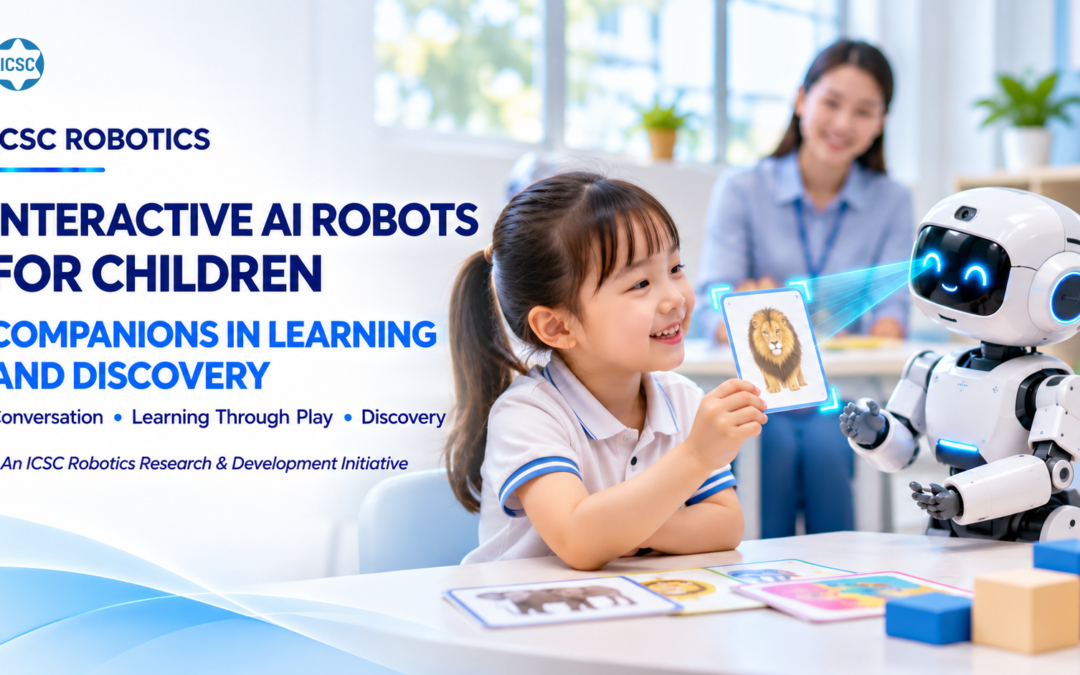
In suitable scenarios, AI Vision could be explored to help robots recognize selected images or objects used in activities, such as learning cards, illustrations, or familiar objects.
For example, a child could hold a picture card in front of the camera, and the robot could respond with its name, a related sound, or a question. Actual capabilities will depend on the camera, lighting conditions, recognition model, and scope of the designed dataset.
3.6. Interactions Tailored to Each Child’s Content and Ability Level
Children do not all share the same interests, vocabulary, or learning pace. An important research direction is therefore to develop content configurable by age, topic, duration, and activity objectives.
Personalization must remain within the scope of data permitted by parents or the managing organization. Adjustments should be supervised by adults, especially when robots are used in educational or child-development support settings.
4. Where Could Interactive AI Robots Be Used?
4.1. At Home – Supporting Interactive Activities
At home, robots could be explored as devices that support short activities such as themed conversations, storytelling, vocabulary recognition, and educational games. Parents can select content and participate alongside their children.
4.2. Preschools and Educational Institutions
In preschools, robots could help teachers organize small-group activities, introduce topics, ask questions, or create interactive situations. Their use should align with the educational plan and take place under teacher guidance.
4.3. Skills Development and Special Education Centers
Centers may be interested in robots as supplementary tools for communication practice, recognition, and interaction using scenarios developed by their specialists. Content must be agreed upon with the responsible professionals; robots do not replace assessment tools or specialized intervention methods.
4.4. STEM and Technology Experience Centers
Robots could also provide hands-on experiences that introduce children to AI, sensors, programming, and the principles of robotics. Children can engage in interactions while learning age-appropriate technology concepts.
5. What Solutions Is ICSC Researching and Developing?
ICSC Robotics is researching and developing interactive AI robot solutions for children, focusing on combining robotic platforms, artificial intelligence, and interactive content suited to different usage contexts.
Research may focus on the following capability areas:
- Voice Interaction Platform: Researching the process of capturing speech, processing content, and delivering spoken responses.
- Themed Conversational Assistant: Developing bounded conversation scenarios suited to age groups and activity objectives.
- Educational and Practice Content: Developing themed sets, games, stories, and activities that support vocabulary, listening comprehension, and expression.
- AI Vision Integration: Exploring the recognition of picture cards, objects, or visual elements in interactive scenarios.
- Content Customization and Management: Researching ways for parents or educational institutions to select topics, set durations, and control content.
- Usage Activity Tracking: Considering ways to record durations, topics, and practice activities at an appropriate level, transparently and with consent.
These are research and development directions, not a list of commercialized features or capabilities guaranteed to be available on a particular robot model. The configuration and functional scope will be determined through research, testing, and feasibility assessment.
6. Important Principles When Developing Interactive Robots for Children
When designing technology for children, an engaging experience is not the only consideration. Safety, privacy, appropriate content, and adult supervision must be considered from the design stage.
- Physical Interaction Safety: Hardware design and selection must consider materials, sharp edges, small parts, temperature, volume, and device movements.
- Age-Appropriate Content: Limit topics, wording, and responses; avoid frightening, biased, or otherwise unsuitable content.
- Children’s Privacy and Data: Clearly define what data is collected, why it is used, how long it is retained, who can access it, and how it can be deleted. Audio or video recording and information storage require appropriate notice and consent mechanisms.
- Adult Supervision: The robot is a supporting tool. Parents, teachers, or responsible adults should determine when, how, and in what context it is used.
- Limits of AI’s Role: Robot responses must not be treated as professional conclusions about a child’s health, psychology, or development.
- Testing Before Deployment: Evaluate recognition of children’s speech, content suitability, device stability, and real-world usage scenarios.
7. Research, Testing, and Refinement Process
Turning an interactive robot concept into a practical application requires defining requirements and validating each step. ICSC envisages the following stages:
Stage 1 – Define the Problem and User Groups: Clarify age ranges, usage environments, interaction needs, activity objectives, and the roles of parents or teachers.
Stage 2 – Research Platforms and Feasibility: Evaluate robotic platforms, hardware, microphones, speakers, cameras, sensors, and suitable AI technologies.
Stage 3 – Design Interaction Scenarios: Develop topics, conversation flows, games, and response principles suited to the age group and intended objectives.
Stage 4 – Integration and Experimental Development: Connect hardware and software, integrate AI functions, and implement the defined test scenarios.
Stage 5 – Evaluation and Optimization: Assess stability, ease of use, interaction quality, content suitability, and safety and privacy requirements.
Stage 6 – Explore Application Opportunities: Work with parents, educational institutions, or specialist partners to identify testing conditions and directions for refinement.
8. ICSC Seeks Collaboration Opportunities in AI Robotics for Children
To ensure that its research addresses real-world needs, ICSC seeks to connect with educational institutions, specialists, and partners experienced in child development.
ICSC is interested in collaborating with:
- Preschools, education networks, and STEM centers.
- Skills development, special education, and early intervention centers.
- Early childhood education, educational psychology, and speech-language therapy specialists.
- AI, robotics, electronics, and hardware research organizations.
- Parents and organizations interested in technology tools that support children’s learning activities.
Potential collaboration may include sharing needs, providing expert advice on interactive content, evaluating usage scenarios, researching device platforms, and coordinating trials when the necessary conditions are met.
The involvement of education and child-development specialists is important to ensure that interactions are purposeful, appropriate, and respectful of children’s developmental characteristics.
9. Conclusion: Technology as a Companion, Not a Replacement for Human Connection
Interactive AI robots for children represent a promising application of Physical AI, bringing artificial intelligence into real-world environments to create more tangible communication and learning experiences.
From themed conversations, storytelling, and recognition games to language-development support activities, robots may offer children more opportunities to explore and practice. However, the value of a solution lies not in how long a robot can talk, but in whether its content is appropriate, safe, and aligned with the intended objectives.
Through its AI robotics research and development direction, ICSC aims to collaborate with educational institutions, specialists, and technology partners to gradually refine practical interactive solutions that place children’s needs and safety at the center.
ICSC ROBOTICS – RESEARCHING AND DEVELOPING AI ROBOTS FOR MEANINGFUL INTERACTIONS.
Are you interested in using AI robots in education and interactive activities for children?
Connect with ICSC to discuss your needs, share professional insights, and explore opportunities to collaborate on solution research and development.
Website: https://icsc.vn/robotics
ICSC Corporation – AI & Robotic Solutions
SEO – GEO – AIO INFORMATION
| SEO Title | Interactive AI Robots for Children: ICSC Robotics’ Research Direction |
| Meta Description | ICSC is researching and developing interactive AI robot solutions for children, combining voice interaction, AI Vision, and educational content to support learning, communication, and exploration. |
| URL Slug | interactive-ai-robots-for-children |
| Primary Keyword | Interactive AI robots for children |
| Secondary Keywords | educational robots, interactive robots for children, language-development support robots, robots for children with speech delays, AI in early childhood education, ICSC Robotics |
| Search Intent | Learn about the technology, research direction, and collaboration opportunities for developing interactive robots for children |
FAQ – Frequently Asked Questions
What are interactive AI robots for children?
These are robotic systems integrating technologies such as speech recognition, natural language processing, and speech synthesis, potentially combined with AI Vision, to interact with children through designed scenarios.
Can AI robots support children’s language development?
Robots can be researched as a way to create additional opportunities to practice vocabulary, listening and speaking, questions and answers, and storytelling. Suitability must be assessed for each child, and robots do not replace speech-language therapy specialists.
Can AI robots be used in preschools?
Robots can be explored for small-group interactions, storytelling, educational games, and introducing topics, with content selected and activities supervised by teachers.
Has ICSC commercialized interactive robots for children?
ICSC is currently researching and developing this solution direction. Configuration, functionality, and deployment scope must be determined through research, testing, and evaluation.
How are children’s voice and image data handled? The solution design must clearly define the types of data collected, processing purposes, retention periods, access rights, and appropriate consent mechanisms. The actual data scope depends on the configuration and deployment approach.