

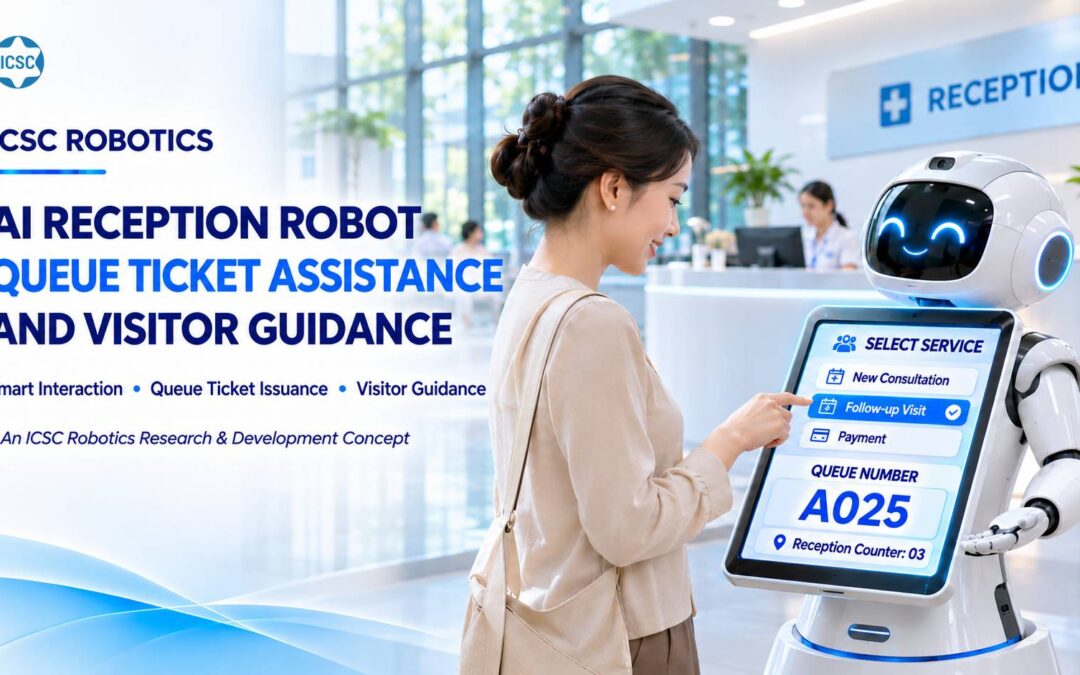
Automating initial reception, reducing manual tasks, and enhancing the customer experience
ICSC Robotics’ research and development direction
1. Optimizing the Reception Process from the Queue Ticket Stage
At hospitals, clinics, banks, public administrative centers, and many service organizations, the reception desk is often the first point of contact between visitors and the organization. During peak hours, staff must continuously guide visitors, identify their needs, explain procedures, and assist with obtaining queue tickets.
When reception relies too heavily on manual tasks, visitors may face long waits, select the wrong ticket category, or be unsure which counter to visit. Receptionists must also repeat the same instructions while needing to focus on more complex situations.
An AI robot that assists with queue ticket issuance represents a robotics application aimed at partially automating reception activities. Through voice interaction or a touchscreen, the robot can ask visitors about their needs, guide them in selecting a service, and assist with issuing queue tickets according to procedures configured by the operating organization.
ICSC is researching and developing this solution concept, with the aim of combining AI robots with queue management systems and reception business software.
2. What Is an AI Robot for Queue Ticket Assistance?
It is a robotic system integrating conversational AI, an interactive interface, and software connectivity to help visitors complete initial reception steps. Instead of using only a conventional ticket dispenser, visitors can interact with the robot to identify their needs and receive guidance.
Depending on the design, the process may include:
- Greeting visitors and identifying needs: The robot proactively welcomes visitors or responds when they initiate an interaction.
- Identifying the service category: It asks brief questions to classify needs such as medical consultations, follow-up visits, payments, consultations, document processing, or other services.
- Guiding service selection: It explains service categories and asks visitors to confirm their selection before a ticket is issued.
- Connecting to the ticketing system: It sends a request to queue management or business software to obtain the appropriate queue number.
- Displaying and issuing tickets: It shows the number on the screen, prints a ticket if a printer is integrated, or announces the number by voice.
- Guiding the next step: It provides information about the waiting area, reception counter, or required documents based on data supplied by the organization.
The robot does not independently determine priority order or change service rules. Routing, prioritization, and ticket issuance rules must be defined and controlled by the operating organization.
3. Example Interaction Workflow at the Reception Desk
A reference interaction scenario may be designed as follows:
Step 1 – Greeting: The robot welcomes the visitor and asks which service they need.
Step 2 – Identifying the need: The visitor responds by voice or selects an option on the screen, such as registering for an examination, a follow-up visit, payment, or consultation.
Step 3 – Clarifying information: If necessary, the robot asks for minimal additional information to identify the correct service category. Only information necessary for the process is collected.
Step 4 – Confirming the selection: The robot repeats or displays the service category for the visitor to confirm before submitting the request.
Step 5 – Issuing a queue number: The system connects to queue management software to obtain a number according to configured rules.
Step 6 – Guiding the visitor: The robot announces the queue number, waiting area, reception counter, or documents to prepare.
Example conversation:
- Robot: “Hello! Which service can I help you with today?”
- Visitor: “I’m here for a follow-up appointment.”
- Robot: “Please select the department for your follow-up appointment on the screen, or tell me its name.”
- Visitor: “Cardiology.”
- Robot: “Would you like to confirm a queue ticket for a Cardiology follow-up appointment?”
- Visitor: “Yes, that’s correct.”
- Robot: “Your queue number is A025. Please proceed to the Cardiology waiting area. Your number will appear on the screen when it is your turn.”
4. Potential Features for Development
4.1. Natural Voice Interaction
Visitors can state their needs instead of searching for the correct function button. The robot uses speech recognition and language processing to understand requests within its designed scope. In crowded environments, speech recognition under noisy conditions must be evaluated, and an alternative input method should be available.
4.2. Needs Classification and Service Routing
The robot can ask questions step by step to determine which procedure the visitor needs, then direct them to the appropriate service category or reception counter. The service catalog and classification rules are managed by the operating organization.
4.3. Queue Management System Integration
This is a key component that allows the robot not only to provide guidance but also to support actual ticket issuance. The system requires an API or another suitable integration method with existing queue management software, including ticket issuance rules, queue status, and handling of interrupted connections.
4.4. Ticket Printing and Information Display
Depending on the hardware design, the robot may connect to a ticket printer, display, or number-calling system to provide clear information to visitors. A ticket may include the queue number, service category, waiting area, and necessary instructions.
4.5. Supporting Different User Groups
The interface may be designed with large text, concise instructions, clear speech, and simple operations to support older adults or visitors unfamiliar with technology. Direct staff assistance must remain available when visitors cannot operate the system independently.
4.6. Reception Activity Statistics and Management
If integrated with a management system, the solution may record interaction counts, selected service categories, ticket issuance times, and errors. Reporting data must be limited according to the organization’s intended purposes, access rights, and privacy policies.
5. Benefits for Operating Organizations
- Reducing repetitive tasks at the counter: The robot can handle some initial guidance and needs classification.
- Standardizing reception procedures: Visitors receive guidance through the same configured information flow.
- Reducing incorrect ticket category selection: Confirmation steps help visitors verify their service category before a number is issued.
- Improving the customer experience: Visitors gain an additional self-service channel, especially during peak hours.
- Helping staff focus on specialized work: Staff can spend more time on cases requiring explanation or direct assistance.
- Improving operational visibility: Interaction data can help organizations assess visitor traffic and common points of difficulty.
Actual improvements depend on process design, software integration capabilities, user habits, and operating conditions at each location.
6. Potential Application Environments
6.1. Hospitals and Clinics
Support initial routing by service category, such as new examinations, follow-up visits, laboratory tests, payments, or document intake. Medical prioritization rules must be defined by the hospital, and the robot must not independently assess emergency conditions.
6.2. Banks and Financial Institutions
Help visitors select transactions such as deposits, withdrawals, account opening, consultations, or counter services. Sensitive information and financial data must be handled according to the organization’s security requirements.
6.3. Public Administrative Service Centers
Guide citizens in selecting procedure categories, issue numbers by service area, and indicate where documents should be submitted.
6.4. Service Centers and Businesses
The solution may be applied in showrooms, warranty service centers, transaction offices, or other locations offering multiple service categories and numbered reception procedures.
7. ICSC’s Research and Development Direction
ICSC Robotics is researching a robot solution for queue ticket assistance at reception desks, focusing on the combination of conversational AI, self-service interfaces, and queue management systems.
Potential areas of research include:
- AI voice and Vietnamese-language conversation: Receiving spoken requests, processing questions, and responding according to defined scenarios.
- Service classification: Building question-and-answer flows to identify the appropriate needs category and guide selection.
- Ticketing system integration: Connecting to queue management or business software through suitable integration interfaces.
- Multimodal interfaces: Combining voice, touchscreen, queue number display, and optional ticket printing.
- Content and rules management: Allowing operators to configure service catalogs, instructions, ticket issuance rules, and counter information.
- Monitoring and reporting: Exploring the ability to record interactions, ticket issuance status, and technical errors to support management.
These are research and development directions, not a list of commercialized features or a commitment that they are available on any specific robot model. Integration feasibility and functional scope will be determined through surveys of existing systems, business requirements, and testing.
8. Key Considerations for Deployment
- Integration with the correct ticketing system: Determine whether the existing software provides APIs, authentication mechanisms, and error-handling procedures.
- Transparent routing rules: Service catalogs, ticket categories, priority groups, and exceptions must be approved by the operating organization.
- Personal data protection: Collect only necessary data and clearly define purposes, retention periods, and access rights.
- Accessibility: Consider screen placement, operating height, volume, text size, and alternative interaction methods.
- Fallback procedures: If the robot or connection fails, visitors must still be able to obtain tickets through conventional methods or receive staff assistance.
- On-site testing: Evaluate noise, visitor volume, connection stability, and ease of use before scaling up.
9. Research, Testing, and Refinement Process
Phase 1 – Reception process assessment: Review the current ticketing process, service categories, peak hours, common problems, and the role of reception staff.
Phase 2 – Existing system evaluation: Assess queue management software, ticket dispensers, printers, number-calling displays, and integration capabilities.
Phase 3 – Interaction scenario design: Develop flows for greeting, classifying needs, confirming selections, issuing numbers, and guiding visitors.
Phase 4 – Development and pilot integration: Connect the robot platform, conversational AI, interface, and ticketing system within the agreed scope.
Phase 5 – Testing in a controlled environment: Evaluate classification accuracy, ticket issuance capability, interaction time, error recovery, and user experience.
Phase 6 – Optimization and application assessment: Refine content, processes, and integrations based on operator feedback before considering expansion.
10. ICSC Seeks Development Collaboration Opportunities
ICSC seeks to connect with hospitals, clinics, banks, public administrative centers, and businesses interested in improving reception, queue ticket issuance, and visitor routing.
Collaboration may include reviewing real-world processes, assessing queue management software, defining integration requirements, developing pilot scenarios, and jointly evaluating the solution.
Participation from the deploying organization’s reception, operations, and IT teams will help define appropriate business rules and ensure the robot supports existing processes rather than adding unnecessary steps.
11. Conclusion: From Automated Ticket Dispensers to an Intelligent Reception Experience
AI robots for queue ticket assistance represent a potential next step in reception self-service. Rather than simply tapping a screen to select a number, visitors could be guided through a voice-based interaction, confirm their needs, and connect directly to the queue management system.
The value of the solution lies in combining robotics, conversational AI, and business software. When properly designed, the system may help standardize initial reception, reduce repetitive tasks, and make it easier for visitors to access the appropriate service.
Through its AI robotics research and development direction, ICSC aims to work with organizations to assess, test, and build intelligent reception solutions tailored to real-world processes.
ICSC ROBOTICS – AUTOMATING INTERACTIONS, ENHANCING THE RECEPTION EXPERIENCE.
Is your organization looking to optimize queue ticket issuance and visitor reception?
Connect with ICSC to discuss your requirements, assess your current systems, and explore opportunities to collaborate on researching and developing a suitable AI robotics solution.
Website: https://icsc.vn/robotics
ICSC Corporation – AI & Robotic Solutions
SEO – GEO – AIO INFORMATION
| SEO Title | AI Robot for Queue Ticket Assistance at Reception Desks – ICSC Robotics |
| Meta Description | ICSC is researching AI robots for queue ticket issuance, needs classification, visitor guidance, and queue management integration at hospitals, banks, and service centers. |
| URL Slug | ai-robot-queue-ticket-assistance-reception |
| Primary Keyword | AI robot for queue ticket assistance |
| Secondary Keywords | reception robot, customer reception robot, hospital queue ticket robot, visitor guidance robot, queue management system, AI at reception desks, ICSC Robotics |
| Search Intent | Learn about reception automation, queue ticket issuance solutions, and integration opportunities with queue management systems |
FAQ – Frequently Asked Questions
How does an AI robot for queue ticket assistance work at a reception desk?
The robot receives requests through voice or a screen, guides visitors in selecting a service, confirms their choice, and connects to the queue management system to issue a number according to configured rules.
Can the robot integrate with an existing ticket dispenser?
Integration feasibility depends on the existing software and equipment, particularly APIs, authentication mechanisms, and connectivity. An assessment is required before an integration approach can be determined.
Can the robot classify visitors by service category?
Conversational flows can be researched to classify needs according to the service catalog and rules established by the operating organization.
What happens if the robot does not understand a request?
The system should offer options to ask again, switch to touchscreen interaction, or direct the visitor to reception staff.
Has ICSC commercialized the queue ticket assistance robot?
ICSC is currently researching and developing this solution concept. Functional scope and integration capabilities will be determined following assessment and testing.
Is the solution suitable for hospitals and banks?
It may be researched for environments with ticketing and visitor routing processes, but it requires configuration tailored to each organization’s operations, security requirements, and existing systems.