
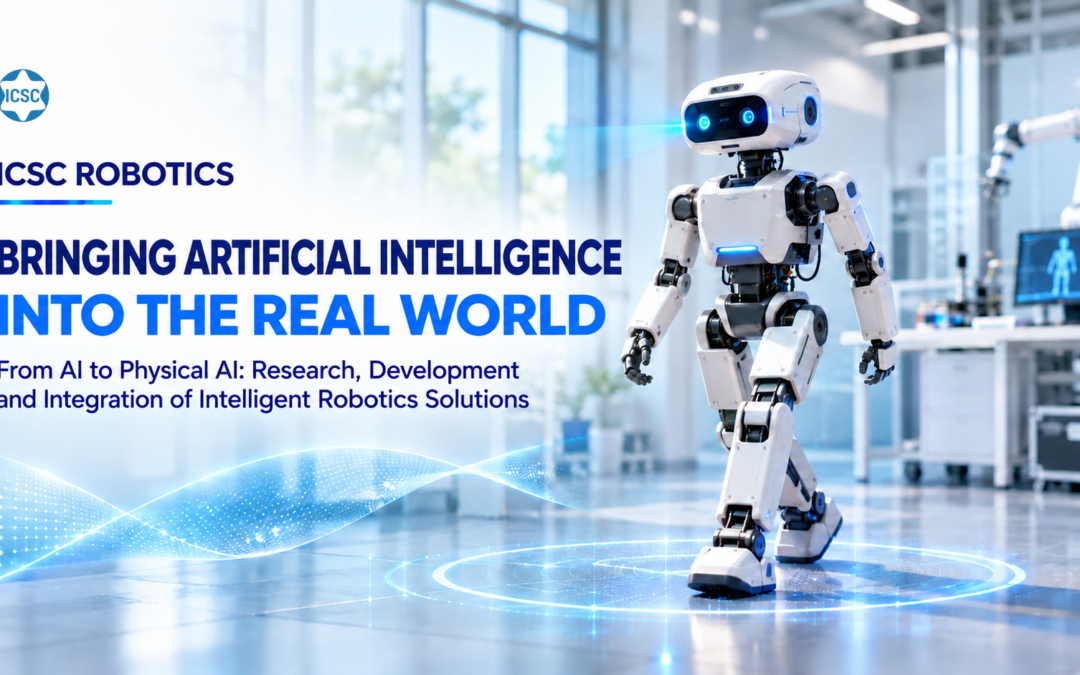
BRINGING ARTIFICIAL INTELLIGENCE INTO THE REAL WORLD
From AI to Physical AI: Research, Development, and Integration of Intelligent Robotic Solutions
1. When Artificial Intelligence Moves Beyond the Screen
In recent years, artificial intelligence (AI) has transformed how people work, communicate, and run businesses. AI can analyze data, process language, recognize images, and support decision-making.
However, an emerging technological trend is extending these capabilities further: Physical AI—artificial intelligence embodied in the physical world.
Rather than operating only on digital platforms, AI is integrated into robotic systems alongside cameras, sensors, motion mechanisms, and controllers. These systems can perceive their surroundings, analyze information, interact with people, and carry out designed actions.
This foundation opens up new possibilities for robotics in education, care, services, and manufacturing.
For businesses, robotics is about more than putting a robot into operation. Its real value lies in combining hardware, software, artificial intelligence, and operational processes to solve a specific problem.
2. ICSC Robotics – Research and Development of AI Robotic Solutions
ICSC Robotics is the research, development, and integration division for AI robotic solutions at ICSC Corporation.
By combining expertise in software development, artificial intelligence, and systems integration, ICSC approaches robotics as the development of systems capable of sensing, processing information, interacting, and acting in real-world environments.
Rather than focusing on a single device or standalone function, ICSC emphasizes coordination across multiple technologies:
- Artificial Intelligence (AI): Integrating AI models to process requests, analyze information, and generate context-aware responses.
- Computer Vision (AI Vision): Using cameras and image-processing algorithms to identify objects and environmental features.
- Voice Interaction: Exploring speech input, language processing, and spoken responses.
- Motion & Control: Integrating controllers and motion mechanisms to perform designed behaviors.
- Hardware & Software Integration: Connecting sensors, cameras, processors, controllers, and software into a unified system.
Together, these capabilities provide a foundation for flexible robotics solutions that can be customized to each organization’s needs and operating conditions.
3. ICSC’s AI Robotics Application Areas
Robotics has potential applications across many sectors. Based on its research direction and technology integration capabilities, ICSC is exploring five primary application areas.
3.1. Robots in Education and STEM Training
Robots can support learning activities, technology exploration, and hands-on STEM education.
Through direct interaction with robots, students and learners can gain a more tangible understanding of artificial intelligence, sensors, programming, and device control.
ICSC aims to research interactive robotic solutions for education, technology experiences, and STEM training.
Potential features may be considered according to each educational institution’s needs, including interactive content, interfaces, functions, and operating methods.
Potential users:
- Schools and preschools.
- STEM centers.
- Technology training providers.
- Educational organizations and technology experience centers.
3.2. AI Robots Supporting Children’s Language and Communication Development
One promising application of AI robots is supporting young children’s language development, communication skills, and social interaction.
For children developing language skills—particularly those with delayed speech, limited vocabulary, or communication difficulties—regular, engaging, age-appropriate opportunities to interact are important.
AI robots could be explored as interactive companions, helping children engage in learning and communication practice through familiar, everyday situations.
Potential features include:
- Speech Recognition and Interaction: Receiving children’s speech, processing its content, and responding through appropriate interaction scenarios.
- Encouraging Speech Practice: Asking simple questions, suggesting vocabulary, and encouraging children to name objects, animals, colors, and familiar things.
- Pronunciation and Vocabulary Practice: Creating word-repetition, word-matching, picture-naming games, and exercises with short sentence patterns.
- Developing Two-Way Communication: Creating opportunities for questions and answers, greetings, expressing needs, and communicating emotions.
- Visual and Game-Based Interaction: Combining AI Vision, audio, and visual content to make activities more engaging for children.
- Personalized Interactive Content: Adjusting topics, difficulty, and content to each child’s age, abilities, and learning goals.
Intended users:
- Children in the language-development stage.
- Children with speech delays or limited vocabulary.
- Children who need more opportunities to practice communication.
- Children who experience difficulties with social interaction and communication.
- Preschools, early intervention centers, and special education providers.
ICSC’s Research Direction
ICSC is exploring how AI robots, speech recognition, natural language processing, AI Vision, and educational interaction scenarios can be combined into a robotic platform that supports children’s learning and communication skills.
Solutions could offer age-appropriate interactive content aligned with specific goals. Mechanisms for tracking practice activities and reporting progress may also be considered, subject to parental or institutional consent.
Robots serve as supportive tools that create additional opportunities to practice. Assessment, diagnosis, and intervention for children with speech delays or developmental disorders must be carried out by qualified professionals. Robots do not replace parents, teachers, or speech-language therapists.
3.3. Interactive Robots and Care Support
Another robotics application area involves developing systems capable of interacting with people.
Using recognition technologies, language processing, and voice responses, robots could be explored to support communication, provide information, and accompany users in selected activities.
ICSC is exploring the integration of AI with interactive robots to create more natural and convenient communication experiences in suitable settings.
Potential applications include:
- Interacting and conversing with users.
- Providing basic information and guidance.
- Supporting interactive activities in care settings.
- Developing communication scenarios tailored to different user groups.
Potential users: Care facilities, educational institutions, service centers, and organizations interested in researching interactive robots.
3.4. Robots in the Service Sector
In service environments, robots could be explored for activities such as welcoming visitors, providing directions and information, initiating interactions, or coordinating simple tasks.
For hotels, hospitals, and service centers, the feasibility of robotic applications depends not only on the equipment but also on the physical environment, business processes, and existing data systems.
ICSC aims to research AI robotic solutions capable of natural interaction, data integration, and coordination with enterprise systems.
Potential users:
- Hotels and resorts.
- Hospitals and healthcare facilities.
- Shopping centers.
- Service centers and businesses.
3.5. Robots in Business and Industry
In business and industrial settings, robotics can be combined with AI Vision and control systems to explore suitable automation scenarios.
Potential applications include:
- Combining cameras and AI Vision to identify objects and support environmental observation.
- Integrating sensors to collect data from operating environments.
- Combining control systems to carry out designed actions.
- Exploring coordination between robots and existing software systems.
For these applications, defining the right problem, operating conditions, and technical requirements is essential before selecting a robot configuration.
ICSC takes a needs-based approach, considering how AI, hardware, software, and business processes can be integrated.
Potential users: Factories, manufacturers, industrial organizations, and businesses exploring automation solutions.
4. The Technology Behind an AI Robotic System
An AI robotic system is more than a robot combined with an AI model.
To perceive information, process data, interact, and take action, multiple technological components must work together.
- AI – Artificial Intelligence: Processes requests, analyzes information, and supports context-aware responses for specific applications.
- AI Vision – Computer Vision: Enables the system to capture images from cameras and process visual information to recognize objects and environmental features.
- Voice Interaction: Explores speech input, language processing, and spoken responses to support human–robot communication.
- Motion & Control: Combines controllers and motion mechanisms so robots can execute behaviors that have been designed and tested.
- Hardware & Software Integration: Connects cameras, sensors, processors, controllers, and software into a unified system, while considering scalability and integration with other systems.
The value of a robotics solution comes from how effectively these components work together—not simply from the robot’s appearance or hardware specifications.
5. ICSC’s Robotics Research and Development Process
ICSC develops AI robotic solutions through a step-by-step process of research, experimentation, and refinement. Each stage helps clarify technical requirements, assess feasibility, and identify suitable applications.
Stage 1: Research: Exploring robotic platforms, technologies, components, and approaches suited to the application problem.
Stage 2: Development: Studying configurations and assembling or integrating hardware and software components on the selected platform.
Stage 3: AI Integration: Gradually incorporating AI capabilities, such as image recognition, language interaction, or information processing, according to experimental objectives.
Stage 4: Testing & Optimization: Evaluating system performance under test conditions, documenting issues, and adjusting configurations, software, or operating behaviors.
Stage 5: Application & Collaboration: Engaging with interested organizations, defining pilot scenarios, and exploring opportunities to jointly assess real-world feasibility.
ICSC prioritizes a phased approach to reduce investment in unsuitable configurations and establish a basis for evaluation before expanding an application’s scope.
6. ICSC Seeks Robotics Development Partnerships
Robotics requires collaboration across many disciplines, including AI, software, electronics, mechanics, and applied research.
To develop practical solutions, ICSC seeks to build connections with end users, experts, research teams, and technology partners.
ICSC welcomes connections with:
- Schools, STEM centers, and technology training providers.
- Early intervention centers, special education providers, and child-development support organizations.
- Experts and research teams in AI and robotics.
- Businesses interested in robotics, AI Vision, and automation applications.
- Organizations working in services, education, and care.
- Technology, hardware, and product development partners.
Potential areas of collaboration include:
- Sharing application challenges and requirements for AI robotics.
- Conducting preliminary assessments of technical feasibility and operating environments.
- Discussing research, integration, or solution customization approaches.
- Exploring joint pilot opportunities when technical conditions are suitable.
ICSC is particularly interested in collaboration opportunities involving STEM education, children’s language development, interactive robots, services, and enterprise automation.
7. Conclusion: From Artificial Intelligence to Real-World Applications
AI is expanding what technology can do, while robotics provides a bridge that brings those capabilities into physical environments.
The combination of artificial intelligence, computer vision, voice interaction, sensors, and control systems is opening new possibilities for education, care, services, and businesses.
Whether it is a robot helping children practice language, an interactive robot in a service setting, or an industrial robotic system incorporating AI Vision, every application begins with identifying the right need and selecting a suitable technological approach.
Through its focus on researching, developing, and integrating AI robotic solutions, ICSC aims to work alongside organizations and partners as they explore, test, and gradually bring robotics into practical applications.
ICSC ROBOTICS – BRINGING ARTIFICIAL INTELLIGENCE INTO THE REAL WORLD.
Do you have an idea or a challenge that could benefit from AI robotics?
Connect with ICSC to discuss your needs, assess possible technological approaches, and explore opportunities to develop suitable robotics solutions together.
Website: https://icsc.vn/robotics
ICSC Corporation – AI & Robotic Solutions
SEO – GEO – AIO INFORMATION
| Meta Description | ICSC researches, develops, and integrates AI robotics, AI Vision, educational robots, robots supporting children’s language development, and service and industrial robotics. |
| URL Slug | icsc-robotics-ai-robotic-solutions |
| Primary Keyword | AI robotic solutions |
| Secondary Keywords | Robotics, Physical AI, educational robots, robots for children with speech delays, robots supporting children’s language development, service robots, AI Vision |
| Search Intent | Explore solutions and find robotics development and integration partners |
FAQ – Frequently Asked Questions
What is ICSC Robotics?
ICSC Robotics is ICSC Corporation’s research, development, and integration division for AI robotic solutions, combining AI, AI Vision, voice interaction, motion control, and hardware–software integration.
Can AI robots support children with speech delays?
AI robots could be researched as tools to help children practice vocabulary, pronunciation, two-way communication, and game-based interaction. They do not replace speech-language therapists or professional intervention.
What is Physical AI?
Physical AI refers to artificial intelligence integrated into physical systems, such as robots, enabling them to perceive information, process data, and act in real-world environments.
In which fields does ICSC research AI robotics?
ICSC explores five application areas: STEM education, children’s language development support, interactive robots and care support, service robots, and business and industrial robotics.
Does ICSC sell ready-made commercial robots?
ICSC focuses on researching, developing, and integrating AI robotic solutions tailored to each partner’s needs. Functional scope is determined through requirements discussions, assessments, and testing.