

An AI solution developed and provided by ICSC under the CIAXI brand
In warehouse operations and order fulfillment, picking and packing play a critical role in ensuring order accuracy before products are delivered to customers.
As the number of SKUs grows and products come in more variations of design, color, and size, relying entirely on employees’ memory and visual checks can expose businesses to various risks: picking the wrong products, incorrect quantities, missing items, and difficulties tracing errors when complaints arise.
For businesses processing large volumes of orders, even a small error rate can result in significant costs related to returns, shipping, complaint handling, and damage to brand reputation.
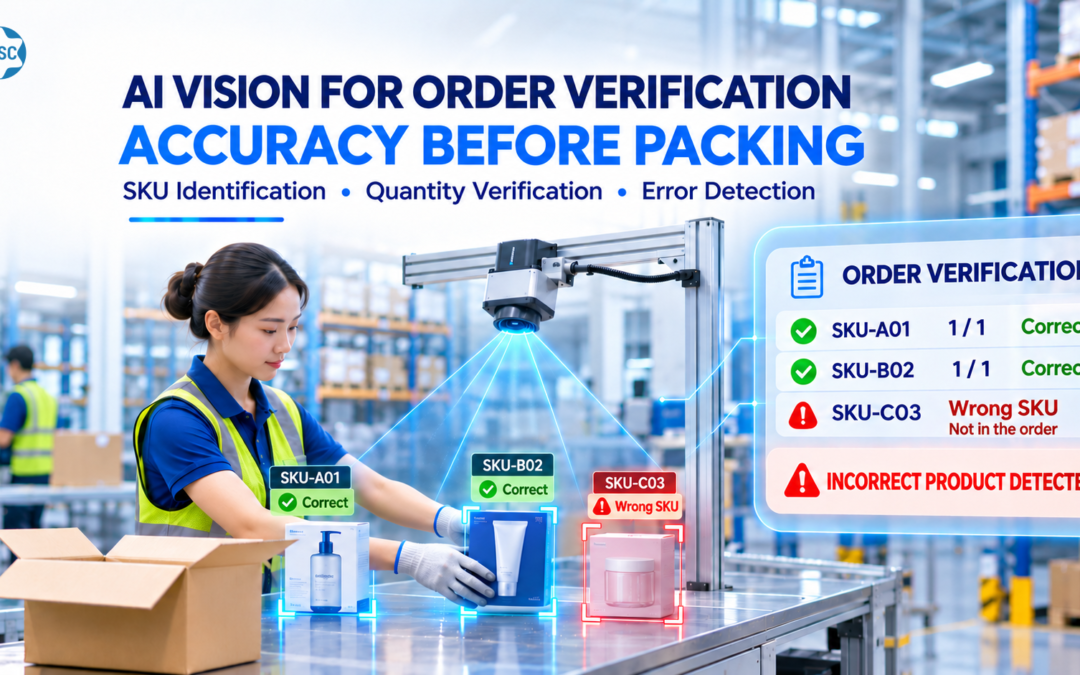
ICSC develops technology solutions to address real-world operational challenges. CIAXI is ICSC’s technology solutions brand, and CIAXI Vision applies computer vision technology to help automate product recognition, inspection, and verification before packing.
Instead of relying solely on manual inspection, the system analyzes camera images, compares products against order data, and issues alerts when discrepancies are detected.
1. The Operational Challenge: Why Do Businesses Need Automated Order Verification?
In conventional order fulfillment workflows, employees typically use product lists on picking slips or management screens to select and check items before packing. Although relatively straightforward, this approach reveals several limitations as operations scale.
Difficulties in product recognition: A warehouse may contain hundreds or thousands of SKUs. Many products look nearly identical, differing only in color, size, version, or minor details. New employees often need time to become familiar with the product catalog, while even experienced staff may make mistakes when processing many orders in succession.
Quantity counting errors: Manual counting and verification depend on employees’ concentration. As order volumes increase, the risk of missing or extra items in packages may also rise.
Lack of immediate alerts during operations: If errors are discovered only after an order has been packed or handed over to a carrier, the business must spend additional time and money resolving them.
Limited traceability when complaints arise: When customers report missing or incorrect items, businesses need evidence to verify the picking and packing process. Without a recording mechanism, reconciliation often depends on employees’ accounts and related documents.
These challenges show that businesses need more than a product recognition tool: they need a solution that can participate directly in the order verification workflow.
2. CIAXI Vision – Bringing AI Vision into the Order Verification Workflow
CIAXI Vision is a solution under ICSC’s CIAXI brand. It uses computer vision to analyze images captured by cameras, recognize products, and support verification against order information.
The solution combines three core components:
- Product data: SKU information, reference images, and identifying product attributes.
- AI Vision system: Image analysis, product identification, and support for quantity verification.
- Order data: Product information, SKUs, and required picking quantities used as the basis for comparison.
By combining these components, the system can help verify products while employees are picking items and preparing them for packing.
3. How CIAXI Vision Works
Step 1: Receive order information. The system receives the list of products to be processed, including SKU codes and their respective quantities. This provides reference data for AI Vision to determine which products should appear during inspection.
Step 2: Capture images from cameras. Cameras are positioned at inspection or packing stations to record product images as employees work. These images are sent to the processing system for analysis and recognition.
Step 3: Analyze and recognize products using AI. The AI Vision system uses image-processing models to identify products based on predefined visual characteristics. Depending on the product category, recognition may use shape, structure, color, surface features, labels, markings, or other visual characteristics.
Step 4: Compare against the order and flag discrepancies. After recognizing products, the system compares the actual items with the SKU list in the order. If an item does not match the requirements, an alert appears directly on the screen so employees can check and correct it before continuing to pack.
Step 5: Count products and record the inspection process. The system helps determine the number of recognized products within the camera’s field of view and compares that number with the quantity required by the order. The inspection process is also recorded on video for traceability and reconciliation when needed.
4. Key Technology Capabilities
4.1. SKU-Based Product Recognition
AI Vision analyzes product images and identifies the corresponding SKUs using established reference data. This capability is useful for businesses with extensive product catalogs, numerous variations, and frequent changes in operational staff. Rather than requiring employees to memorize every product code, the system provides an additional automated verification layer based on actual images.
4.2. Real-Time Detection and Alerts for Incorrect Products
When an employee picks the wrong item, AI Vision analyzes its image and compares it with the SKU required by the order. If a discrepancy is detected, the system displays an alert directly on the screen. Detecting errors during the operation helps prevent incorrect items from entering packages and reduces reliance on subsequent rechecks.
4.3. Quantity Counting and Verification
In addition to recognizing products, the system supports quantity checks using camera images. Recognition results are compared with the order quantities to help detect missing or extra items. For stacked, partially obscured, or complex-shaped products, the solution requires assessment and optimization of camera angles, imaging conditions, and recognition methods to ensure reliability.
4.4. Video Recording and Traceability
CIAXI Vision supports video recording of the order inspection process, allowing businesses to review activities at packing stations when complaints arise. These records help verify product picking and inspection, support reconciliation, investigate the causes of errors, and improve operational transparency.
5. Practical Demonstration: How Does AI Vision Verify Orders?
To better understand how the technology works in an actual workflow, businesses can watch the CIAXI Vision demo video below.
The video demonstrates how the system uses cameras and AI Vision to recognize products, verify SKUs, detect discrepancies, and support picking checks before packing.
6. Benefits for Business Operations
- Reduce the risk of incorrect or incomplete deliveries: Recognizing and comparing products against orders helps detect discrepancies earlier and limit errors during picking and packing.
- Support employee training and management: New employees gain an additional product recognition tool, reducing dependence on individual experience and shortening the time needed to become familiar with workflows.
- Improve quality control: Businesses can add an automated inspection layer to outbound processes, helping standardize order verification.
- Enhance traceability and reconciliation: Image and video data provide additional evidence for investigating incidents, resolving complaints, and evaluating operational quality.
- Build a foundation for warehouse automation: When integrated with warehouse management data and order processing systems, AI Vision can become part of a broader operational automation ecosystem.
7. AI Vision Deployment Must Fit Each Business’s Operating Conditions
An effective AI Vision system depends not only on its AI models but also on real-world deployment conditions. Every business has different product catalogs, warehouse layouts, picking processes, and imaging environments.
Therefore, several factors should be evaluated before deployment:
- Product catalog: Number of SKUs, visual similarity between products, and frequency of catalog changes.
- Camera conditions: Viewing angles, distances, resolution, and lighting.
- Operational workflow: Employee working positions, product placement, and order processing speed.
- Integration data: Ability to receive order information, SKUs, and quantities from existing management systems.
- Storage requirements: Video retention periods, storage capacity, and data retrieval mechanisms.
For products that look almost identical, it is particularly important to establish appropriate reference image datasets and test the system under actual operating conditions. AI Vision deployment should therefore be approached as a system integration project rather than merely installing a standalone image recognition model.
8. ICSC – Developing Technology Solutions Under the CIAXI Brand
ICSC develops and provides technology solutions focused on applying AI, automation, and system integration to business management, commercial activities, and operations.
CIAXI is ICSC’s technology solutions brand, focused on bringing AI applications to practical business challenges. Within this ecosystem, CIAXI Vision specializes in computer vision, helping businesses recognize, monitor, and control activities using visual data.
The value of the solution lies not only in image recognition but also in connecting AI technology with real-world operational data and processes. Depending on business needs, AI Vision applications may be explored further for product appearance inspection, production-line defect detection, process monitoring, and activity control in work areas.
ICSC – Developing technology solutions and enabling smarter operations.
CIAXI – ICSC’s AI solutions brand.
Contact ICSC to Discuss Your AI Vision Challenges
If your business faces challenges in SKU verification, product counting, or reducing packing errors, ICSC is ready to discuss your needs, assess the operational requirements, and propose a CIAXI Vision approach suited to your actual workflows.