

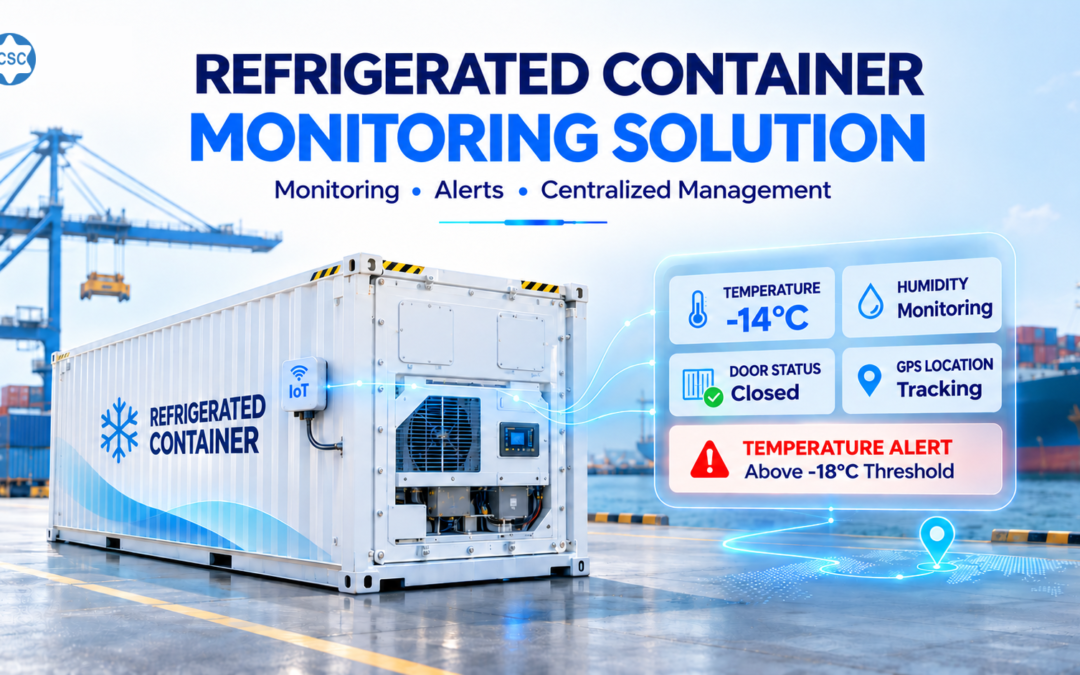
From temperature and humidity measurements to anomaly alerts and device control—helping businesses proactively manage cargo in refrigerated containers.
1. Introduction: Is Your Cargo Really Kept at the Right Temperature Throughout Its Journey?
A refrigerated container carrying seafood leaves the port with its temperature set to -18°C.
During transit, the container may pass through multiple locations, stop at transfer stations, and be affected by external environmental conditions.
But does your business know:
- Is the temperature inside the container consistently maintained within the required limits?
- Does humidity fluctuate abnormally during transportation?
- Is the container door opened outside the planned schedule?
- When temperature exceeds the threshold, can the system detect the deviation and issue a timely alert?
- Where is the container, and is monitoring data recorded continuously?
- When an incident occurs, can the business review the entire operating history?
If your business must still wait for driver reports, perform manual checks, or discover problems only after cargo arrives, it faces significant cold chain management risks.
The ICSC Fleet Tracking + Cold Chain Monitoring solution is designed to connect sensors, monitoring devices, and a centralized management platform, enabling businesses to track reefer container conditions, receive anomaly alerts, and support device control within the scope of the integration.
Rather than simply knowing where a container has traveled, businesses can also monitor cargo storage conditions throughout the journey.
2. What Is a Reefer Container Monitoring Solution?
Reefer Container Monitoring / Cold Chain Monitoring is an IoT- and sensor-based system that collects, transmits, stores, and analyzes container operating data during storage or transportation.
The system focuses on three main functional areas:
MEASUREMENT → ALERTS → CONTROL
- Measurement: Collect temperature, humidity, door status, and vehicle/container location data according to device configuration.
- Alerts: Detect out-of-range parameters, unexpected door openings, or disconnected devices.
- Control: Support sending commands or changing device states through compatible controllers that have been integrated with appropriate access permissions.
Overall system architecture:
Sensors / IoT Devices → Gateway / Data Connectivity → Management Platform → Monitoring Dashboard → Alerts / Control / Reports
The system’s value extends beyond displaying the current temperature: it helps businesses detect anomalies, identify when they occur, and retrieve data for operational management.
3. Key Features of the Reefer Container Monitoring Solution
3.1. Temperature and Humidity Measurement and Monitoring Over Time
Temperature and humidity are critical parameters when storing goods that require controlled environmental conditions.
Using sensors installed in suitable locations, the system can collect data and update a centralized management platform.
Information that can be monitored includes:
- Temperature inside the container.
- Humidity inside the container (when a humidity sensor is installed).
- Data recording timestamps.
- Historical temperature and humidity fluctuations.
- Sensor connectivity status.
Example: A seafood container must maintain a storage temperature of -18°C. Instead of checking the temperature only when goods leave the warehouse and upon receipt, operations staff can monitor data throughout the journey.
When the temperature shows signs of abnormal change, the system can record the event and issue an alert based on configured thresholds.
This enables businesses to move from occasional storage-condition checks to continuous data monitoring throughout transportation.
3.2. Alerts When Temperature or Humidity Exceeds Thresholds
One of the greatest risks in refrigerated transportation is that an incident may occur without being detected promptly.
Examples include:
- Temperature rising above the permitted threshold.
- Temperature falling below the configured threshold.
- Humidity exceeding the configured limit.
- Sensor data not being updated.
- Monitoring devices losing connectivity.
With automated alerts, businesses can configure thresholds for different cargo types or operating requirements.
When abnormal conditions are detected, the system records the event and sends an alert to the responsible personnel through integrated channels.
Example alert record:
| Information | Illustrative Data |
| Container | CONT-001 |
| Alert Type | Temperature above threshold |
| Configured Threshold | -18°C |
| Recorded Temperature | -14°C |
| Time | 02:15 |
| Status | Requires inspection |
| Responsible Person | Operations staff |
This enables staff to proactively inspect the vehicle, refrigeration equipment, or operating conditions instead of waiting until the goods are delivered.
3.3. Container Door Open/Close Status Monitoring
Container doors are an important factor to control when transporting temperature-sensitive goods.
The system can integrate door-status sensors to record:
- When the door is opened.
- When the door is closed.
- The current door status.
- Door-opening events during the journey.
- Alerts when a door is opened outside configured conditions or time windows.
Example: A container carrying frozen food has its door opened at a time not included in the delivery schedule. The system can record the event and alert the management team.
By combining door data with temperature and GPS location, businesses gain more information to examine relationships between door-opening events and changes in storage conditions.
3.4. GPS Location and Container Journey Tracking
In addition to cargo storage conditions, location and transport routes are important data for cold chain management.
With integrated GPS tracking devices, businesses can:
- Track the transport vehicle’s location.
- View route history.
- Record stopping points.
- Cross-check travel times.
- Combine location with temperature data and recorded events.
Example: A reefer container carries seafood from a factory to an export port. The management team can track the vehicle’s location and compare it with temperature readings at each stage.
If an incident occurs, the business can determine where the container was, when the event occurred, and the relevant environmental readings.
3.5. Remote Device Control and Operational Management
Beyond monitoring and alerts, many businesses need the ability to take action through devices when anomalies are detected.
Through integration with compatible controllers, the system can be developed to support control functions within the project’s agreed scope.
Potential capabilities include:
- Sending control commands to integrated devices.
- Monitoring device status before and after a command is executed.
- Assigning permissions to authorized control users.
- Recording an audit trail of operations.
- Monitoring device response status.
Example: When an unusual container temperature is detected, operations staff can review the data and coordinate corrective action. If the refrigeration equipment and controller support integration, the system can be designed to perform appropriate control operations.
Technical note: The ability to control refrigeration units, change temperature setpoints, or switch equipment on and off depends on the controller model, communication protocol, access permissions, and actual integration design. Not all reefer containers support remote control through a monitoring platform.
3.6. Historical Data Storage and Operational Reporting
Monitoring data is truly valuable only when businesses can retrieve and reuse it.
The system aims to store and consolidate:
- Temperature and humidity history.
- Alert history.
- Door open/close history.
- GPS location and route history.
- Device connectivity status.
- Periods of missing data.
- Control operation history (if integrated).
Businesses can then review each container’s storage conditions, identify when anomalies occurred, and support operational reporting.
In particular, identifying periods with no data helps managers distinguish normal operation from situations in which devices failed to record information.
4. How Does a Reefer Container Monitoring System Work?
A Cold Chain Monitoring system can be deployed by connecting IoT devices to a centralized management platform.
Step 1 – Data Collection: Temperature, humidity, door-status sensors, and GPS devices collect data according to their configurations.
Step 2 – Data Transmission: Data is transmitted through a gateway or suitable connectivity infrastructure, such as cellular networks, Wi-Fi, or industrial connections, depending on deployment conditions.
Step 3 – Analysis and Processing: The platform receives data, compares it with configured thresholds, and determines operating status.
Step 4 – Anomaly Alerts: When a threshold is exceeded or a device loses connectivity, the system records the event and notifies the responsible personnel according to configuration.
Step 5 – Monitoring and Control: Managers view container status on a dashboard. Control functions are available when compatible equipment and appropriate integration are in place.
Step 6 – Storage and Reporting: Data is organized by container, vehicle, journey, and time to support retrieval, cross-checking, and management.
5. What Information Can Businesses Monitor?
| Data Category | Recorded Information | Management Value |
| Temperature | Readings, timestamps, fluctuation history | Control storage conditions |
| Humidity | Humidity readings and history | Monitor internal environment |
| Door Status | Open/closed, event timestamps | Control access activity |
| GPS | Location, route, stopping points | Track transportation |
| Alerts | Threshold violations, door opening, disconnection | Detect incidents |
| Connectivity | Device status, data gaps | Monitor data continuity |
| Control | Commands and response status, if integrated | Manage device operations |
| Reports | Historical data and events | Cross-check and evaluate operations |
Displayed parameters depend on sensor types, devices, and the integration scope of each project.
6. How Does Traditional Reefer Container Monitoring Differ from IoT-Based Monitoring?
| Criterion | Manual Monitoring | IoT-Based Monitoring |
| Temperature | Checks at individual points in time | Tracks readings at configured intervals |
| Humidity | Requires separate equipment and checks | Automatically collected when sensors are installed |
| Alerts | Depends on personnel performing checks | Alerts based on configured thresholds |
| Door Status | Manual inspection | Recorded using door sensors |
| Location | Contact the driver | GPS tracking when equipment is installed |
| History | Manually compiled | Centralized storage and retrieval |
| Missing Data | Difficult to detect | Can identify data gaps |
| Control | Operations performed at the device | Remote control integration possible if supported by the equipment |
The main difference is that businesses can manage operational data centrally rather than relying entirely on manual inspections and reports.
7. Which Industries Should Implement Reefer Container Monitoring?
Seafood import and export businesses: Monitor temperature, humidity, and reefer container routes when transporting frozen seafood products.
Food and food processing businesses: Control storage conditions while transporting fresh foods, frozen foods, and other products requiring suitable temperatures.
Logistics and refrigerated transport businesses: Manage multiple vehicles, containers, and journeys on a single platform.
Cold storage operators: Monitor sensor readings and operational events in temperature-controlled storage areas.
Pharmaceutical and temperature-sensitive goods businesses: Deployment can be considered based on each business’s storage requirements, data standards, sensor accuracy, and operating procedures.
8. Must Businesses Replace All Their Existing Equipment?
Not necessarily.
A reefer container monitoring system may be implemented using some existing equipment and infrastructure, provided they meet technical requirements.
Existing Sensors → Gateway → IoT Platform → Dashboard / Alerts / Reports
Before deployment, the following should be assessed:
- Models and types of existing sensors.
- Refrigeration system controllers.
- Communication protocols and connectivity capabilities.
- Network infrastructure and coverage.
- Data collection and transmission intervals.
- Alerting and data retention requirements.
- Integration needs involving existing management software.
Importantly, monitoring and control are two different technical requirements. A sensor may transmit temperature data without enabling the system to control the container’s refrigeration unit.
Therefore, an on-site equipment assessment is necessary to select an appropriate implementation approach.
9. Frequently Asked Questions About Reefer Container Monitoring
1. What is a reefer container monitoring solution?
It is an IoT- and sensor-based system that collects and monitors temperature, humidity, door status, and container location data, while supporting alerts when abnormal parameters are detected.
2. Can reefer container temperatures be monitored remotely?
Yes, when the container has suitable sensors and data transmission equipment. Managers can view information on a centralized platform without physically visiting the container.
3. Does the system automatically alert users when temperatures exceed thresholds?
Yes. The system can set temperature thresholds and issue alerts when recorded values exceed the configured limits. The ability to receive immediate alerts depends on connectivity and data transmission infrastructure.
4. Can the system identify when a container door is opened?
Yes, through integrated door-status sensors. The system records opening and closing times and supports alerts based on configured conditions.
5. Can the location of a reefer container be tracked?
Yes, when the vehicle or container is equipped with a suitable GPS device. Location data can be combined with temperature readings and event history to support journey management.
6. Can the system remotely control a container’s refrigeration unit?
Integration may be possible if the refrigeration controller supports communication and remote control. This capability must be verified for the specific device model and technical approach.
7. What happens if the container loses its Internet connection?
When connectivity is lost, the platform may stop receiving new data and cannot guarantee real-time alerts. Data buffering and synchronization after reconnection depend on the device and deployment architecture. The system can record disconnection status or periods of missing data if configured appropriately.
8. Can multiple containers be managed on one system?
The platform can be designed to manage multiple containers centrally, categorized by vehicle, journey, or operating unit according to project requirements.
9. Can the solution integrate with an existing logistics management system?
Integration may be considered through APIs or suitable communication protocols. Actual feasibility depends on the business’s existing software architecture and devices.
10. From Temperature Monitoring to Proactive Cold Chain Management
When transporting temperature-controlled goods, knowing where the cargo is located is not enough.
Businesses also need to know the current storage conditions, when incidents occur, and how they can be addressed.
An effective reefer container monitoring system needs to connect the following data categories:
- Temperature and humidity.
- Door open/close status.
- GPS location and route.
- Anomaly alerts.
- Operational history and reports.
- Device control where suitable integration is available.
MEASUREMENT → MONITORING → ALERTS → RESPONSE → CONTROL
This approach helps businesses gradually strengthen cold chain management, reduce reliance on manual checks, and improve transparency throughout cargo transportation.
11. ICSC – IoT-Based Reefer Container Monitoring and Management Solutions
ICSC provides solutions integrating software platforms, IoT devices, and sensor systems to help businesses monitor storage conditions and manage refrigerated cargo transportation.
Through ICSC Fleet Tracking + Cold Chain Monitoring, the solution focuses on:
- Sensor-based temperature and humidity monitoring.
- Container door open/close status tracking.
- GPS-based vehicle location and route tracking.
- Alerts when parameters exceed thresholds or devices disconnect.
- Historical data storage and retrieval.
- Consolidated reports for operational management.
- Consulting on device-control integration based on actual technical feasibility.
Every business has different cargo types, storage requirements, equipment, and operating processes. ICSC therefore emphasizes implementation based on real-world assessments rather than applying a fixed configuration to every system.
Is Your Business Maintaining the Right Container Temperature Throughout Every Journey?
If your business operates reefer containers, transports seafood or frozen food, or manages a refrigerated fleet and wants a centralized monitoring system, ICSC can help assess your needs, evaluate existing equipment, and recommend a suitable implementation approach.
Contact ICSC for consultation on IoT-based reefer container monitoring, alerts, and management.
ICSC Corporation – Technology Solutions and Digital Transformation for Businesses
Website: https://www.icsc.vn
Email: info@icsc.vn
Hotline: +84 28 37 15 07 81